(🇪🇸 Leer la versión en español aquí)
Every time a frontier lab ships an image generator update, social feeds flood with cherry-picked demo renders and zero discussion of API latency or unit economics. With ChatGPT Images 2.6 — detailed in OpenAI's official announcement — the genuine engineering upgrade isn't prettier gradients: OpenAI finally splits rapid layout drafting from multi-edit fidelity and adds clean vector SVG exports free of embedded rasters or scripts.
Behind the ChatGPT UI, developer documentation tracked by Apidog and MaverickFrame surfaces one pricing caveat teams building automated media pipelines need to see clearly: even though gpt-image-2.6-flare renders roughly 50% faster (down to ~6 seconds at low quality), both variants carry the exact same per-token output bill.
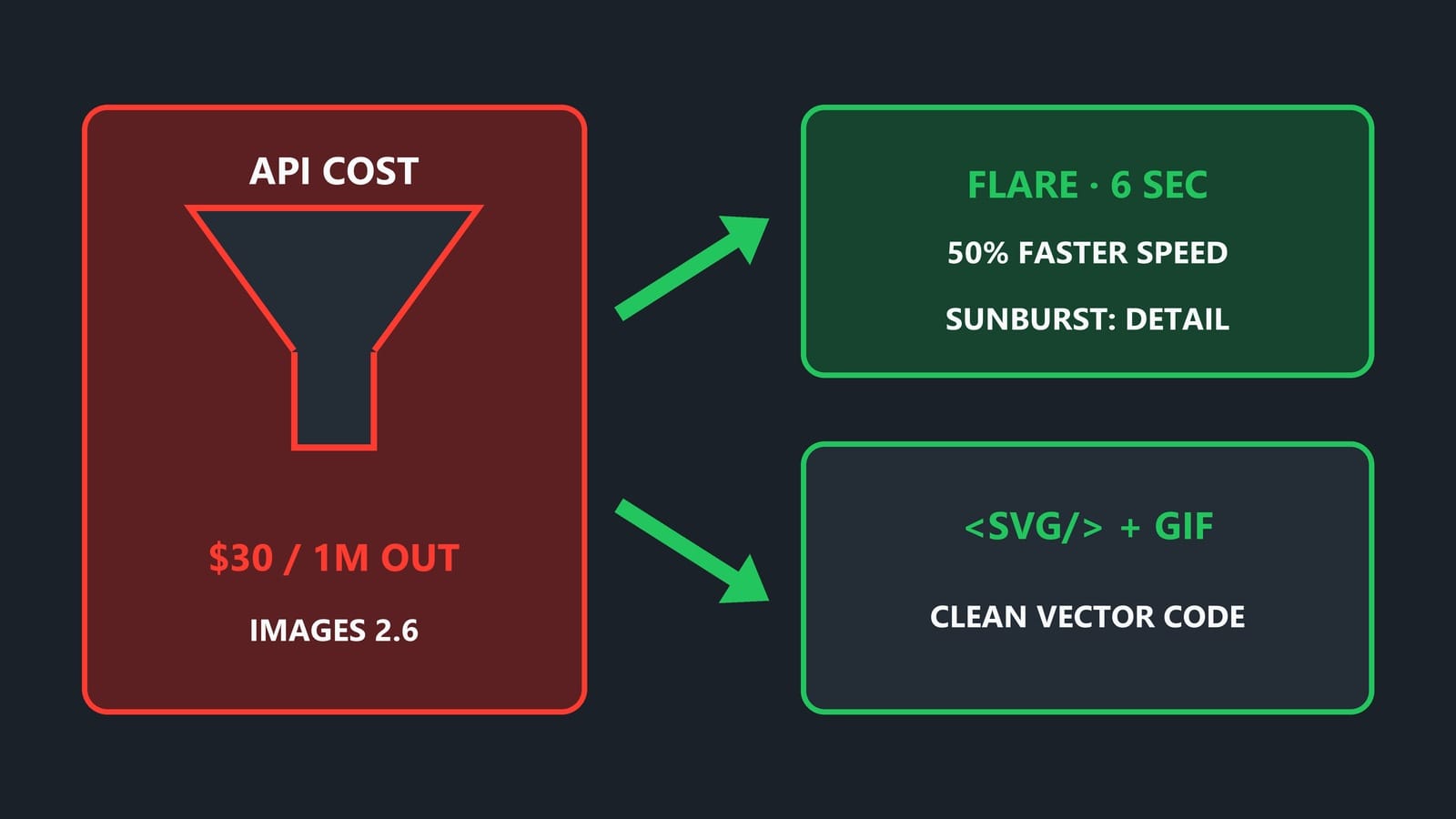
gpt-image-2.6-flare vs. gpt-image-2.6-sunburst: Speed & Unit Economics
OpenAI exposes two distinct API endpoints alongside a tunable complexity parameter (low, medium, high) and direct markup-guided spatial edits:
| Technical Dimension | gpt-image-2.6-flare |
gpt-image-2.6-sunburst |
Production Takeaway |
|---|---|---|---|
| Primary workload target | Fast layout drafts, posters & mockups | Peak detail & multi-round edit consistency | Route previews to flare; reserve sunburst for final renders |
| Latency & throughput | ~50% faster (~6 seconds on low quality) | Longer pass optimized for coherence | Trims synchronous HTTP wait times in UI tools |
| Native vector & motion | Pure static SVG + looping GIFs (2–16 frames) | Pure static SVG + looping GIFs (2–16 frames) | Eliminates bloated Base64 PNG wrappers inside .svg files |
| Text & image input pricing | ~$5.00 / 1M text · ~$8.00 / 1M image | ~$5.00 / 1M text · ~$8.00 / 1M image | Identical token table; savings come from fewer retries |
| Visual output token pricing | ~$30.00 / 1M output tokens | ~$30.00 / 1M output tokens | Blind regeneration loops burn budget quickly without caching |
Why Clean SVG Export Matters (And Where Teams Still Waste Budget)
- No more fake SVGs wrapping Base64 bitmaps: Historically, asking image generators for icons yielded either broken paths or
<image href="data:image/png;base64,...">bloat. Shipping true scalable<svg>primitives without embedded scripts makes frontend asset generation practical — and you can rasterize, resize, or strip metadata cleanly in local browser memory via our Private SVG to PNG/WebP Converter and Private WebP Compressor & EXIF Cleaner. - Markup-guided edits beat blind prompt loops on cost: Circling the broken region directly prevents burning $30/1M output tokens re-rolling full scenes from scratch. Model combined token-pipeline spending accurately inside our LLM Token Cost & Prompt Caching Calculator.
- Looping GIFs don't bypass UI QA: Even with 2–16 frame looping stickers rendered in seconds, publishing directly to production without checking accessibility contrast or file weight hurts Core Web Vitals.
FAQ: OpenAI ChatGPT Images 2.6
What is the actual difference between gpt-image-2.6-flare and gpt-image-2.6-sunburst?
Following OpenAI's rollout and API benchmarks documented by Apidog, flare is tuned for rapid layout consistency (~50% faster, ~6s drafts), whereas sunburst optimizes fine detail and visual consistency across chained edit turns — both at identical per-token rates.
How is the Images 2.6 API priced?
As noted in MaverickFrame's breakdown, both gpt-image-2.6-flare and gpt-image-2.6-sunburst match the prior 2.5 token rates: ~$5 per million text input tokens, ~$8 per million image input tokens, and ~$30 per million image output tokens.
Writing and infographic by Syncroma Studio. Cover photograph: Pioneer Building in San Francisco, by HaeB via Wikimedia Commons (CC BY-SA 4.0).

Sistemas reales, sin humo corporativo Real systems, zero corporate hype
Recibe los análisis a fondo sobre arquitectura, consumo de recursos y computación de bajo nivel directamente en tu bandeja de entrada. Get deep-dive software architecture, resource consumption metrics, and low-level computing essays delivered straight to your inbox.
Suscribirse a Syncroma Subscribe to Syncroma

