
(🇪🇸 Leer la versión en español aquí)
Over the past two years, production software engineering teams deploying large language models learned a vital survival rule: never bind your backend directly to a single vendor's raw API endpoint.
If your application relies solely on api.openai.com, the moment their datacenters spit out a cascade of HTTP 500 Internal Server Errors, P99 tail latency spikes past 20 seconds, or traffic triggers unexpected HTTP 429 Too Many Requests throttles, your entire platform collapses. In response, the industry embraced multi-provider API gateways and model routers (such as OpenRouter, LiteLLM, Portkey, or Cloudflare AI Gateway).
Through an intelligent gateway, your services dispatch abstract requests. If OpenAI hiccups, the gateway seamlessly fails over to Anthropic’s Claude, Google's Gemini, or DeepSeek within milliseconds. But for OpenAI, this architectural abstraction presents a grave two-front strategic hazard: the threat of being commoditized into a replaceable "dumb pipe" and the systemic extraction of its reasoning models via adversarial distillation.
The counteroffensive has arrived: OpenAI updated its Usage Policies to enforce strict regulatory oversight over third-party gateways.
1. The Gateway Mandate: Mandatory Prior Approval
In its revised terms of service, OpenAI established a firm operational rule aimed at API intermediaries: any platform that provides third parties with direct, unbundled access to OpenAI models—including model routers and gateways—must undergo OpenAI review and obtain explicit approval.
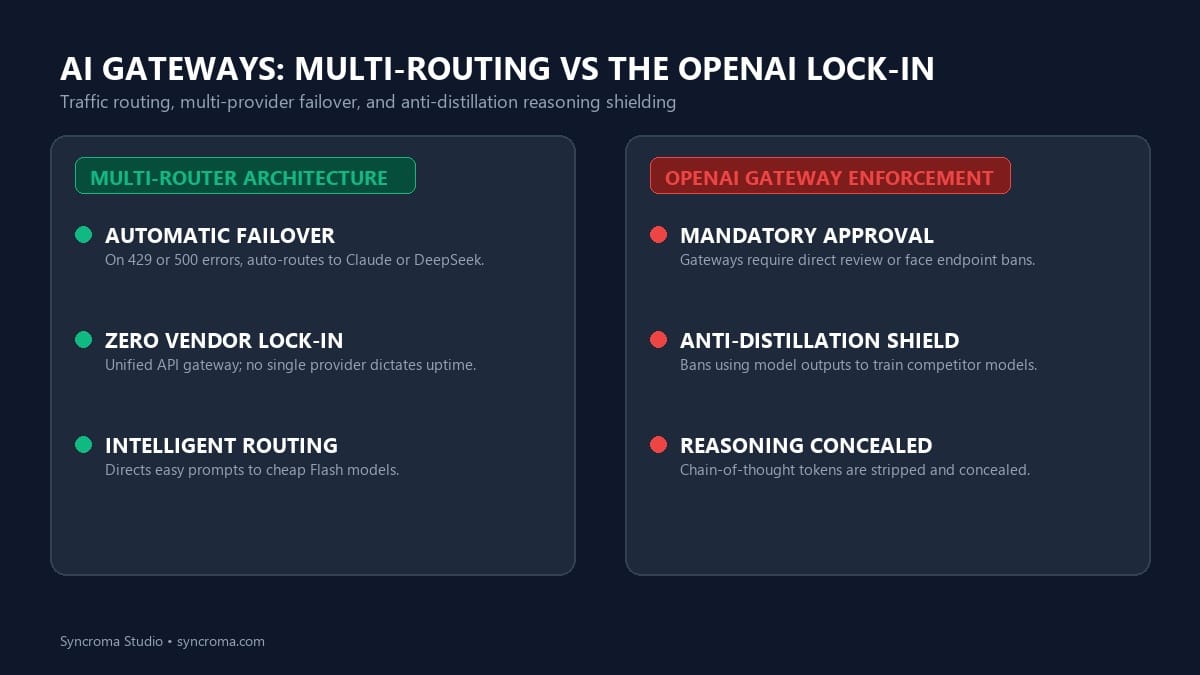
Figure 1: Multi-provider routing architecture versus OpenAI's gateway approval and anti-distillation controls. Credits: Syncroma Studio.
The operational ramifications for engineering teams are significant:
- Curbs on Reseller Arbitrage: Unregulated third parties that repackaged bulk enterprise tokens or routed prompts through unvetted accounts face immediate compliance barriers.
- Telemetry and Origin Auditing: OpenAI insists on verifying the true downstream identity of consumers, preventing public proxies from functioning as anonymizing buffers that mask request sources.
- Risk of Sudden Endpoint Revocation: Intermediary services that fail compliance evaluations or decline commercial terms risk abrupt revocation of their enterprise API keys.
2. Fear of Model Distillation: Shielding the Chain-of-Thought
OpenAI's clampdown extends beyond defending commercial token margins; it is an existential defense of proprietary IP against open-weight laboratories.
With advanced reasoning models (o1, o3, GPT-6 Astra), the core technical moat is no longer just broad pre-training weights, but the internal Chain-of-Thought (CoT) reasoning traces. These latent tokens document how the model formulates deductive hypotheses, verifies algorithmic steps, catches intermediate errors, and refines complex logic.
Client Prompt
  ↓
[Unvetted API Gateway / Extraction Script]
  ↓
Automated Query Blast to GPT-6 Reasoner (100,000 algorithmic prompts)
  ↓
Harvesting Intermediary Chain-of-Thought Traces
  ↓
Structured Synthetic Training Dataset
  ↓
Supervised Fine-Tuning / Knowledge Distillation on Open Weights (Llama / Qwen / DeepSeek)
  ↓
Outcome: Open model achieving 90% frontier capability at 1% execution cost
To disrupt this extraction vector, OpenAI deployed technical and legal barriers:
- Concealment and Summarization of CoT: Raw cognitive traces are completely stripped from public API JSON payloads; developers receive only a sanitized, high-level summary or the final distilled output string.
- Active Distillation Heuristics: Behavioral monitoring flags abnormal API usage patterns that mirror automated synthetic dataset harvesting pipelines.
- Contractual Prohibition: The terms strictly ban using any model outputs to train, benchmark, or distill competing artificial intelligence models.
3. The Production Architecture Dilemma
For systems architects, OpenAI’s policy shift highlights a central tension between platform lock-in and operational resilience. In modern distributed systems, model routers deliver capabilities that no single vendor can match:
| Architectural Need | Direct OpenAI Binding | Multi-Model Gateway (LiteLLM / OpenRouter) |
|---|---|---|
| Outage Resilience | Total service outage if OpenAI returns 500/503 | Automatic fallback to Anthropic, Google, or open models |
| Rate Limit Mitigation (429) | Rejected requests and forced client retries | Dynamic routing across secondary keys or peer tiers |
| Token Cost Optimization | Fixed OpenAI rate card across all queries | Semantic routing (cheap Flash models for basic text, Reasoners for math) |
| Vendor Independence | Complete lock-in to proprietary SDK specs | Loosely coupled architecture via open standard endpoints |
If proprietary vendors restrict open intermediaries, engineering teams must transition to self-hosted, private API gateways within their own VPCs (such as private LiteLLM containers running on internal Kubernetes clusters with proprietary keys) to retain routing autonomy while remaining compliant with downstream terms of service.
4. Hard Reality: The Walled Garden Era
The initial era where frontier AI models could be treated as friction-free public infrastructure commodities is concluding. AI research labs are raising higher defensive walls to prevent competitors from siphoning their multi-billion-dollar synthetic reasoning pipelines through distillation.
For engineers building production backends, the conclusion is clear: infrastructure resilience cannot be surrendered. Decouple client applications from proprietary vendor SDKs, host your own internal routing proxies, and architect your systems knowing that third-party platform rules will shift faster than your release cycles.
To evaluate exponential backoff delay schedules and prevent API cascading failures during provider outages, explore our Exponential Backoff & Retry Simulator.
Sistemas reales, sin humo corporativo Real systems, zero corporate hype
Recibe los análisis a fondo sobre arquitectura, consumo de recursos y computación de bajo nivel directamente en tu bandeja de entrada. Get deep-dive software architecture, resource consumption metrics, and low-level computing essays delivered straight to your inbox.
Suscribirse a Syncroma Subscribe to Syncroma

