
(🇪🇸 Leer la versión en español aquí)
The ugliest hidden tax when autoscaling LLM inference on Kubernetes is not the GPU hourly rate itself—it is paying for idle silicon while every fresh Pod downloads weights, allocates KV caches, runs torch.compile, and captures CUDA graphs. On big Mixture-of-Experts deployments, every cold start burns 6 to 19 minutes of compute before serving a single production token.
Timed for KubeCon + CloudNativeCon North America 2026, NVIDIA open-sourced three foundational pieces of its DSX AI Factory Platform: NVIDIA Kubernetes Engine (NVKE), NVIDIA Kubernetes Recipes (NVKR), and NVIDIA Snapshot. While NVKE and NVKR standardize bare-metal multi-tenant GPU cluster lifecycles with signed node images managed via nvkectl (GitHub repository), the immediate operational breakthrough is Snapshot: checkpointing initialized CPU state (CRIU) and live GPU memory so new replicas restore in seconds instead of recompiling from scratch.
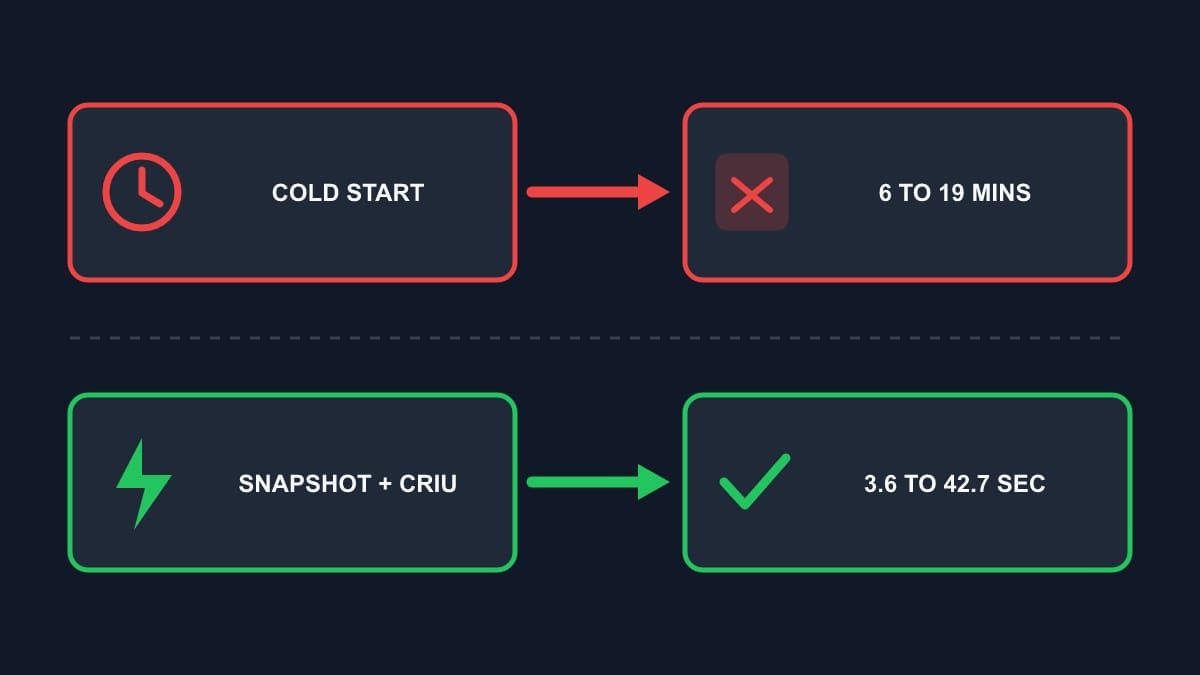
Hard Numbers: Where the Seconds Drop (and Where Storage Takes Over)
In benchmarks published by the NVIDIA Technical Blog on NVIDIA B200 GPUs (driver 615.71.09, VAST NFS storage, running vLLM 0.31.0, SGLang 0.5.21, and TensorRT LLM 1.3.0), skipping initialization dramatically reshapes tail scaling latency:
| Benchmark / Metric | Traditional Cold Start | With NVIDIA Snapshot | Verified Stack / Source |
|---|---|---|---|
| End-to-end restore (0.6B to 8-GPU MoE) | Minutes (6–19 min on 8x GPU MoE) | 3.6 to 42.7 seconds (8x–36x faster) | NVIDIA B200 + VAST NFS |
| 8-GPU MoE checkpoint footprint | Reload weights + torch.compile |
600 GB to 1 TB artifact | TP / DEP / DCP (KV cache freed) |
| GPU vs CRIU CPU restore split (8x MoE) | Full engine warmup | 18–29 s CUDA / 4.2–10.8 s CRIU | Storage throughput bound |
| One-time checkpoint creation | Paid repeatedly per replica | 15 s to 5.5 min (paid once) | Faster than 1 cold start on first restore |
| GLM-5.3 Pod readiness (Crusoe) | ~8 minutes | 31 seconds | NVIDIA HGX B300 (Cloud Native Now) |
| vLLM scale-from-zero (Saturn Cloud) | 2 to 8.5 minutes | 6 to 34 seconds | NVIDIA HGX B300 (Cloud Native Now) |
On the Kubernetes control plane side, integration relies on custom resources (PodSnapshot and SnapshotJob) paired with a nvidia.com/restore-from Pod annotation—alongside NVIDIA donating OpenShell to the CNCF to sandbox autonomous agent workloads.
The Three Production Constraints Still Waiting on Your Cluster
Before declaring Kubernetes cold starts dead, read the fine print documented by NVIDIA's engineers:
- Strict GPU & driver pinning: A Snapshot artifact is not write-once-run-anywhere bytecode. It only restores onto nodes running the exact same GPU model and driver version (e.g., matching B200 hardware on driver
615.71.09). Without immutable node OS builds—which is precisely why NVIDIA pairs Snapshot with NVKR—heterogeneous fleets break restore compatibility. - Brutal storage bandwidth demands: Because 600 GB to 1 TB of live host and CUDA state must stream back into memory (even after releasing the KV cache pre-checkpoint), scaling 10 replicas simultaneously will saturate weak network storage. Benchmarking on VAST NFS wasn't accidental; slow object-store pulls simply relocate the bottleneck from compute compilation to NIC throughput.
- Single-node multi-GPU scope & unmeasured node boot overhead: Multi-GPU
TP,DEP, andDCPcheckpoints stay scoped to one node (up to 8 GPUs), and container image pulling plus node provisioning remain outside Snapshot's clock. Make sure scheduling itself isn't leaving expensive GPUs stranded inPendingby verifyingkube-reserved, DaemonSets, and GPU slots in our Kubernetes Pod & Node Bin-Packing Calculator and double-checking VRAM budgets via the LLM VRAM Calculator.
Ground-Level Verdict
NVIDIA Snapshot kills the most wasteful phase of LLM autoscaling: forcing every new Pod replica to re-run torch.compile, autotune kernels, and re-capture CUDA graphs while traffic spikes queue up. Paired with NVKE and NVKR, NVIDIA is shipping an open-source reference blueprint for AI factories tired of gluing bare-metal GPU Kubernetes scripts together by hand.
Just remember the trade-off: trading 19 minutes of compute compilation for 3.6–42.7 seconds of CRIU + CUDA restore only works if your storage fabric feeds hundreds of gigabytes fast enough and your fleet discipline keeps GPU drivers locked in sync. Explore more cluster sizing calculators across Syncroma Tools.
Visual Credits: Editorial photograph and localized technical infographic by Syncroma Studio.
Sistemas reales, sin humo corporativo Real systems, zero corporate hype
Recibe los análisis a fondo sobre arquitectura, consumo de recursos y computación de bajo nivel directamente en tu bandeja de entrada. Get deep-dive software architecture, resource consumption metrics, and low-level computing essays delivered straight to your inbox.
Suscribirse a Syncroma Subscribe to Syncroma

