(🇪🇸 Leer la versión en español aquí)
At 120 kilowatts per square meter, the laws of thermodynamics do not negotiate with Silicon Valley marketing. When Jensen Huang unveiled the Blackwell architecture and its flagship hyperscaler rack, the NVL72, the spec sheet dazzled Wall Street: 72 B200 GPU accelerators interconnected via passive copper backplanes and 36 Grace Arm CPUs, promising up to a 25x reduction in cost and power consumption compared to the Hopper H100 generation.
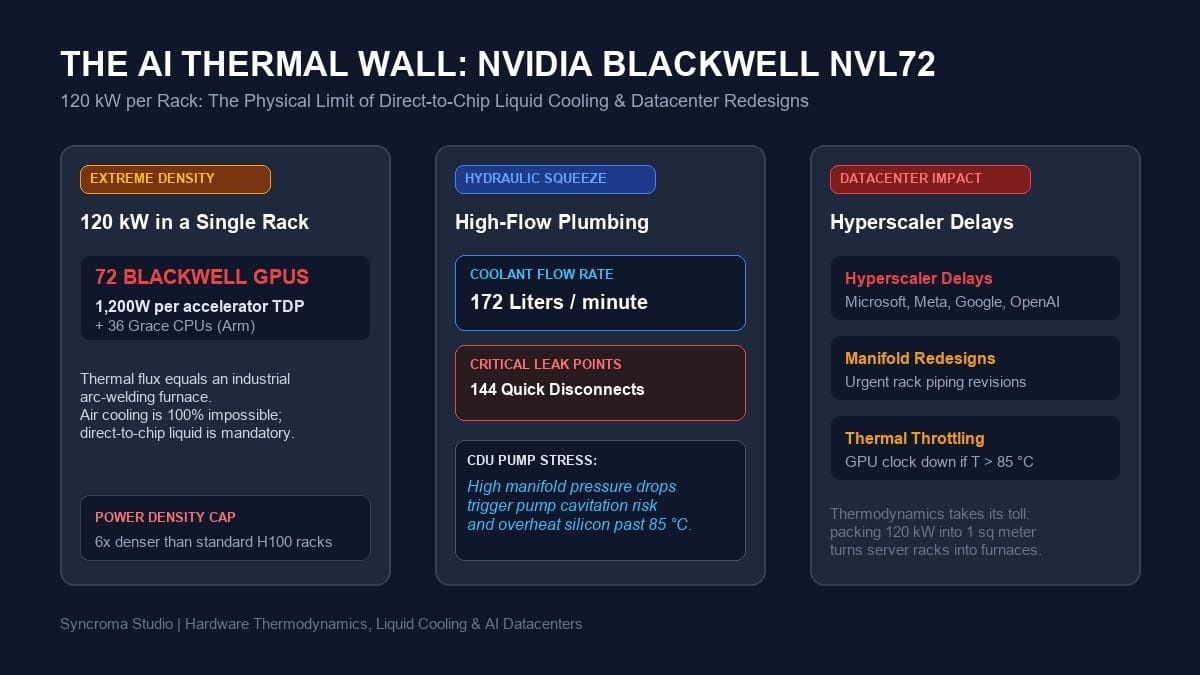
Yet as initial validation racks were assembled inside the production datacenters of tier-one cloud providers—including Microsoft Azure, Meta, Google Cloud, and OpenAI—infrastructure engineers ran headfirst into cold physical reality: the 120 kW racks overheat under full synthetic load, coolant fails to carry away heat flux with sufficient headroom, and GPUs trigger aggressive thermal throttling above 85 °C.
This hydraulic and thermal bottleneck has forced Nvidia to request multiple urgent manifold and chassis piping redesigns from server ODM suppliers. The resulting production hiccups highlight an uncomfortable truth for the AI industry: we have reached the physical wall where silicon no longer battles silicon—it battles fluid mechanics.
1. The Anatomy of a 120 kW Monster
To put this thermal density in perspective, consider the evolution of server rack power over the past decade:
- Standard Enterprise x86 Rack: Typically draws between 5 kW and 10 kW. Comfortably cooled with traditional raised-floor cold/hot aisle containment and forced air.
- Nvidia Hopper H100 Rack (DGX H100): Draws 30 kW to 40 kW. Pushed extreme air cooling to its absolute ceiling, requiring loud high-RPM delta fans and rear-door heat exchangers (RDHx).
- Nvidia Blackwell NVL72 Rack: Skyrockets thermal density to 120 kW inside a single 19-inch footprint.
Concentrating 120 kW of heat dissipation inside the volumetric envelope of a refrigerator is thermodynamically identical to running an industrial arc-welding furnace inside a server room. Each Blackwell B200 GPU integrates two reticle-sized monolithic dies bridged by a 10 TB/s interface, resulting in a staggering 1,200 W TDP per accelerator (compared to 700 W on an H100 SXM5). Multiplied across 72 GPUs, plus 36 Grace CPUs and high-radix NVSwitch trays, the rack generates a heat flux that ambient air is physically incapable of removing, no matter how many 15,000 RPM fans are stuffed into the chassis.
Direct-to-Chip (D2C) liquid cooling is not an exotic performance perk for Blackwell; it is the fundamental physical prerequisite for silicon survival.
2. Heat Capacity Physics: Why Water Is Reaching Its Ceiling
The governing equation for single-phase liquid cooling in hyperscale facilities is deceptively simple:
ṁ = Q / (cp · ΔT)
Where:
- Q is the total thermal heat load (120,000 W).
- cp is the specific heat capacity of the coolant (≈ 4,184 J/(kg·K) for treated deionized water, or ≈ 3,850 J/(kg·K) for a 25% propylene glycol PG25 water mix with biocides and corrosion inhibitors).
- ΔT is the allowable temperature rise of the coolant between the cold supply manifold and the hot return manifold.
In modern high-efficiency datacenters operating on ASHRAE TC 9.9 Facility Water System W4 standards (inlet water between 30 °C and 32 °C to avoid power-hungry mechanical chillers), the maximum allowable temperature rise through the GPU cold plates is restricted to 10 °C to 12 °C. If coolant leaves the rack above 45 °C, silicon junction temperatures (Tjunction) quickly breach the critical 85 °C barrier, triggering hardware thermal trip points that downclock GPU cores and decimate training cluster throughput.
Plugging in the thermodynamics numbers:
ṁ = 120,000 W / [4,184 J/(kg·K) × 10 K] = 2.868 kg/s ≈ 172 Liters per minute
A single NVL72 rack demands a continuous, pressurized stream of over 172 liters of liquid coolant every single minute through an intricate maze of internal microchannels. In a standard 10-rack cluster row, that translates into an industrial torrent of 1,720 L/min flowing at high pressure just millimeters away from multi-million-dollar computing boards.
3. The Manifold Bottleneck: Pressure Drops, Cavitation, and Quick Disconnects
The underlying culprit behind the overheating reports is not a defect in Blackwell's silicon dies, but in the rack's internal hydraulic plumbing:
- Extreme Manifold Pressure Drop (ΔP): Forcing 172 L/min through 72 micro-finned copper cold plates, bypass valves, and tight-radius flexible tubing generates severe hydraulic resistance. To sustain required flow velocities, Coolant Distribution Unit (CDU) pumps must operate at elevated head pressures.
- Asymmetric Flow Distribution Across Compute Trays: In early rack revisions, coolant did not split evenly across the vertical manifold. Trays at the far end of the supply runner experienced lower volumetric flow rates. While lower compute shelves stayed at 35 °C, upper shelves suffered localized starvation, pushing die temperatures past 85 °C and inducing severe thermal throttling.
- The Quick Disconnect (QD) Reliability Trap: Every compute tray in an NVL72 must be hot-swappable for field service without draining the entire 120 kW rack. This requires at least 144 dry-break Quick Disconnect fittings per rack. At high flow rates and continuous thermal cycling, minor seal misalignments cause micro-leaks or cavitation. A single trapped micro-bubble inside a copper cold plate eliminates conductive heat transfer, causing catastrophic local die thermal runaways within milliseconds.
To resolve these field validation failures, Nvidia has worked closely with supply chain partners to widen fluid conduits, refine internal manifold geometry, and lower pressure drops across the chassis.
4. The Hyperscaler Dilemma: Retrofits vs. Greenfields
For hyperscale operators like Microsoft, AWS, and Google Cloud, deploying 120 kW racks is far from a drop-in upgrade:
- Floor Loading Limits: A fully cabled, coolant-filled NVL72 rack weighs approximately 1,360 kg (3,000 lbs). Legacy raised-floor datacenters cannot support this point load without structural steel sub-floor reinforcement.
- Absence of Facility Liquid Loops: Over 80% of existing global datacenters rely solely on chilled-air perimeter CRAC units. They lack in-row secondary coolant loops, perimeter CDUs, or continuous capacitive leak-detection tape. Hyperscalers facing long Blackwell queues must either undertake expensive brownfield retrofits or settle for lower-density air-cooled HGX B200 boards, forfeiting the latency advantages of 72-GPU NVLink copper domains.
- Zero Thermal Inertia: If a pump loses redundancy in a 15 kW air-cooled rack, residual airflow keeps machines alive for minutes. In a 120 kW liquid-cooled rack experiencing total flow loss, the thermal mass of the copper cold plates is exhausted in less than 3 to 5 seconds before silicon temperatures spike to destructive levels unless safety relays cut AC power instantly.
Conclusion: Silicon Is No Longer the Bottleneck
For half a century, computing progress was measured by Moore's Law—how many transistors could be fabricated onto a square millimeter of silicon. With Blackwell, that engineering frontier has migrated to fluid dynamics and thermal mechanical engineering.
Nvidia has proven it can architect the most powerful AI accelerator on Earth. But cramming 72 of them into a single cubic meter has collided with classical thermodynamics. Until precision liquid manifolds, robust quick disconnects, and balanced hydraulic topologies are perfected across the global hardware supply chain, AI datacenters will continue sweating to keep Blackwell's 120 kilowatts from melting down.
(Visual Credit: Syncroma Studio | Hardware Thermodynamics, Liquid Cooling & AI Datacenters)
Sistemas reales, sin humo corporativo Real systems, zero corporate hype
Recibe los análisis a fondo sobre arquitectura, consumo de recursos y computación de bajo nivel directamente en tu bandeja de entrada. Get deep-dive software architecture, resource consumption metrics, and low-level computing essays delivered straight to your inbox.
Suscribirse a Syncroma Subscribe to Syncroma