
(🇪🇸 Leer la versión en español aquí)
If you manage Kubernetes clusters, ingress controllers, or bare-metal reverse proxies in production, an infrastructure engineer's worst nightmare has just gone public: F5 and the NGINX open-source project have released emergency security updates to patch a severe multi-stage exploit chain dubbed NGINX2Root.
This is not a minor configuration oversight or a trivial layer-7 denial of service. NGINX2Root chains five independent memory corruption vulnerabilities inside NGINX core (led by the critical flaw CVE-2026-123007) with a local privilege escalation bug in the Linux kernel’s SCTP networking module. The resulting impact is catastrophic: an unauthenticated remote attacker sends crafted binary HTTP/2 frames, achieves Remote Code Execution (RCE) inside an unprivileged NGINX worker process, and immediately breaks out of the Docker container to gain absolute root access on the host operating system.
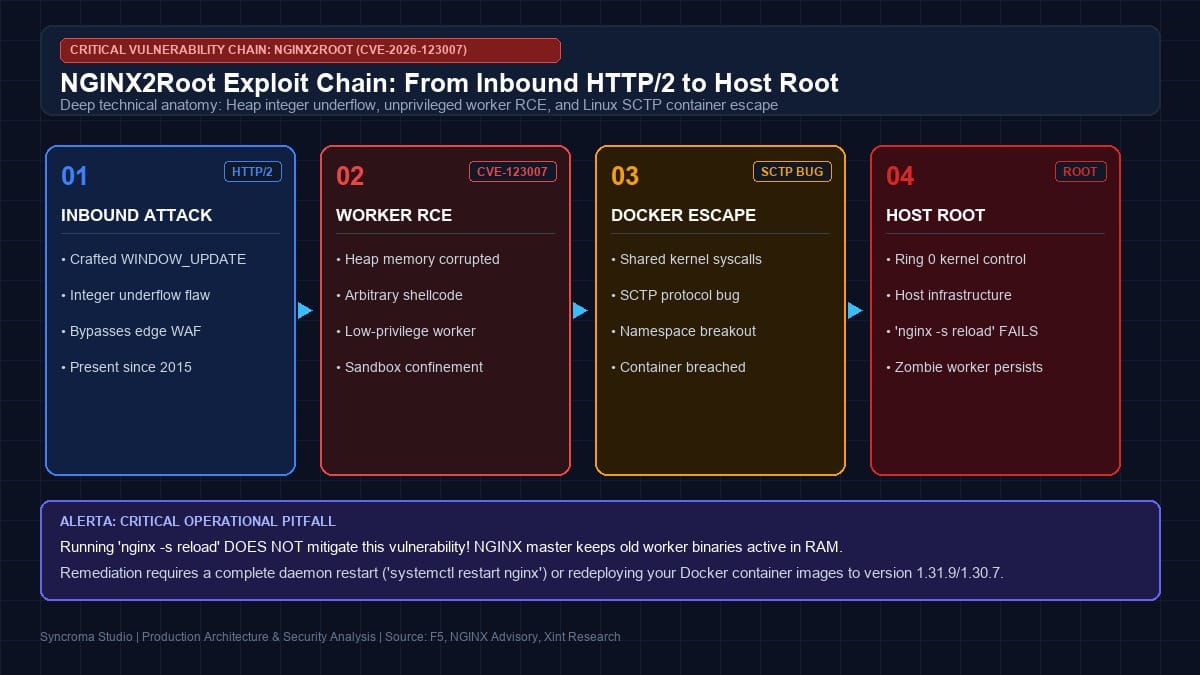
Infographic: The four-stage NGINX2Root kill chain, bridging unauthenticated HTTP/2 integer underflow to container breakouts and host kernel compromise. Credit: Syncroma Studio.
1. The Root Cause: A Decade of Latent HTTP/2 Window Underflow
The foundational exploit vector resides in NGINX’s HTTP/2 flow control state machine (ngx_http_v2_module.c), which has shipped across all mainline and stable releases dating all the way back to NGINX 1.9.5 in 2015 up to version 1.31.8:
- HTTP/2 Window Management &
WINDOW_UPDATEFrames: In HTTP/2, endpoints actively advertise and manage flow-control windows using 31-bit integers to prevent fast senders from exhausting slower receivers. - The Integer Underflow Mechanism: When processing incoming frames across multiplexed streams under high concurrency, NGINX subtracted stream window deductions without enforcing strict boundary assertions under asynchronous race conditions. An attacker interleaving empty frames with dynamic stream dependency shifts forces an arithmetic underflow, transforming the counter into an astronomical unsigned integer (
0xFFFFFFFF). - Heap Buffer Overwrite & Execution Divergence: Believing the inbound buffer window has near-infinite capacity, NGINX’s internal memory pool writes past allocated chunk boundaries, corrupting adjacent function pointers on the worker process heap. The instruction pointer is redirected into arbitrary shellcode staged in payload memory.
The security audit also uncovered four related memory flaws: two Use-After-Free conditions in HTTP/2 and HTTP/3 handling (CVE-2026-123633 and CVE-2026-121810), an internal DNS resolver memory leak (CVE-2026-123634), and an unauthenticated buffer overflow in the mail proxy module (CVE-2026-113425).
2. The Container Isolation Fallacy: Why Docker Failed
The instinct of modern platform engineers when hearing about web server RCE is often: "Our reverse proxies run as unprivileged nginx users inside isolated Docker containers, so the blast radius is contained."
NGINX2Root provides an aggressive reminder that containers share the host Linux kernel:
- Once remote code execution is achieved inside the worker process (even with unprivileged UID/GID), the attacker has direct, unmediated access to host kernel syscalls exposed inside the container runtime.
- The exploit chain leverages an unpatched vulnerability in the Linux kernel’s Stream Control Transmission Protocol (SCTP) networking stack. By issuing crafted socket control messages from the worker process, the attacker corrupts internal kernel namespace data structures.
- The container boundaries collapse instantly: the execution context escapes the container's PID and mount namespaces, elevating privileges to
root(UID 0) on the bare-metal host.
3. The Production Trap: Why nginx -s reload Leaves You Compromised
This is the most critical operational pitfall currently hitting DevOps teams worldwide:
When system administrators update the NGINX package (apt upgrade nginx or dnf update nginx), the instinctive step is executing a graceful reload to avoid dropping client traffic:
# WARNING: THIS DOES NOT MITIGATE NGINX2ROOT!
nginx -s reload
Under NGINX's process architecture:
nginx -s reloadsignals the master process to parse the configuration and spawn fresh workers running the newly installed disk binary.- However, any long-lived client connections (HTTP/2 multiplexing, active WebSockets, persistent keep-alive pools) prevent old worker processes from terminating until their connections close naturally.
- The unpatched, vulnerable binary code remains loaded and running in RAM inside those zombie worker processes, leaving the exploitation window open to established network sessions.
To guarantee remediation, operations teams must force a complete process termination or execute a clean rolling redeployment:
# On bare-metal Linux servers and VMs:
systemctl stop nginx
systemctl start nginx

# Verify no deleted, unlinked vulnerable binaries remain active in RAM:
lsof -n | grep nginx | grep '(deleted)'

# In Kubernetes environments:
kubectl rollout restart deployment/ingress-nginx
4. Architectural Verdict
For over a decade, NGINX has been treated as a rock-solid, infallible foundation at the edge of the internet, assuming layer-7 WAFs (Cloudflare, AWS WAF) could shield against upstream bugs.
NGINX2Root exposes the systemic fragility of running complex binary protocol parsers written in C without compile-time memory safety or strict sandboxing. Organizations that have migrated their edge traffic to memory-safe proxies (such as Cloudflare’s Pingora or Rust-hardened Envoy builds) were immune to this exploit chain. For the vast majority of engineering teams running standard NGINX, today is a day to verify what binaries are actually running in server memory.
Sistemas reales, sin humo corporativo Real systems, zero corporate hype
Recibe los análisis a fondo sobre arquitectura, consumo de recursos y computación de bajo nivel directamente en tu bandeja de entrada. Get deep-dive software architecture, resource consumption metrics, and low-level computing essays delivered straight to your inbox.
Suscribirse a Syncroma Subscribe to Syncroma

