
(🇪🇸 Leer la versión en español aquí)
For years, enterprise IT teams paid the integration tax bridging Salesforce CRM records and Microsoft productivity suites with fragile ETL scripts and manual CSV exports. Today, November 17, 2026, kicking off Microsoft Ignite in San Francisco, the two rivals unveiled Copilotforce — detailed simultaneously on Microsoft News and the Salesforce Newsroom.
With Accenture serving as design partner and "Customer Zero" across its global sales organization, technical briefings from The Futurum Group and MuyComputerPRO show a calculated architectural tradeoff: wire Salesforce Data 360 straight into Microsoft Copilot, Teams, and Fabric OneLake via Zero Copy — while anchoring enterprise budgets across both clouds simultaneously.
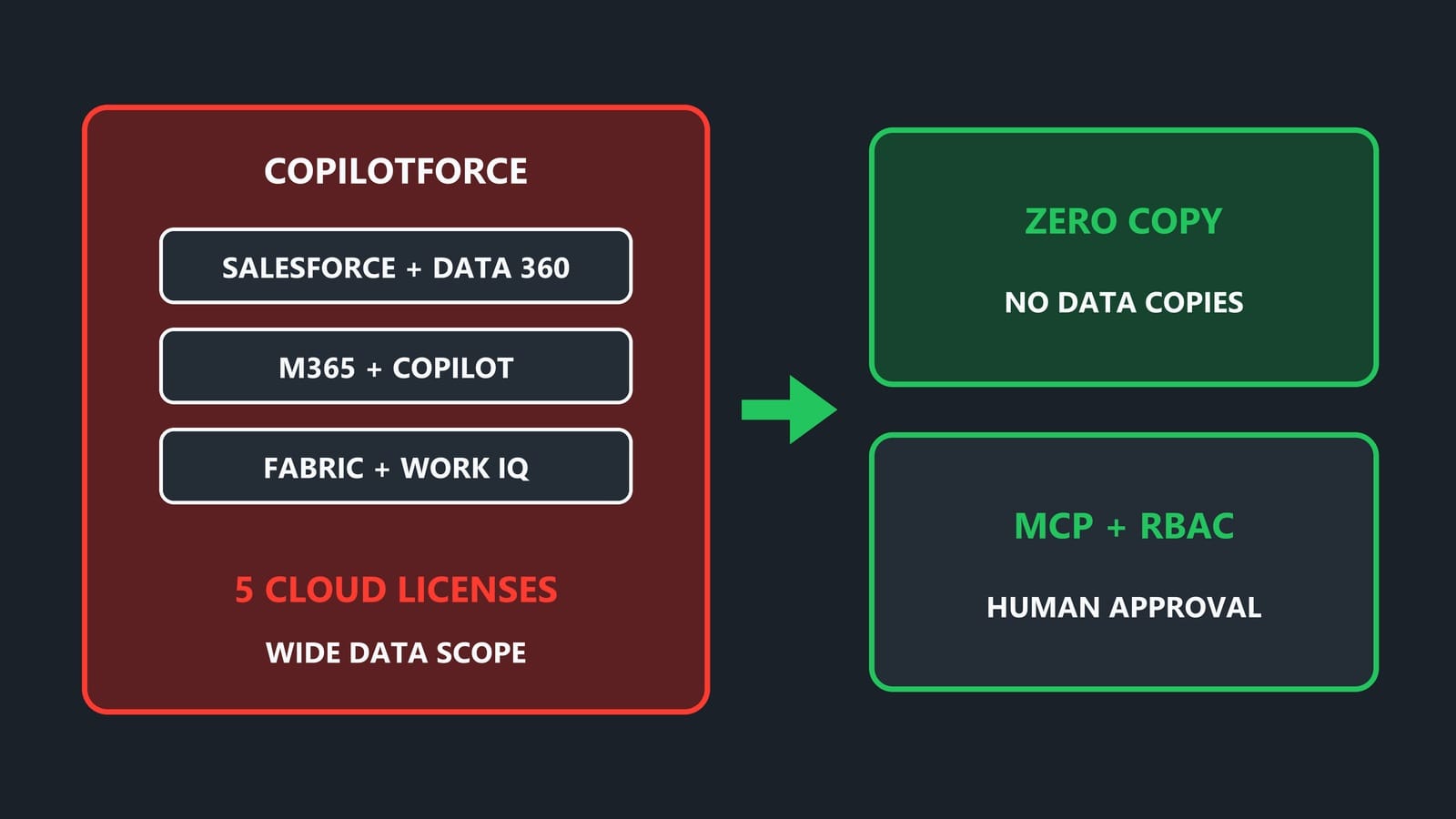
Inside the Copilotforce Architecture (Beyond Keynote Slides)
Stripping out executive keynote rhetoric, Copilotforce consists of four concrete technical components confirmed in today's rollout notes:
| Technical Component | What It Actually Does | Rollout Stage (Nov 2026) | Real-World Ops Impact |
|---|---|---|---|
Salesforce Copilot Plugin (Work IQ) |
Exposes 38+ prebuilt sales skills (Pipeline Reviews, Deal Reviews, Close Planning, Customer Health, Renewal Radars) fusing CRM + Outlook + SharePoint/OneDrive + Teams calls | Public Preview | Eliminates manual copy-paste prep before customer calls |
Bidirectional Zero Copy (Data 360 ↔ Fabric OneLake) |
Cross-queries customer tables between Salesforce Data 360 and Microsoft Fabric with zero ETL dataset duplication | Announced joint integration | Cuts duplicate storage footprints while binding query compute to both ecosystems |
Sales Cloud in Teams |
Embeds live CRM opportunity collaboration directly inside Teams channels & meetings | Enterprise customer pilot (open beta later this year) | Keeps deal collaboration inside existing chat flows |
Authenticated Salesforce MCP Write-Back |
Enforces each user's native Salesforce RBAC permissions and requires explicit human approval + CRM validation rules before mutating records | Core governance layer | Stops unapproved autonomous writes, yet inherits pre-existing permission sprawl |
What Account Reps Won't Highlight: License Bloat & Permission Blast Radius
Before signing an enterprise Copilotforce bundle for 2027, infrastructure and procurement leads should examine two practical tradeoffs:
- Zero Copy eliminates duplicate storage, not seat licensing sprawl: Unlocking the full end-to-end promise means licensing Salesforce + Data 360 + Microsoft 365 + Copilot + Microsoft Fabric in parallel. Audit total per-seat TCO against lightweight custom pipelines in our Annual SaaS Subscription Audit Calculator and raw warehouse/storage pricing in our AWS S3 vs. Cloudflare R2 vs. Backblaze B2 Cost Calculator.
- Joining Work IQ with CRM amplifies legacy SharePoint oversharing: Fusing Teams transcripts, Outlook threads, SharePoint files, and CRM pipelines means any overly broad internal SharePoint permission immediately surfaces inside AI deal summaries unless ACLs are audited beforehand.
- Human-in-the-loop MCP write-backs are the right guardrail: Enforcing explicit user approval plus server-side Salesforce validation rules prevents autonomous hallucinated updates from corrupting production revenue records.
FAQ: Microsoft & Salesforce Copilotforce
Can Copilotforce AI agents alter Salesforce records automatically?
No by default. Per Microsoft News and The Futurum Group, Copilotforce relies on authenticated Salesforce MCP honoring existing CRM user permissions and requires explicit human approval plus validation-rule checks before committing changes.
What does bidirectional Zero Copy between Salesforce Data 360 and Microsoft Fabric mean?
Both platforms query shared tables in place without copying or duplicating raw storage buckets back and forth across ETL pipelines, reducing storage redundancy while running analytics across connected cloud tenants.
Writing and infographic by Syncroma Studio. Cover photograph: exterior of Moscone Center in San Francisco (venue of Microsoft Ignite 2026), by Another Believer via Wikimedia Commons (CC BY-SA 3.0).

Sistemas reales, sin humo corporativo Real systems, zero corporate hype
Recibe los análisis a fondo sobre arquitectura, consumo de recursos y computación de bajo nivel directamente en tu bandeja de entrada. Get deep-dive software architecture, resource consumption metrics, and low-level computing essays delivered straight to your inbox.
Suscribirse a Syncroma Subscribe to Syncroma

