(🇪🇸 Leer la versión en español aquí)

If your enterprise relies on Microsoft Entra Connect Health to monitor hybrid identity synchronization between on-premises Active Directory and Entra ID (Azure AD), log into Azure Service Health immediately. Microsoft has wrapped up an internal security probe confirming the kind of news no IT director wants to read heading into a weekend: a cloud API authorization flaw lingered unpatched for four months and was actively exploited by threat actors.
The vulnerability was quietly introduced on July 23, 2026, bypassed telemetry until November 9, and was remediated via a server-side fix on November 19. However, post-incident forensic audits confirmed that unauthorized actors successfully harvested tenant-level metadata, including the direct contact emails of Global Administrators and key technical personnel across impacted organizations.
Corporate PR communications will predictably emphasize that "no passwords, valid session tokens, or customer directory payloads were exposed." But anyone in enterprise security operations understands the reality: threat actors now hold a pristine, verified reconnaissance database of the exact identities holding the master keys to enterprise cloud environments.
Anatomy of the Vulnerability: BOLA in the Cloud Control Plane
Microsoft Entra Connect Health acts as a cloud-based telemetry hub, monitoring on-premises synchronization health, sync latency, and directory provisioning errors. To serve dashboards and hybrid agents, the platform exposes backend REST APIs consumed by both the web management console and on-prem connectors.
The vulnerability was a classic Broken Object Level Authorization (BOLA / IDOR) flaw residing within an Entra Connect Health API endpoint:
[Authenticated Attacker / Valid Azure Session]
        │
        ▼  GET /api/health/tenant/{target_tenant_id}/summary
┌────────────────────────────────────────────────────────┐
│ Microsoft Entra Connect Health Backend API Endpoint    │
│ ❌ Flaw: Verifies caller auth, but FAILS to enforce    │
│    tenant authorization on the {target_tenant_id}      │
└───────────────────────┬────────────────────────────────┘
                        │
                        ▼ (Unauthorized read-only extraction)
┌────────────────────────────────────────────────────────┐
│ Harvested Tenant Metadata:                             │
│ • Direct Global Administrator & Contact Emails         │
│ • Tenant ID, Initial Root Domain & License Tier        │
│ • Hybrid Sync Status & Last Successful Timestamp       │
│ • Stale Internal Registration Certificates from 2024   │
└────────────────────────────────────────────────────────┘
Because the API failed to validate whether the authenticated caller belonged to the requested tenant_id, any actor with an active Azure tenant could iterate identifiers and extract organizational metadata across boundaries without triggering perimeter alarms.
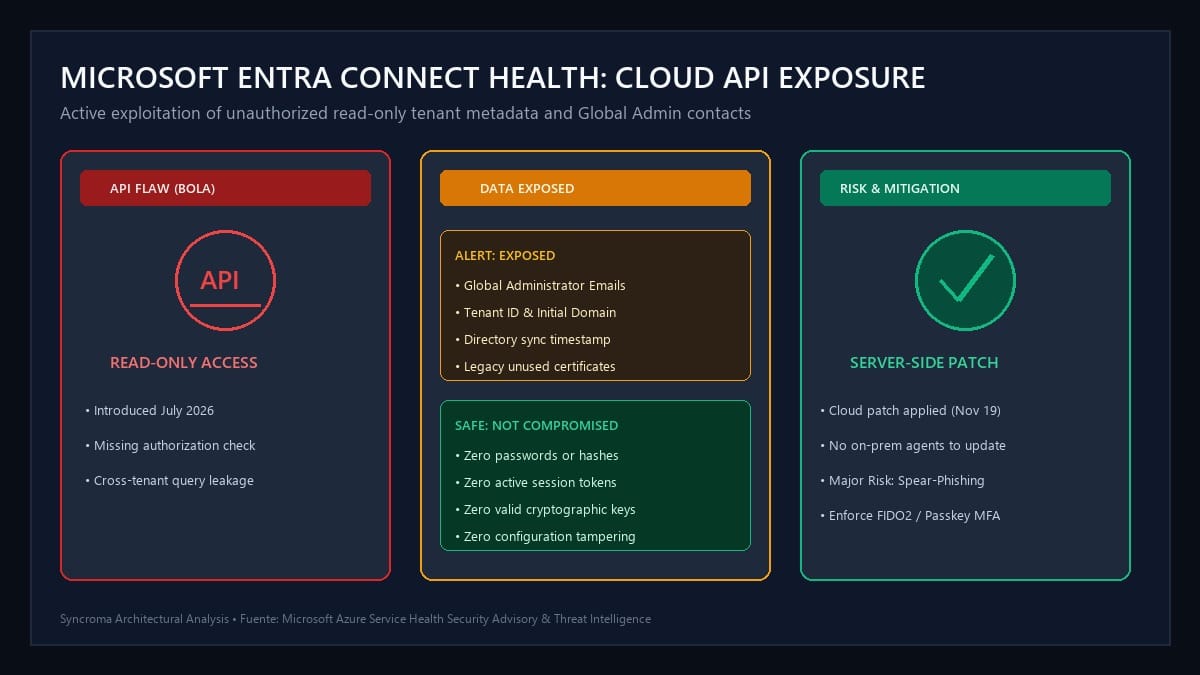
What Leaked vs. What Was Safeguarded
To cut through vendor spin without manufacturing hysteria, here is the verified breakdown from Microsoft's internal audit:
1. Confirmed Compromised Data:
- Global Administrator & Technical Contact Email Addresses: The highest-risk asset. Attackers mapped the exact accounts possessing unrestricted tenant management privileges.
- Tenant IDs & Root Domain Names: Precise directory identifiers used to configure targeted password sprays and reconnaissance scripts.
- Synchronization State & Timestamps: Real-time visibility into directory replication health and telemetry windows.
- Legacy Decommissioned Certificates: Expired registration certificates associated with an internal backend service retired in late 2024 that had not been purged from database tables.
2. What Was NOT Compromised:
- Zero passwords, password hashes (NTLM/Kerberos), or credential vaults.
- Zero active OAuth session tokens, refresh tokens, or SAML assertions.
- Zero valid cryptographic private keys.
- Zero unauthorized configuration modifications: While the vulnerable endpoint theoretically permitted write payloads, forensic log analysis verified that attackers limited operations to read-only reconnaissance and bulk scraping.
The Real Production Hazard: Precision Spear-Phishing
The absence of leaked passwords does not make this breach harmless. In modern identity attacks, reconnaissance constitutes the foundation of high-impact breaches.
Armed with confirmed Tenant IDs, active domain configurations, and direct Global Admin emails, threat actors possess the exact ingredients required for highly convincing spear-phishing campaigns:
- Spoofed administrative alerts warning of "Urgent Entra Connect Sync Disruption on Tenant [Real-Tenant-ID]".
- Fabricated notices requiring "Immediate Re-authentication of Hybrid Directory Certificates".
- Targeted MFA fatigue attacks zeroed in on the handful of individuals authorized to bypass Conditional Access boundaries.
Immediate Action Plan for IT Engineering & Security Teams
Because Microsoft deployed a server-side hotfix on November 19, 2026, administrators do not need to deploy patches on local on-premises servers. However, immediate defensive actions are critical:
- Verify Azure Service Health: Access the Azure portal directly (never follow email links) and verify whether your organization received the official security incident notification.
- Enforce Phishing-Resistant MFA (FIDO2 / Passkeys): Traditional SMS or simple push notifications are vulnerable to adversary-in-the-middle (AiTM) phishing kits. Migrate all Global Administrators immediately to hardware FIDO2 security keys (e.g., YubiKey) or Certificate-Based Authentication (CBA).
- Brief Privileged Admin Teams: Notify all registered technical contacts that their work emails are part of an active attacker reconnaissance dataset. Instruct them to treat any unexpected directory synchronization alerts with extreme scrutiny.
- Harden Conditional Access: Restrict privileged administrative roles strictly to managed, compliant hardware connecting from verified, geofenced IP ranges.
This incident reinforces an unavoidable cloud architecture truth: no matter how robust your on-prem hardening is, an authorization bug in a hyperscaler's monitoring API can expose your top administrators to adversary targeting in minutes.
(Engineered by Syncroma Studio. Verified technical references: Microsoft Azure Service Health Security Advisory, The Hacker News, and enterprise identity telemetry).
To audit authentication token entropy and generate cryptographic secrets client-side, check out our Private Password Generator & Entropy Auditor and our Private cURL to Code Converter.
Sistemas reales, sin humo corporativo Real systems, zero corporate hype
Recibe los análisis a fondo sobre arquitectura, consumo de recursos y computación de bajo nivel directamente en tu bandeja de entrada. Get deep-dive software architecture, resource consumption metrics, and low-level computing essays delivered straight to your inbox.
Suscribirse a Syncroma Subscribe to Syncroma

