
(🇪🇸 Leer la versión en español aquí)
When you tap upload inside the Facebook Android app to share a single photo, the operating system asks for media access. What millions of everyday phone owners never realized—and what just landed Meta Platforms Ireland Limited an €805 million (~$887 million) fine—is that bundling that prompt let the app continuously comb through personal photos, videos, and associated metadata on users' handsets just to pop up "post ideas" while browsing.
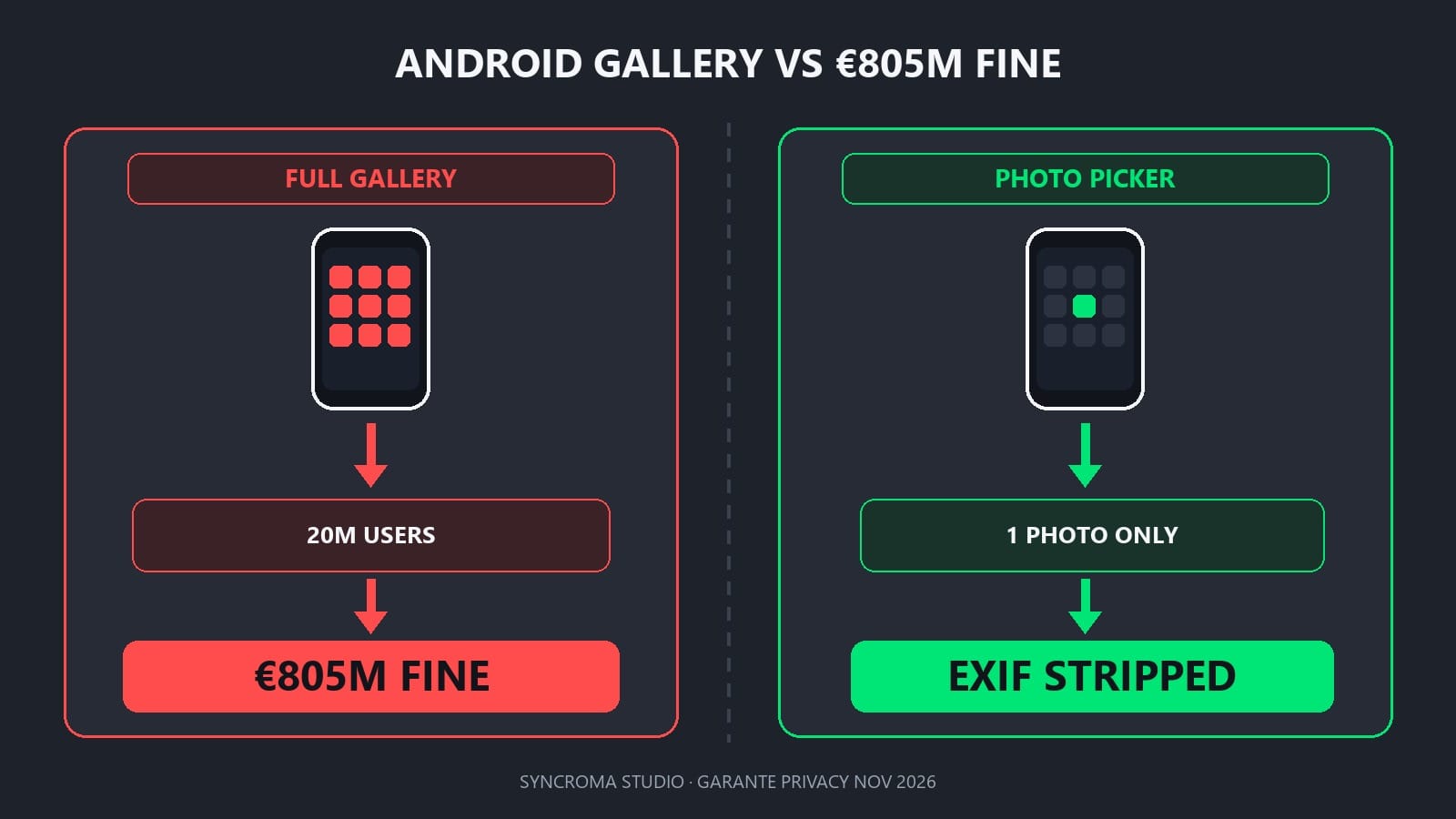
According to the official press release published on November 14, 2026 by Italy’s Garante per la protezione dei dati personali and corroborated by The Guardian, the investigation opened in July 2025 after a complaint from Bolzano’s consumer group Centro Tutela Consumatori Utenti. Auditing the Facebook Android feature "Get tips from your gallery while browsing Facebook"—live since 2023—Italy’s watchdog ruled that Meta turned a broad device permission into silent default access spanning roughly 20 million Android users in Italy.
The Permission Architecture Behind the Ruling
In modern mobile engineering, there is a bright architectural line between letting a user hand a single image URI to an app versus requesting sweeping access to read an entire camera roll. The Garante’s technical inspection highlighted three design choices that broke informed consent:
- Single app-wide blanket authorization: Facebook requested photo-library access under one global permission valid for the entire app, lumping unrelated capabilities together.
- Ambiguous prompt paired with opt-out defaults: Before requesting access, the app displayed a generic notice ("enable other features") that gave normal users zero clue they were turning on background gallery-suggestion scanning—while leaving the feature enabled by default.
- Permanent dark-box access with zero auditability: As the authority noted explicitly, once blanket gallery permission is granted, the app can permanently read the device’s entire photo archive without either the user or regulators being able to verify which photos or metadata are actually consumed.
| Audited Control | Facebook Android Feature (Fined) | Scoped Baseline (Android Photo Picker) | Real-World Privacy Effect |
|---|---|---|---|
| OS Grant Scope | App-wide library & metadata read access | Temporary per-selection URI (PickVisualMedia) |
App never inspects the rest of your camera roll |
| Initial State | Enabled by default since 2023 | Triggered only on explicit user pick | Eliminates passive background scanning |
| Prompt Clarity | Vague pre-notice ("enable other features") | Native OS picker UI with clear file selection | Zero dark-pattern bundling |
| EXIF Metadata Risk | Broad access to timestamps, device & location tags | Restricted strictly to explicitly chosen media | Minimizes hidden geolocation profiling |
Why This Ruling Hurts Beyond €805M: ePrivacy Jurisdiction & Cloud Processing Next
For Meta—where €805 million equals roughly 0.47% of global annual revenue—the deeper danger sits in two legal and architectural traps inside the Garante’s order:
- No Irish GDPR "One-Stop-Shop" shield: Meta argued Italy lacked jurisdiction and tried routing enforcement to Ireland’s data regulator. The Garante rejected that argument flatly because the breached law is Article 122 of Italy’s Privacy Code implementing the EU ePrivacy Directive—which protects the smartphone terminal itself as private space, regardless of whether data ever leaves the phone or causes downstream harm. That precedent allows national EU regulators to act independently on mobile permission abuse.
- The 2026 cloud gallery feature is next: The Garante explicitly noted this sanction did not examine AI training claims (which Meta denies), and reserved the right to open a separate probe into Meta’s new 2026 feature enabling cloud-side processing of gallery media.
- Hard compliance clocks despite appeal: Meta called the fine "disproportionate" and plans to appeal, arguing users already grant OS device permissions and can revoke them in settings. Even so, the order forces Meta to report initial steps within 30 days, switch the feature off by default within 60 days—retroactively resetting users who previously clicked allow unless they opt into a separate specific prompt—and verify full implementation within 90 days.
From a systems standpoint, the excuse makes no sense in 2026. Android explicitly provides Jetpack Activity contracts like PickVisualMedia via the system Photo Picker so social apps can let users upload selected photos and videos without ever requesting permanent access to their entire media library. Pushing users toward broad library permissions is a product choice, not an OS limitation.
How to Lock Down Your Android Camera Roll Today
Do not wait 60 days for a server-side toggle flip or an appellate brief:
- Revoke blanket Android media access: Go to Settings > Apps > Facebook > Permissions > Photos and videos and switch from Always allow all to Ask every time, Allow limited access, or Don’t allow.
- Disable gallery suggestions inside Facebook: Open Settings & privacy > Settings, locate camera-roll / gallery browsing suggestions (and any cloud gallery processing toggle), and switch them off.
- Strip EXIF metadata before uploading: Before sharing sensitive screenshots or phone photos anywhere online, strip GPS coordinates, device IDs, and timestamps locally inside your browser using our Private WebP Compressor & EXIF Metadata Cleaner and audit account hygiene with the Password Entropy Auditor & Generator.
Visual credits: Cover editorial photograph by Tony Webster (Wikimedia Commons, CC BY 2.0) · Technical infographic generated by Syncroma Studio.

Sistemas reales, sin humo corporativo Real systems, zero corporate hype
Recibe los análisis a fondo sobre arquitectura, consumo de recursos y computación de bajo nivel directamente en tu bandeja de entrada. Get deep-dive software architecture, resource consumption metrics, and low-level computing essays delivered straight to your inbox.
Suscribirse a Syncroma Subscribe to Syncroma

