
(🇪🇸 Leer la versión en español aquí)
For nearly three years, Silicon Valley's artificial intelligence narrative seemed completely detached from the fundamental laws of economic gravity. Quarter after quarter, Nvidia's data center division posted 200% to 300% year-over-year revenue spikes with gross margins flirting with 75%, defying enterprise capital expenditure cycles and positioning the company as the supreme engine of the generative AI boom. But when accounting reality and the laws of physics finally catch up, PowerPoint projections unravel fast.
The U.S. Securities and Exchange Commission (SEC) has formally launched a civil inquiry into Nvidia's accounting practices and financial disclosures (The Wall Street Journal, Reuters, The New York Times).
Federal enforcement attorneys are not probing a routine Excel rounding error. Their investigation targets the exact three structural pillars that sustained Nvidia’s liquidity mirage throughout Jensen Huang’s tenure: circular vendor financing (round-tripping of capital to AI startups), the sudden reclassification of billions in Singapore-billed revenue to circumvent export controls, and massive unhedged datacenter lease commitments.
1. The Capital Carousel: Manufacturing Infinite Demand With Your Own Balance Sheet
To understand what federal regulators are scrutinizing under the microscope, one must follow the physical cash flow rather than Wall Street press releases.
In traditional enterprise hardware, a fabless semiconductor designer creates a chip, has TSMC manufacture it, and sells it to downstream enterprise customers who pay for it out of organic operational cash flow. If those customers cannot turn a profit deploying that hardware, they cease placing purchase orders. That is the fundamental feedback mechanism of market supply and demand.
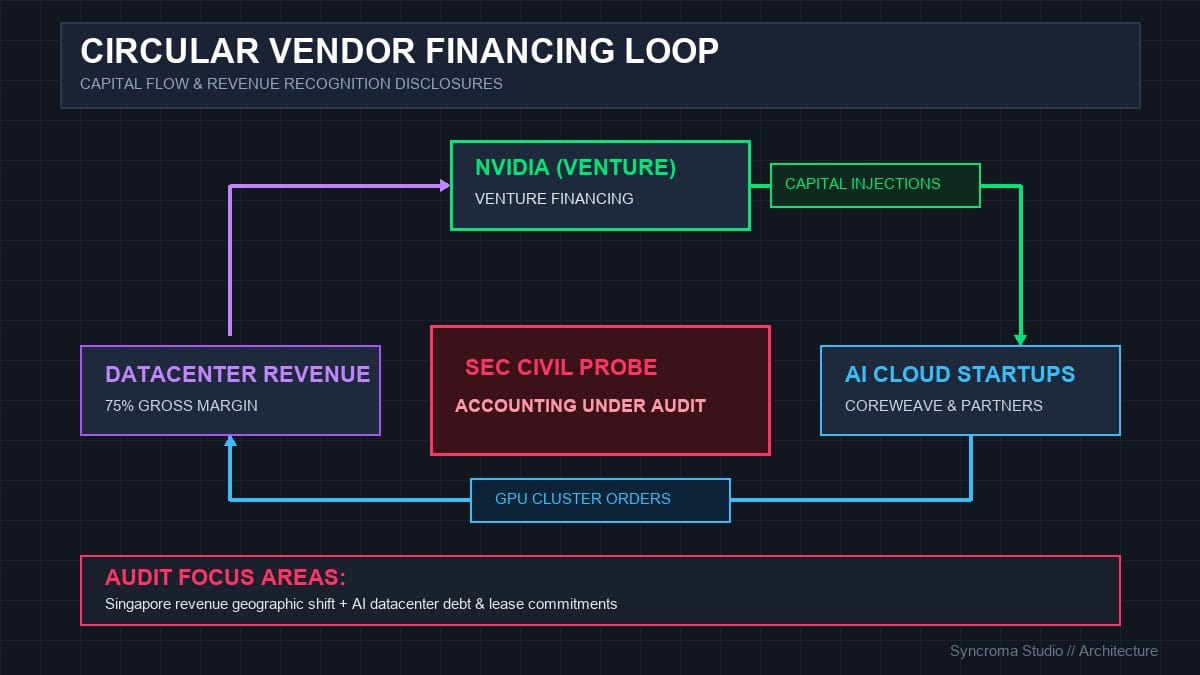
During the generative AI gold rush, Nvidia fundamentally altered that boundary through what forensic accountants call a circular vendor financing loop:
- Venture Capital Injections: Via its corporate venture arm (Nvidia Ventures), Nvidia injected hundreds of millions of dollars into neo-cloud providers and frontier model startups (including CoreWeave, Lambda Labs, Mistral AI, and Imbue).
- Contractually Mandated Hardware Spend: Embedded within many of these investment syndications and preferred silicon allocation agreements was a direct expectation: venture dollars were immediately channeled back to purchase full-rack deployments of Nvidia H100, H200, and GB200 NVL72 systems at full list price (MSRP).
- Immediate Revenue Recognition: Nvidia booked those server deliveries as immediate data center revenue in the active quarter, inflating top-line revenue growth and printing staggering 70% to 75% gross margins.
- Expense Deferral: The purchasing startups absorbed none of that pain upfront: they capitalized the GPUs as fixed physical assets on their balance sheets, depreciating them across a comfortable 4-to-6-year lifecycle, or leveraged the physical silicon as collateral to secure multi-billion-dollar debt facilities.
The core regulatory dilemma under SEC scrutiny is straightforward: How much of Nvidia's historic data center growth represented genuine, commercially viable end-user demand, and how much was a closed-loop accounting cycle where Nvidia essentially financed its own hardware sales?
Under U.S. GAAP standards—specifically ASC 606 (Revenue from Contracts with Customers)—when an enterprise makes an equity investment in a customer concurrently with a sales contract, there is a strong presumption that consideration paid to the customer must be treated as a reduction of the transaction price (reducing recognized revenue), unless the seller can prove an arms-length fair market value completely independent of the commercial transaction.
2. The Singapore Disappearing Act: Wiping 15% of Global Sales Off the Map
The second pillar of the SEC inquiry cuts directly into export geopolitical compliance and geographic revenue disclosures.
Across fiscal years 2024 and 2025, Nvidia’s 10-Q and 10-K filings displayed an anomaly that raised eyebrows among veteran forensic analysts: Singapore—a city-state of just 6 million residents—surged to represent over 15% of Nvidia’s total worldwide revenue, booking billions of dollars worth of bleeding-edge AI accelerators in single quarters (Forbes, Financial Times).
Anyone who manages physical data center infrastructure knows Singapore has neither the industrial real estate, the electrical grid capacity, nor the substation megawatt allocations to deploy that density of high-TDP compute clusters. Singapore was functioning as an offshore intermediary and billing clearinghouse. From there, third-party logistics entities and distributors routed silicon into jurisdictions subject to tightening U.S. Department of Commerce export restrictions—predominantly mainland China.
As federal enforcement agencies ramped up scrutiny on secondary re-export channels, Nvidia enacted a sudden, quiet accounting maneuver: it altered its geographic reporting methodology in subsequent public filings.
Instead of reporting revenue based on customer billing address, Nvidia shifted to reporting based on customer corporate headquarters. Almost overnight, Singapore disappeared as a distinct geographic line item on Nvidia's revenue charts, absorbed into broader consolidated totals.
The SEC is now demanding internal communications, shipping manifests, and auditor sign-off documentation that justified this reporting pivot amidst evolving international export controls.
3. The Hangover: Jensen Huang's Exit and the Reality Check in Production
This civil inquiry hits Nvidia at its most vulnerable corporate juncture. The sudden resignation of founder-CEO Jensen Huang in early November 2026 stripped the company of its charismatic talisman—the dealmaker who personally orchestrated handshake agreements with sovereign wealth funds and cloud hyperscalers.
Interim leadership, steered by veteran CFO Colette Kress, now faces three simultaneous headwinds that compound one another:
- Overlapping Federal Probes: In parallel with the SEC's accounting inquiry, the Department of Justice (DOJ) continues to investigate potential antitrust violations surrounding Nvidia's CUDA proprietary lock-in and the bundled tying of high-margin InfiniBand networking switches with GPU allocation quotas.
- The Hyperscaler Amortization Wall: Cloud giants (Microsoft, Google, AWS, Meta) have poured upwards of $300 billion into AI infrastructure over two years. Boardrooms are done writing blank checks: Chief Technology Officers and VP of Infrastructure are being forced to show hard token-economics ROI per megawatt consumed. If foundation models cannot generate tangible enterprise SaaS profits to offset server depreciation schedules, future capex orders face an abrupt freeze.
- Pricing Power Erosion: With the maturation of custom in-house ASICs (Google TPU v6, AWS Trainium2, Microsoft Maia) and the emergence of lower-power inference architectures bypassing expensive high-bandwidth memory (HBM), Nvidia's historical ability to command 80% margins on commodity compute is evaporating.
Production Verdict: When Accounting Catches Up to Hardware
In software engineering, there is a fundamental law: architecture hacks and premature micro-optimizations always generate technical debt that must eventually be repaid with interest.
In corporate accounting, the physics are identical. Providing vendor financing to your own startup clients to inflate quarterly top-line revenue might propel stock valuations for a few quarters, but it does not produce financially solvent long-term customers.
The SEC probe into Nvidia signals the end of generative AI's unscrutinized gold-rush phase. Those of us operating infrastructure in production knew from day one that the trillions thrown around in conference keynotes did not match real-world workload demand. Now, the federal auditors in Washington are finally asking to see the actual receipts.
Infographic: Syncroma Studio. Sources: SEC 10-Q & 10-K Filings, The Wall Street Journal, Reuters, The New York Times, Bloomberg News.
Sistemas reales, sin humo corporativo Real systems, zero corporate hype
Recibe los análisis a fondo sobre arquitectura, consumo de recursos y computación de bajo nivel directamente en tu bandeja de entrada. Get deep-dive software architecture, resource consumption metrics, and low-level computing essays delivered straight to your inbox.
Suscribirse a Syncroma Subscribe to Syncroma

