(🇪🇸 Leer la versión en español aquí)
The Great Replacement Myth: It Isn’t Intelligence, It’s Liquidity
For the past two years, the technology industry has endured the same patronizing lecture from LinkedIn evangelists and venture capital influencers: "AI won't replace you; a professional using AI will." Or worse: "Frontier models now reason better than senior engineers, and that is why Big Tech is cleaning out its office towers."
It is an intellectual fraud. A fairy tale manufactured to sell prompt engineering courses and prop up inflated stock multiples.
Anyone who has deployed code to a production environment or monitored token latency under load knows that foundation models do not "think." They are autoregressive statistical calculators that fail catastrophically the moment they encounter an architectural edge case. AI is not purging human software engineers because it is smarter, more creative, or more reliable at debugging distributed systems.
Workers are not being pushed out the door by an algorithmic prodigy.
They are being pushed out the door by Nvidia’s hardware invoice.
The Physical Plumbing: Silicon Depreciation and the Myth of the Ether
Enterprise marketing has successfully spun the illusion that artificial intelligence is an ethereal spirit drifting weightlessly through "the cloud." For infrastructure architects in the server room, the reality is vastly more industrial, thermal, and brutally expensive: AI is heavy, power-hungry, depreciating iron.
Deploying and sustaining a modern compute cluster for frontier training and high-concurrency inference requires an obscene physical footprint that non-technical executives chronically underestimate:
- High-density server racks stacked with H100, B200, and GB200 accelerators retailing at tens of thousands of dollars per silicon die.
- Dedicated high-voltage substations consuming the electrical output of entire mid-sized metropolitan areas under multi-decade power purchase agreements (PPAs).
- Direct-to-chip closed-loop liquid cooling infrastructure to prevent thermal throttling under sustained tensor workloads.
- High-Bandwidth Memory (HBM3e) running on rapid physical degradation schedules, where capital assets face complete economic obsolescence within thirty-six to forty-eight months.
Every single token generated by a model does not cost "software." It costs raw megawatts, chilled water, rare metals, and multi-billion-dollar infrastructure leases. AI is not the 90% gross margin, capital-light SaaS business of the last decade. It is capital-intensive heavy industry.
Corporate Mathematics: The Employee as a Balancing Item
To understand why entire floors of skilled tech workers are being cleared out while companies celebrate record-shattering earnings, you do not look at reasoning benchmarks. You look at the Capital Expenditure (CapEx) column on the corporate balance sheet.
Microsoft provides the canonical blueprint for this balance sheet triage:
- The company recently posted record quarterly net profits of $36.6 billion, marking an extraordinary 32% year-over-year surge.
- Simultaneously, it executed workforce reductions, structural reorganizations, and voluntary separation programs impacting approximately 60,000 employees (nearly 25% of its workforce across key operational divisions and global regions).
- Why does a corporation generating all-time record net income push tens of thousands of engineers onto the street? Because its forward guidance projects spending up to $190 billion exclusively on CapEx for data centers, server racks, and AI hardware.
This is the cold, unvarnished corporate mathematics of the Chief Financial Officer.
Wall Street demands that hyperscalers win the generative infrastructure land grab at all costs, but it mercilessly punishes any compression in Free Cash Flow (FCF) margins. When your hardware CapEx bill multiplies by 500% to pour concrete and buy accelerators in Iowa and Wisconsin, that cash must be extracted from the existing operating budget (OpEx). And in an enterprise software company, the single largest, most liquid, and immediately reducible OpEx line item is human payroll.
You are not being eliminated because a bot writes cleaner backend pipelines than you. You are being eliminated because your salary—aggregated across 60,000 colleagues—is the only immediate budget adjustment variable the CFO can liquidate to pay Jensen Huang without triggering a Wall Street sell-off.
Corporate leadership simply swapped payroll for silicon.
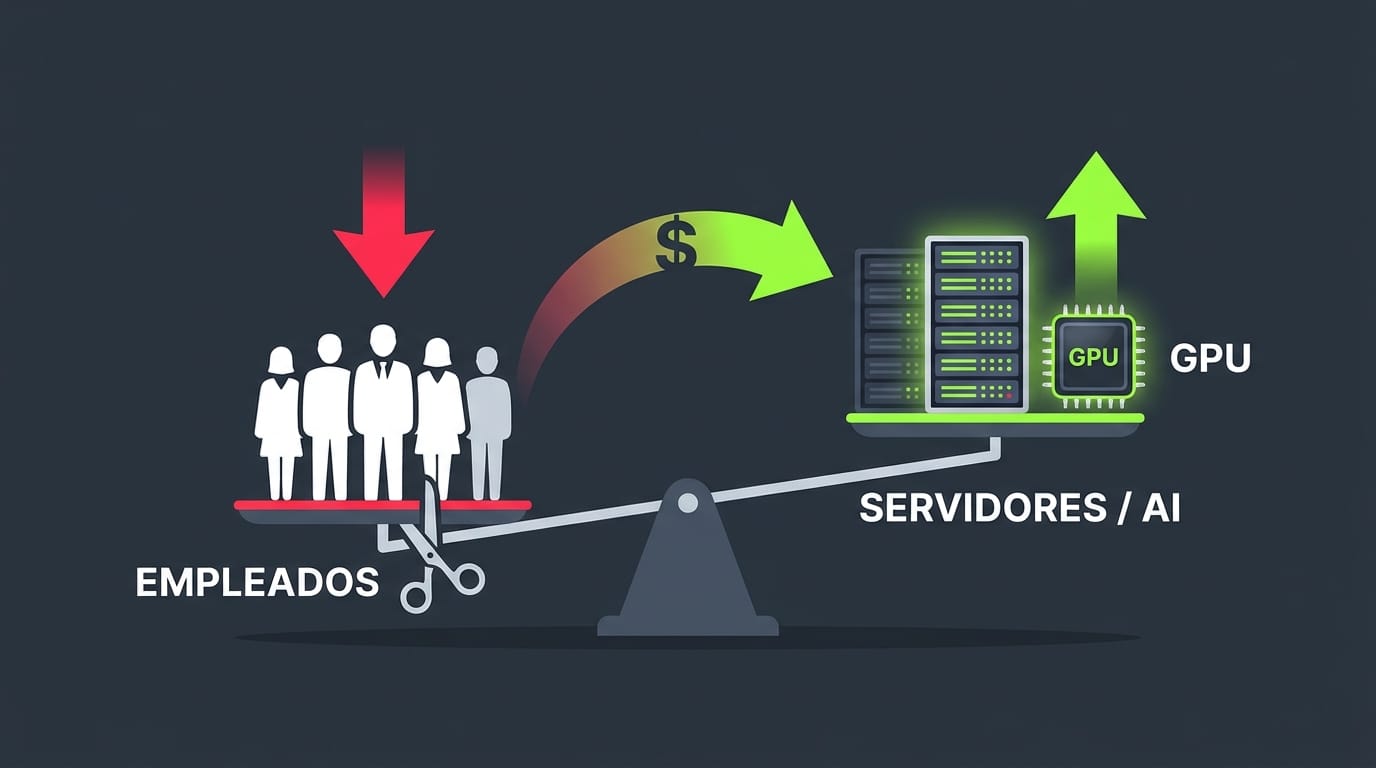
2D conceptual infographic: Big Tech's financial balance scale. Human headcount is liquidated as an immediate budget adjustment variable to fund the vertical surge in server racks and AI GPU chips.
The Infrastructure Remedy: Escaping the Hyperscaler Quagmire
This reality check carries an urgent operational warning for every CTO, CFO, and systems architect in the traditional enterprise.
If the world's wealthiest technology conglomerates—companies pulling in dozens of billions in pure profit every quarter—are suffocating under the physical CapEx demands of frontier AI and sacrificing a quarter of their workforce to pay their electricity and chip bills, what do you imagine will happen to your balance sheet if your entire digital roadmap depends on their proprietary third-party APIs?
They are currently selling inference at subsidized rates to lock you into their ecosystem, while desperately attempting to pass their astronomical infrastructure overhead onto your monthly cloud bill. The moment those subsidies dry up, that API invoice will incinerate your margins.
The sustainable engineering path forward does not lie in feeding $190 billion server complexes:
- Targeted Small Language Models (SLMs): Ninety percent of enterprise use cases do not require a trillion-parameter monolithic model. They are resolved with superior accuracy and deterministic latency by 7B or 8B parameter models that are distilled, fine-tuned, and quantized.
- Sovereign, Localized Infrastructure: Hosting lightweight models on private servers, dedicated edge instances, or controlled on-premise hardware provides fixed, predictable unit economics, guarantees data sovereignty, and eliminates network latency.
- Engineering Rigor Over Brute Force: Well-indexed relational schemas, optimized query pipelines, and clean software architecture are orders of magnitude cheaper, faster, and more resilient than mindlessly hurling millions of tokens at an unoptimized LLM to paper over technical debt.
Stop buying into the marketing myth of algorithmic transcendence. Big Tech’s layoffs are not a demonstration of superhuman machine intelligence; they are a balance-sheet emergency caused by an unsustainable hardware bill.
And in that financial game of musical chairs, if you do not understand the physical plumbing of hardware, the silicon will always take your seat.
References and Verified Sources
- Microsoft Investor Relations (FY24 / FY25 Guidance): Form 10-K & Quarterly Financial Releases — Official disclosures verifying $36.6 billion in net profit alongside accelerated CapEx allocation toward cloud AI infrastructure.
- Inc. Magazine & Financial Times: Big Tech's Great Reallocation: 60,000 Reductions and the $190B Data Center Surge — Forensic investigation into workforce reductions alongside forward-looking capital deployment of $190 billion in physical compute centers.
- Seeking Alpha / Wall Street Tech Analysis: The AI CapEx Reality: Replacing Payroll with GPUs — Analysis on tech giants sacrificing operating payroll to preserve free cash flow margins while funding multi-billion-dollar hardware acquisitions.
- Semiconductor Industry Association (SIA): State of the Global Semiconductor and AI Hardware Market — Benchmarks detailing power draw per rack, thermal dissipation constraints, and the capital amortization cycle of modern accelerator clusters.
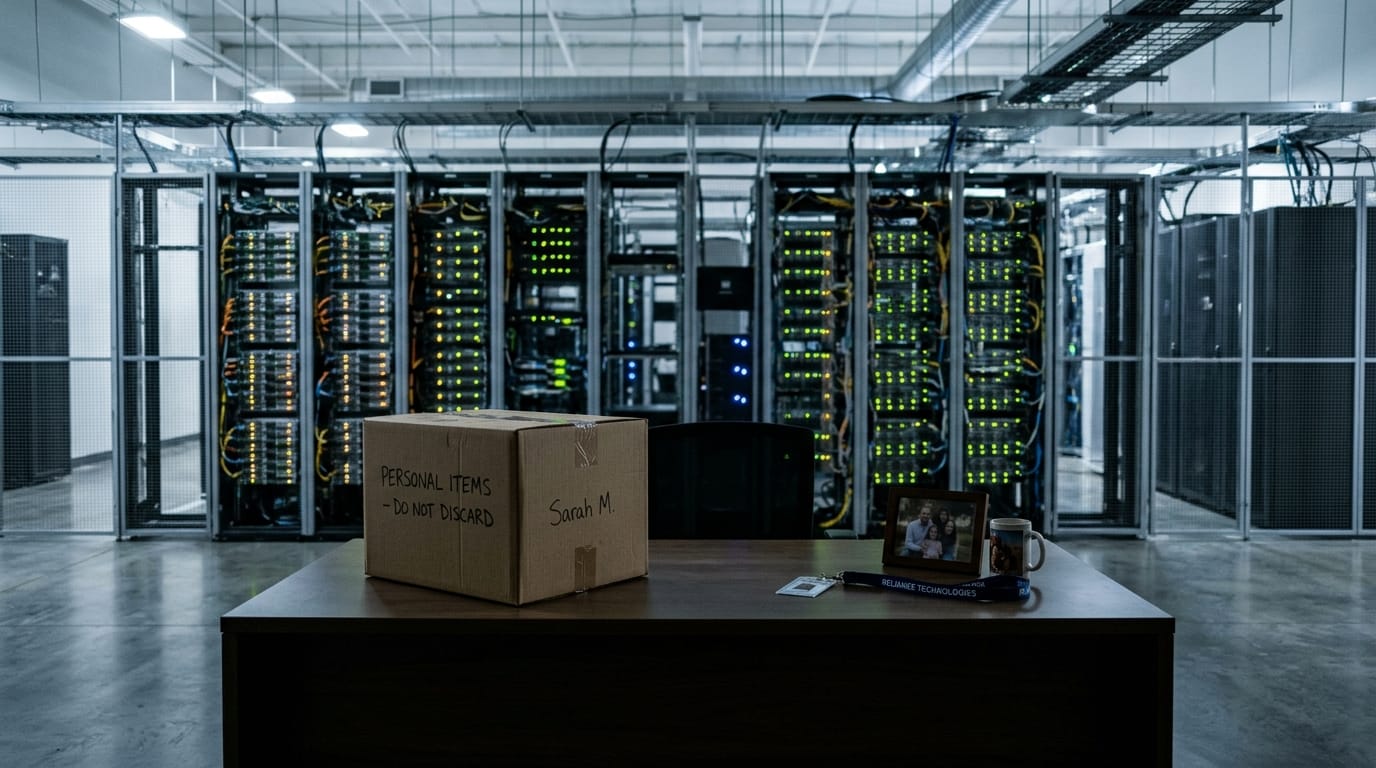
Visual Credits: Cover by Syncroma Studio (hyper-realistic industrial photography: Massive cold data center vs. Vacant workstation). Body: Minimalist 2D conceptual infographic by Syncroma Studio.
Sistemas reales, sin humo corporativo Real systems, zero corporate hype
Recibe los análisis a fondo sobre arquitectura, consumo de recursos y computación de bajo nivel directamente en tu bandeja de entrada. Get deep-dive software architecture, resource consumption metrics, and low-level computing essays delivered straight to your inbox.
Suscribirse a Syncroma Subscribe to Syncroma

