
(🇪🇸 Leer la versión en español aquí)
Anyone who has copied a big ISO or backup onto a cheap USB thumb drive on Linux knows the trap: Dolphin's progress bar rockets straight to 99% or 100% in three seconds, fires a "Transfer complete" notification… and then leaves your desktop dangling for two minutes while the kernel slowly drains gigabytes of dirty RAM pages over a sluggish USB controller. Worse, if you clicked Move instead of Copy—or unplugged the stick right when the UI claimed victory—you risked silently deleting the source files before blocks ever reached physical flash.
With KDE Frameworks 6.32—tracked in the KDE Frameworks 6 release announcements and highlighted by Linuxiac—that infamous Bug #281270 (originally filed against KDE 4.7 back in September 2011) is finally squashed.
Why KIO Kept Lying for 15 Years: Page Cache Illusion
As KDE developer Méven Car details in his deep dive on KDE Blogs, the culprit was classic POSIX buffered I/O semantics colliding with user expectations:
write()succeeds in RAM, not on flash: Whenever KIO pushes bytes via standardwrite(), Linux copies them into the OS page cache in free memory and returns success almost instantaneously. KIO dutifully incremented its progress counter as if the USB drive had already written them.- Lethal race on "Move" operations: Because dirty pages sat un-flushed in RAM for tens of seconds on slow USB drives and network mounts, KIO assumed the copy was done and deleted the original file—leaving data vulnerable to unplug corruption or power loss.
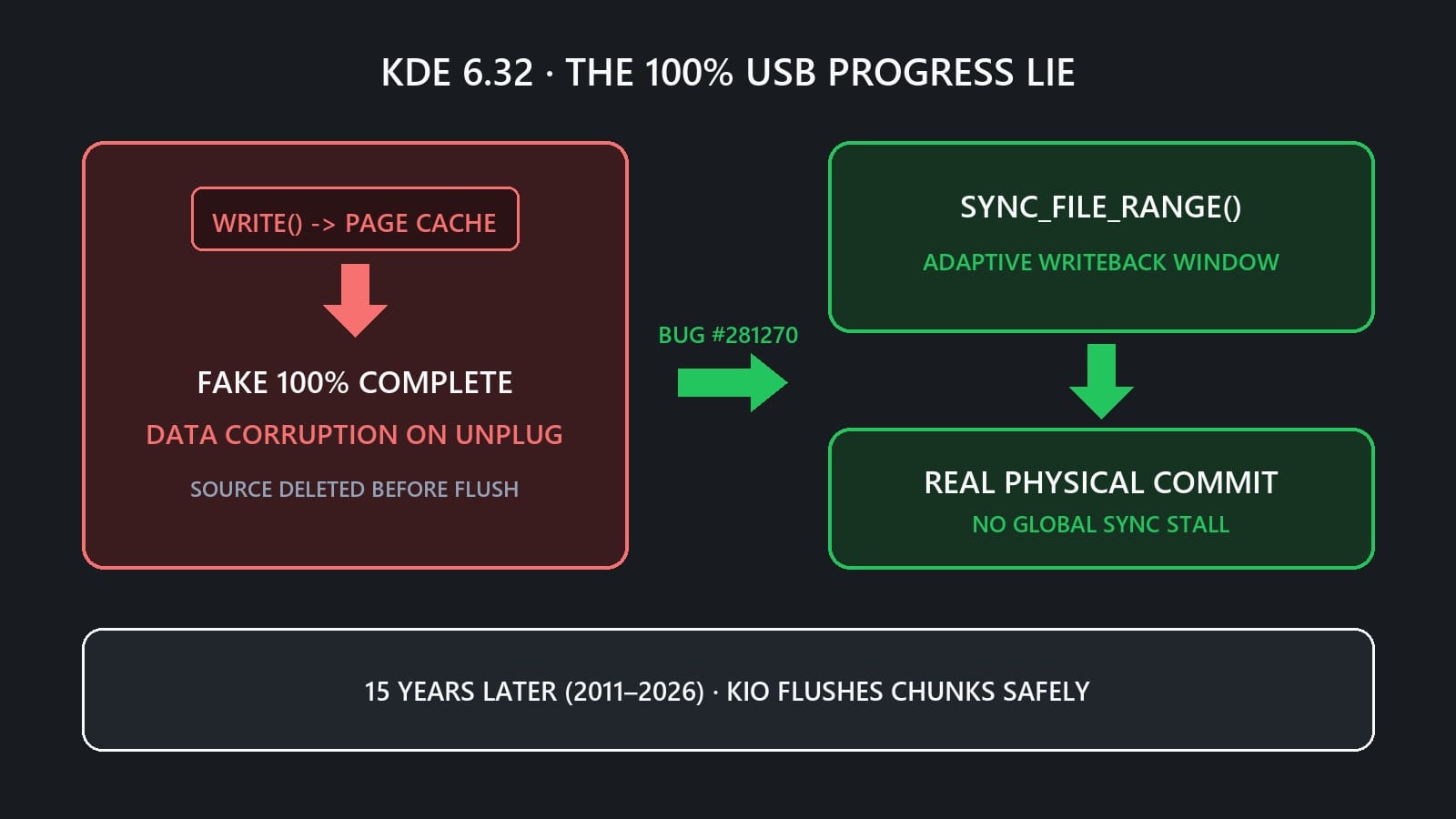
The Fix: sync_file_range() With an Adaptive Writeback Window
Linux kernel veteran Alan Stern actually pointed out the right syscall—sync_file_range()—just weeks after Bug #281270 was opened in 2011. Yet shipping it took fifteen years because naive sync() or coarse fsync() calls kill sequential throughput and lock up desktop responsiveness.
| File Transfer Behavior in KIO | Legacy Path (2011–2026) | KDE Frameworks 6.32 (Nov 2026) | Practical Impact |
|---|---|---|---|
| Syscall strategy | Buffered write() into page cache |
Granular sync_file_range() per chunk |
Avoids stalling entire filesystems |
| Writeback pacing | Unbounded dirty memory buildup | Adaptive writeback window + helper thread | Keeps copying next window while flushing previous |
| UI progress accuracy | Races to 100% then freezes | Tracks physical storage commit | Honest ETA and completion prompt |
| Move / unplug safety | Source deleted before flash commit | Source kept until safe flush | Prevents silent truncation & loss |
By pairing an adaptive writeback window with a dedicated background helper thread running sync_file_range(), KIO overlaps writing the next window while flushing the prior one—preserving fast NVMe and USB 3 throughput while guaranteeing the progress bar never lies on slow flash sticks or SMB/NFS shares.
Lessons for Production Storage & Backups
- Never treat a desktop file-manager completion toast as cryptographic verification: When staging OS images, cold backups, or firmware packages to external media, re-mount and verify hashes locally afterward with Syncroma's Private SHA-256 & HMAC File Checksum Verifier.
- Don't confuse OS RAM write buffering with sustained drive IOPS: Just as Linux page cache masks a slow $5 USB stick behind multi-GB/s initial bursts, QLC caches and RAID write-holes mask real disk saturation. Model sustained write penalties in Syncroma's RAID & ZFS IOPS Calculator or evaluate self-hosted storage costs in our Cloud vs Home NAS TCO Calculator.
Engineering Verdict
Méven Car's fix in KDE Frameworks 6.32 is a reminder of why low-level Linux desktop bugs sometimes survive 15 years: taming Linux page cache semantics without wrecking NVMe throughput requires real systems plumbing. Using sync_file_range() with adaptive writeback windows finally kills one of the oldest data-loss footguns on Linux desktops.
Infographics created by Syncroma Studio. Cover photo: Wikimedia Commons (CC BY-SA) (editorial crop).

Sistemas reales, sin humo corporativo Real systems, zero corporate hype
Recibe los análisis a fondo sobre arquitectura, consumo de recursos y computación de bajo nivel directamente en tu bandeja de entrada. Get deep-dive software architecture, resource consumption metrics, and low-level computing essays delivered straight to your inbox.
Suscribirse a Syncroma Subscribe to Syncroma

