
(🇪🇸 Leer la versión en español aquí)
When you install a free-to-play iPhone puzzle game or grab a casual title on Steam, you expect banner ads or microtransactions. You do not expect a quiet "minor bug fixes and improvements" patch to turn your phone or home fiber router into a commercial exit node for third-party web traffic.
Research published by threat-intelligence firm Spur Intelligence—and detailed by security outlets—exposed an ecosystem of free iPhone apps, Steam desktop games, and Chrome extensions linked to Lithuania-based publisher Appsalt (Beellet UAB in Vilnius) routing external customer traffic through consumer devices without transparent consent (CyberInsider).
Buying Existing Apps for $7,000, Then Slipping In a Proxy SDK
Instead of publishing fresh apps from scratch that trigger heightened store scrutiny, the operation relied on acquiring established software with built-in installs:
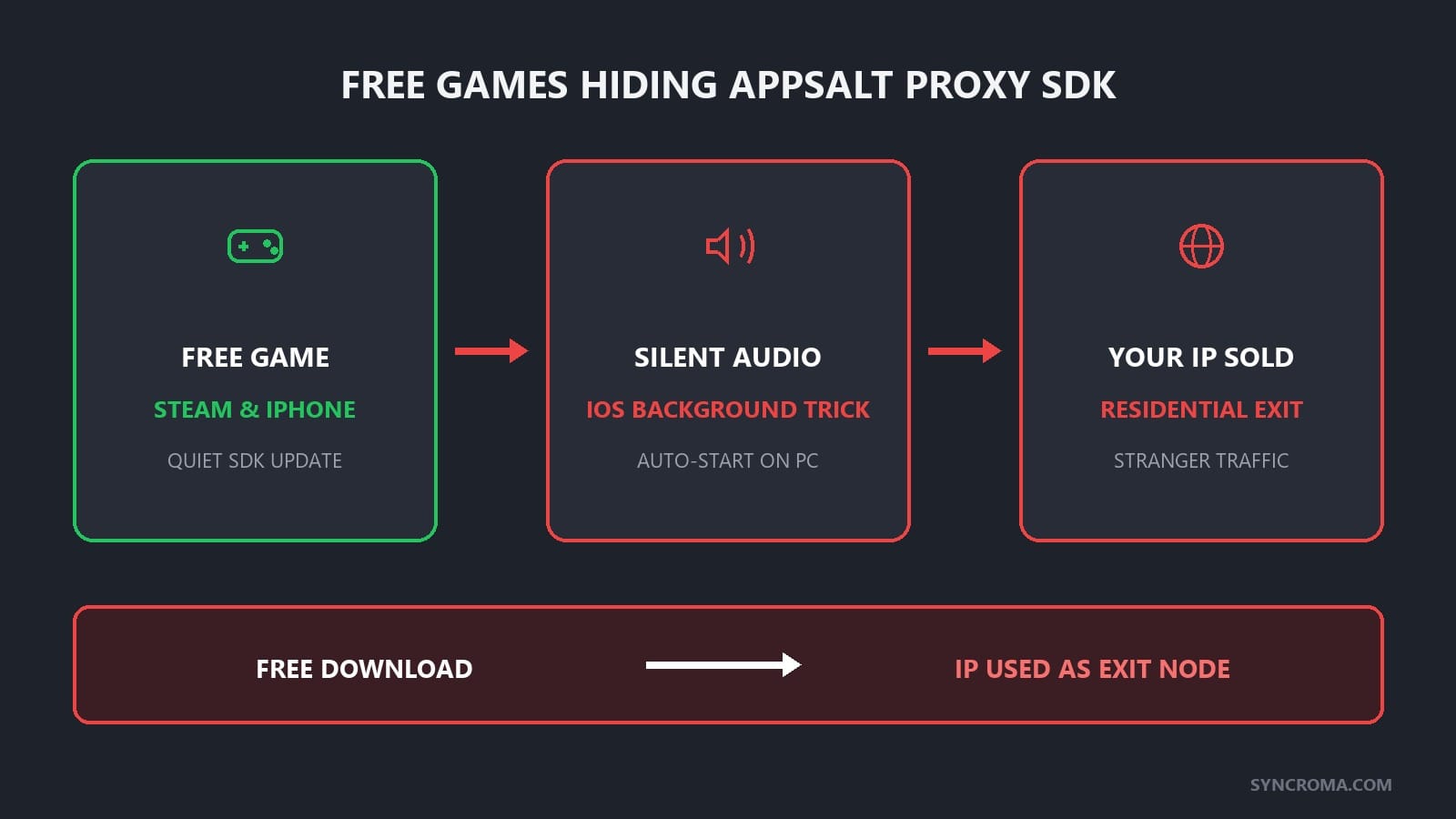
- The stealth update playbook: According to Spur, Couples Game had already amassed nearly 29,000 downloads before Beellet acquired it for roughly $7,000. Its very first update under the new owner in March 2026 bundled the proxy SDK under generic release notes promising minor fixes and improvements (CyberInsider).
- Silent audio keeping iOS awake: Mobile operating systems aggressively freeze background sockets. Across all 12 iPhone apps Spur examined containing Appsalt's SDK, 11 embedded a silent audio file and declared background audio permissions, while 10 Unity-based games actively looped that silent track whenever users switched away to keep the proxy alive (CyberInsider, Apple App Store Guidelines). Not one of those 12 App Store privacy labels disclosed bandwidth sharing.
- Steam tray persistence & deceptive Chrome extensions: On desktop, Spur spotted the SDK inside Steam builds of Wattverse and Farm Story Life, which lingered in the system tray or menu bar after closing and registered Windows startup on login when users accepted defaults. Worse, Appsalt's Picture-in-Picture Extension (
v0.2.0) shipped code harvesting browsing history, open tabs, Google Search results (including AI Overviews), and ChatGPT conversations before swapping two days later (v0.4.0) to a Node Pointer SDK browser proxy—while MP3 Cut left the proxy enabled even when users closed the consent prompt (CyberInsider).
Following the Traffic: Honeygain’s 8.3M-IP Network and Partner Takedown
By correlating SDK code, developer documentation, and backend infrastructure, Spur linked Appsalt's proxy stack to Honeygain, a subsidiary of commercial proxy vendor Oxylabs—across a broader observed network of roughly 8.3 million Oxylabs exit IPs, though researchers could not confirm the exact share contributed by Appsalt (CyberInsider).
Following disclosure, Honeygain issued an official misuse statement confirming it had disabled the offending partner's integration, cut off infrastructure access, and tightened periodic consent audits across all third-party SDK integrations (Honeygain SDK Statement).
| Affected Vector | Hidden Mechanism Observed | Real Cost to End Users | Actionable Mitigation |
|---|---|---|---|
| 12 iOS apps (10 Unity builds) | Silent audio loop + background mode without privacy label disclosure. | Silent battery drain, cellular quota burn, and exposed mobile IP. | Uninstall suspect free apps and check per-app background network stats. |
| Steam (Wattverse, Farm Story Life) | Menu-bar/system-tray persistence + Windows login auto-start entry. | Home ISP fiber serves commercial proxy requests whenever PC boots. | Audit OS startup entries cleanly and remove unwanted game binaries. |
| Streaming apps (Cinema HQ) | Starts Appsalt and EarnFM even when "Share Resources" (Hopmn) is toggled off. | UI toggle gives false illusion of opt-out control. | Remove the app and verify IP status via Have I Been Proxied. |
| Chrome extensions (PiP, MP3 Cut) | Scraped history/ChatGPT in 0.2.0; pre-enabled consent traps in 0.4.0. |
AI prompt leakage followed by silent browser proxy routing. | Purge unnecessary extensions and rotate exposed credentials (Password Auditor). |
Why End Users Absorb All the Operational Risk
From an infrastructure standpoint, covert proxy SDKs create an asymmetric liability dump: the SDK broker monetizes "clean residential IPs" per gigabyte while the consumer carries every operational side effect:
- Burned IP reputation: To any bank WAF, e-commerce anti-bot filter, or streaming gatekeeper, third-party scraping looks like it comes straight from your home router. You inherit permanent CAPTCHAs and quiet account locks.
- NAT table exhaustion & modem battery tax: Maintaining persistent proxy channels on iOS forces continuous cellular baseband wakeups while blowing through open connection slots on cheap ISP consumer routers.
- Store review blind spots: Automated static checks flagged neither a legitimate-looking iOS media-playback API misused as a keep-alive hack nor post-acquisition silent updates.
You can check right now whether your current public IP appears in commercial residential proxy pools using Spur's free lookup tool at Have I Been Proxied. And if you operate public APIs or edge caches trying to absorb sudden scraper floods from hijacked residential subnets, model your cache memory headroom and hit-ratio impact cleanly with our new Redis & Valkey Memory RAM Sizer. When a free app runs silent audio in the background without playing a sound, you aren't the customer—your router is.
Visual credits: Syncroma Studio (technical infographic). Cover photograph: Liam Dawe — Comparison of Steam Deck and ASUS Vivobook S15 via Wikimedia Commons (CC BY-SA 4.0).

Sistemas reales, sin humo corporativo Real systems, zero corporate hype
Recibe los análisis a fondo sobre arquitectura, consumo de recursos y computación de bajo nivel directamente en tu bandeja de entrada. Get deep-dive software architecture, resource consumption metrics, and low-level computing essays delivered straight to your inbox.
Suscribirse a Syncroma Subscribe to Syncroma

