(🇪🇸 Leer la versión en español aquí)
Managed-memory languages are supposed to shield production servers from classic buffer overflows—until handwritten assembly sneaks back into the runtime for a throughput win. Today, November 17, 2026, the U.S. Cybersecurity and Infrastructure Security Agency (CISA) issued an emergency patching advisory for CVE-2026-114938, quickly dubbed Java4Shell (CVSS v4.0 9.2 Critical).
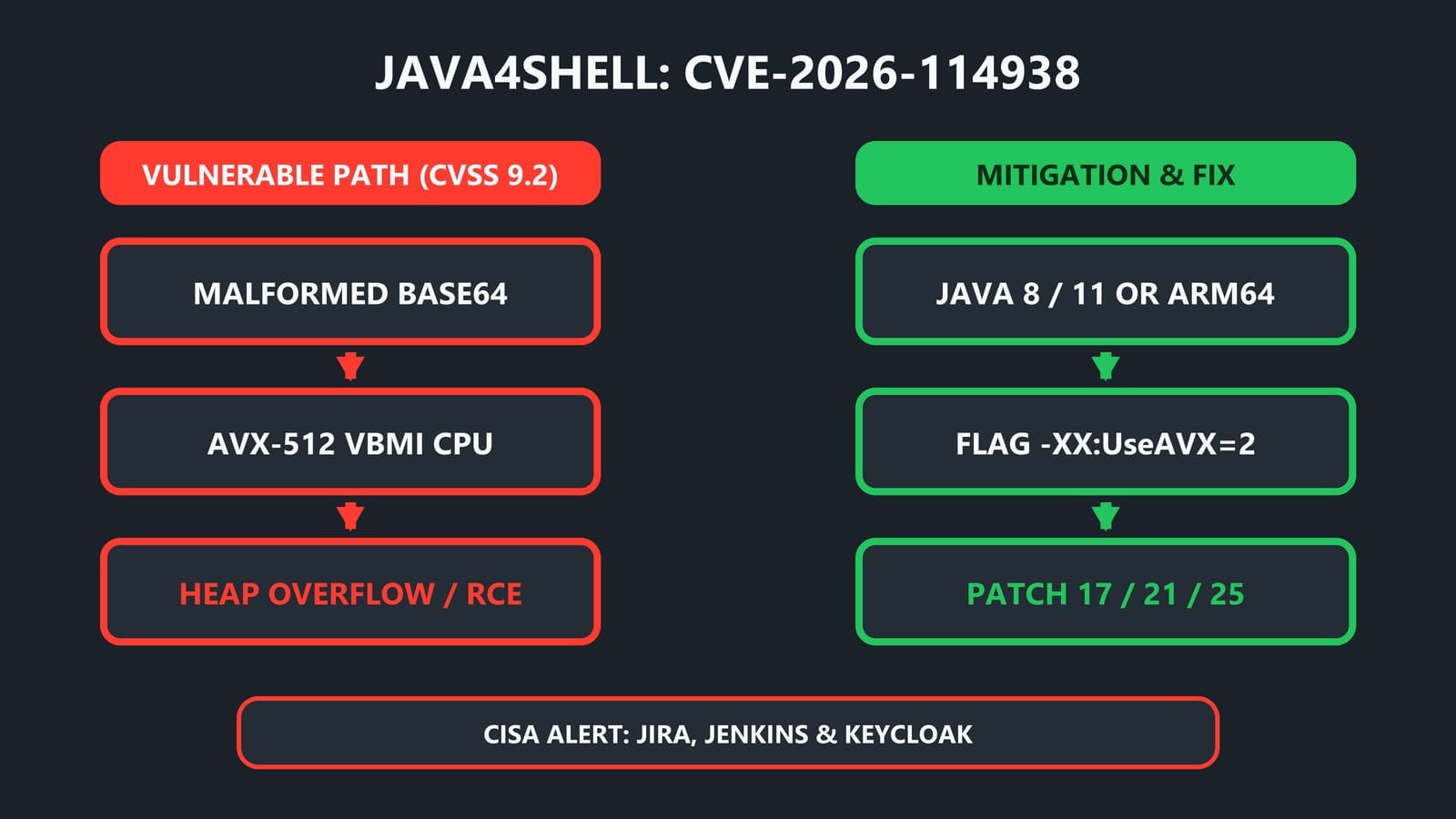
Why the immediate scramble across SRE and platform teams? Base64 decoding sits right at the unauthenticated front door of modern enterprise infrastructure—HTTP Basic authentication headers, JWT payloads, cookies, and file upload parsers. Feeding a specially crafted invalid Base64 payload to vulnerable x86-64 JVMs triggers a heap out-of-bounds write capable of crashing processes or enabling unauthenticated Remote Code Execution (RCE) across flagship platforms like Atlassian Jira, Confluence, Jenkins, Keycloak, JFrog Artifactory, and PingFederate.
Inside the AVX-512 VBMI Heap Corruption
As documented today by Datadog Security Labs, Qualys Threat Research, and The Hacker News, the flaw lives inside OpenJDK's HotSpot intrinsic assembly accelerating Base64 decoding via AVX-512 VBMI (Vector Byte Manipulation Instructions). Under malformed input patterns, the vectorized loop writes bytes past buffer boundaries on the Java heap before validation aborts.
Crucially, not every Java host is exposed—you must intersect runtime version and CPU silicon:
| Deployment Profile | Exposed to CVE-2026-114938? | Exact Silicon / Runtime Reason |
|---|---|---|
| Java 17.0.6+ / 21 / 25 on modern x86-64 | Yes (Critical) | Hits Intel Xeon (Ice Lake through Granite Rapids) & AMD EPYC (Zen 4+) with AVX-512 VBMI |
| Legacy Java 8 or Java 11 | No | Older LTS releases lack this AVX-512 VBMI Base64 intrinsic path |
| ARM64 hosts (AWS Graviton, Ampere, Apple Silicon) | No | Completely different instruction set; x86 assembly path is absent |
| Internet-facing targets cited in advisories | High blast radius | Jira, Confluence, Jenkins, Keycloak, JFrog Artifactory, PingFederate |
How to Patch or Mitigate Safely (Watch Out for ARM64 Footguns)
Cross-referencing Red Hat's security advisory (RHSB-2026-018) and vendor patches shipped November 17, 2026, act across two tracks:
- Upgrade JDK/JRE container base images immediately: Pull the emergency fixes shipped today: Java 17 (
17.0.21.1+4), Java 21 (21.0.13.1+4), Java 25 (25.0.5.1), or Java 27 (27.0.1.1). Scan third-party vendor containers carefully, because appliances frequently ship private bundled JREs outside OS package managers. - Emergency JVM flag (
-XX:UseAVX=2) if patching waits: If full image rebuilds cannot roll out immediately, forcingUseAVX=2disables the vulnerable AVX-512 VBMI code path in seconds.- CRITICAL PRODUCTION WARNING: Apply
-XX:UseAVX=2only on x86-64 pods/hosts. If you drop-XX:UseAVX=2into a shared Helm chart orJAVA_TOOL_OPTIONSacross a mixed-architecture Kubernetes cluster scheduling ARM64 (Graviton) nodes, ARM64 JVMs reject the unrecognized x86 flag and fail startup immediately (CrashLoopBackOff).
- CRITICAL PRODUCTION WARNING: Apply
While auditing suspicious JWT or Base64 auth headers in reverse-proxy logs, decode tokens safely without leaking secrets using our Private Offline JWT Decoder & WebCrypto Verifier, and verify node placement across mixed-arch clusters with our Kubernetes Bin-Packing Calculator.
Bottom Line
Java4Shell (CVE-2026-114938) is a stark reminder that low-level SIMD assembly shortcuts reintroduce raw heap memory corruption into otherwise memory-safe runtimes. If you run Java 17, 21, or 25 anywhere near modern Intel Xeon or AMD EPYC CPUs on internet-facing auth, CI/CD, or ticketing tools, patch the JDK today—and don't blindly blast -XX:UseAVX=2 onto ARM64 containers.
Technical analysis infographics by Syncroma Studio. Editorial cover photograph via Wikimedia Commons (Håkan Dahlström, CC BY 2.0).

Sistemas reales, sin humo corporativo Real systems, zero corporate hype
Recibe los análisis a fondo sobre arquitectura, consumo de recursos y computación de bajo nivel directamente en tu bandeja de entrada. Get deep-dive software architecture, resource consumption metrics, and low-level computing essays delivered straight to your inbox.
Suscribirse a Syncroma Subscribe to Syncroma

