(🇪🇸 Leer la versión en español aquí)
Every few weeks, LinkedIn feeds fill up with claims that autonomous AI agents just made security engineers obsolete. Strip away the breathless keynotes and look closely at the telemetry in OpenAI's "A thousand fewer paths to root" alongside the GPT-6 Cyber announcement: the disruption isn't magical bug-free code—it's brute-force exploit economics slamming straight into human patch triage.
In an automated 30-hour run against the Linux kernel master branch (followed by a 10-day manual analysis pass), OpenAI's multi-agent pipeline burned $1,213,430 in API credits to surface 2,308 candidate bugs, dynamically reproduce 1,724 flaws inside sandboxed VMs, and synthesize 948 distinct working local privilege escalation (LPE) root exploits plus 291 info-leak PoCs, as reported by SecurityWeek and MLQ.ai.
$1,279 per Kernel Root Shell Breaks Bug Bounty Math
From a pure infrastructure and defense-economics standpoint, the delta over earlier models is stark. Back in July 2026, running the same harness on GPT-5.6 Sol produced 166 unique LPE exploits for roughly $513,690. GPT-6 Cyber nearly sextupled that output to 948 working root exploits, dropping marginal cost to roughly $1,279 per working kernel LPE.
| Evaluation Run / Environment | Reproduced Bugs | Working LPE Root Exploits | Token Burn / Market Benchmark | Primary Source |
|---|---|---|---|---|
GPT-5.6 Sol (Linux master, Jul 2026) |
N/A | 166 unique LPEs | ~$513,690 API cost | OpenAI |
| GPT-6 Cyber (Linux standard VM, Nov 2026) | 1,724 (of 2,308 cand.) | 948 LPEs + 291 info leaks | $1,213,430 (~$1,279/exploit) | SecurityWeek |
GPT-6 Cyber vs. hardened kernelCTF |
N/A | 21 LPEs + 25 info leaks | vs. 26 accepted 2026 zero-days | MLQ.ai |
| Mozilla Firefox parallel campaign | 81 high-severity | Validated w/ Mozilla | AI-assisted patch verification | OpenAI |
As The Hacker News highlighted, single Linux kernel LPEs at Pwn2Own or TyphoonPWN regularly command $20,000 to $70,000. Once automated token burn can reliably turn unprivileged local access into root for under $1,300—including 10 novel exploitation primitives researchers had not catalogued before—relying on obscurity around forgotten legacy subsystems is dead.
948 Exploits Enter the Funnel, 61 Patches Exit
Here is the production reality check every engineering lead needs to read before assuming frontier models magically secure upstream open source. Once OpenAI wrapped up its 10-day triage sprint, it had disclosed 304 critical findings with candidate AI patches to Linux maintainers.
How many had actually landed upstream by report publication? 61. Another 43 sat in staging queues, while 299 remained mired in public review threads.
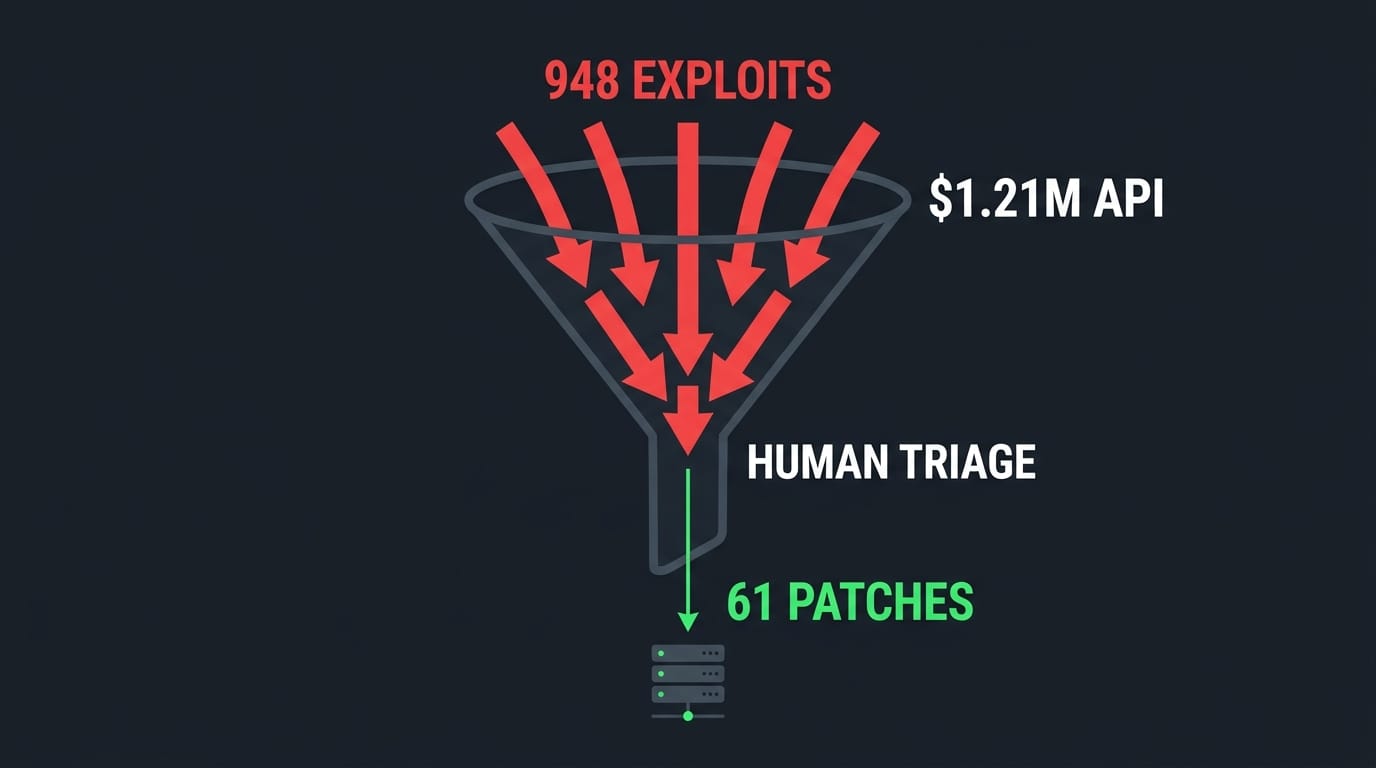
Spinning up VMs to confirm a crash takes cheap parallel compute. Verifying that an AI-generated C diff does not introduce a subtle RCU race condition, lock inversion, or userspace ABI regression still bottlenecks directly on overworked volunteer and corporate kernel maintainers. Security discovery scaled 6x; patch review throughput did not.
Why Hardening (kernelCTF) Cut the Blast Radius by 97%
Read the fine print in MLQ.ai carefully: 948 LPEs were verified inside desktop-style test VMs (even with KASLR, SMEP, and SMAP enabled), not zero-click remote server takeovers.
When OpenAI aimed the exact same $1.21M pipeline at Google's hardened kernelCTF environment, output dropped from 948 LPEs down to 21 working LPEs and 25 info leaks.
The operational takeaway for infrastructure teams is straightforward:
- Automated exploit synthesis is now cheap enough for scale: legacy kernel attack surfaces that assumed high reverse-engineering labor cost are exposed.
- Isolation beats reactive patching: tight
seccompfilters, stripped capabilities, restricting unprivileged user namespaces, and hardened kernel builds cut viable exploit paths from 948 down to 21. - Know your compute bill: whether you are budgeting defensive agent loops or evaluating inference costs, run real numbers with our Cloud API vs. Dedicated GPU Calculator or browse Syncroma Tools.
Cover photography and localized infographics created by Syncroma Studio.
Sistemas reales, sin humo corporativo Real systems, zero corporate hype
Recibe los análisis a fondo sobre arquitectura, consumo de recursos y computación de bajo nivel directamente en tu bandeja de entrada. Get deep-dive software architecture, resource consumption metrics, and low-level computing essays delivered straight to your inbox.
Suscribirse a Syncroma Subscribe to Syncroma

