(🇪🇸 Leer la versión en español aquí)
For two years, hyperscaler keynotes pushed one neat story: custom in-house Arm server CPUs would steadily replace traditional x86 sockets across every tier of cloud infrastructure. Then heavily regulated banks, hospital groups, and defense buyers demanded hardware-enforced memory encryption for live AI inference.
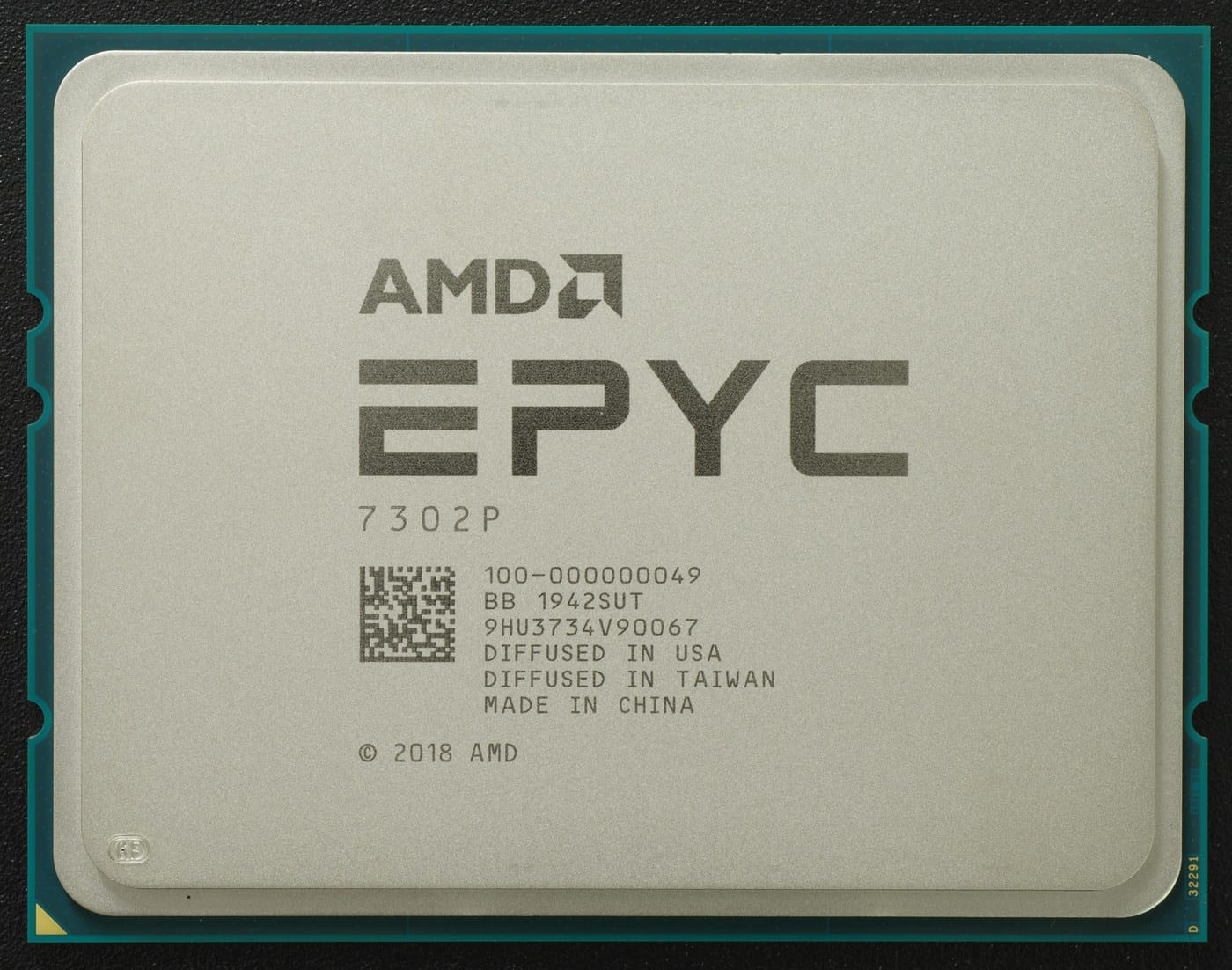
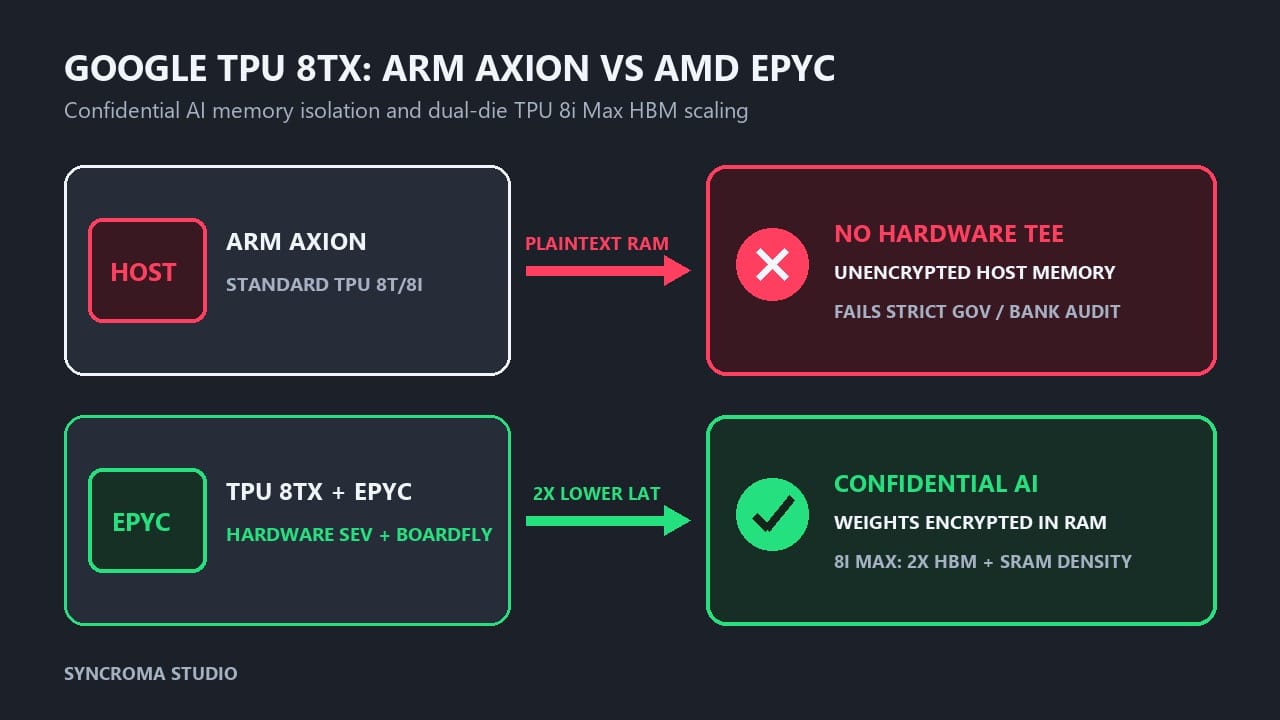
Google Cloud just expanded its eighth-generation TPU lineup — shipping four distinct systems inside a single year — with the new TPU 8tx and TPU 8i Max, documented in Google's official infrastructure announcement, AMD’s press release, Tom's Hardware, and TechRadar Pro. Underneath the launch spin sits an unmistakable engineering pivot: to ship its first confidential-computing TPU, Google dropped its own custom Arm Axion host chips and turned to 5th-Gen AMD EPYC ("Turin") processors.
Breaking Down TPU 8tx vs TPU 8i Max Across Google’s 8th-Gen Lineup
Alongside April’s TPU 8t (2.7× training speedup vs prior gen) and TPU 8i (80% better inference price-performance), Google now serves nearly 100 external TPU customers — from frontier AI labs and trading firms to retailers and on-prem deployments — with two targeted architectural builds:
| 8th-Gen TPU System | Host Server CPU | Key Packaging / Network Trick | Primary Production Workload |
|---|---|---|---|
TPU 8t (Apr 2026) |
Custom Arm Axion | High-goodput training silicon (2.7× prior gen) |
Large-scale foundation model pretraining |
TPU 8i (Apr 2026) |
Custom Arm Axion | Low-latency Boardfly network cuts inter-chip delays up to 50% | Real-time reasoning & interactive chat |
TPU 8tx (Nov 2026) |
5th-Gen AMD EPYC | TPU 8t die + Boardfly network (2× lower latency) + hardware confidential AI |
Banking, healthcare, defense encrypted-in-use AI |
TPU 8i Max (Nov 2026) |
Dual-die 8i package |
Puts two TPU 8i dies on one package: 2× compute, SRAM & HBM bandwidth per rack | Million-token agentic code & long video context |
Modular Packaging Beats Wait-3-Years Silicon Spins
Google’s core engineering point inside its launch post is worth copying regardless of your cloud vendor: neither TPU 8tx nor TPU 8i Max required taping out brand-new logic transistors. Masking a fresh chip takes multi-year fab cycles; co-packaging two 8i dies (TPU 8i Max), mixing 8t accelerator silicon with the fast Boardfly interconnect (2× latency drop with near-zero overhead), and swapping Arm Axion hosts for AMD EPYC confidential computing (SEV) let Google assemble purpose-built systems in months.
At the same time, it exposes an uncomfortable reality for custom-ARM cheerleaders: TLS in transit and KMS keys at rest still leave model weights and user prompts exposed in plaintext host RAM during execution. When regulated buyers demanded audited Trusted Execution Environments (TEEs), Arm Axion wasn't ready to close the deal — AMD EPYC Turin was.
Three Architecture Checks Before Locking Into AI Cluster Contracts
- Memory bandwidth & SRAM dictate agent speed, not peak FP8 TFLOPS: Long-context coding agents choking on KV cache thrash HBM pipelines fast; check your real VRAM footprint with our LLM VRAM & Context Memory Calculator.
- Verify encrypted-in-use SLAs for regulated data: If compliance requires protecting prompts from hypervisor admins, standard multi-tenant endpoints don't cut it — verify confidential GPU/TPU attestation paths explicitly.
- Benchmark TCO before signing multi-year capacity commitments: Run real break-even math using our AI API vs Self-Hosted GPU Cost Calculator and power/cooling envelopes in the GPU Cluster Power, PUE & TCO Calculator.
Conceptual infographic designed by Syncroma Studio. Cover photograph: Smial via Wikimedia Commons (Free Art License / FAL).

Sistemas reales, sin humo corporativo Real systems, zero corporate hype
Recibe los análisis a fondo sobre arquitectura, consumo de recursos y computación de bajo nivel directamente en tu bandeja de entrada. Get deep-dive software architecture, resource consumption metrics, and low-level computing essays delivered straight to your inbox.
Suscribirse a Syncroma Subscribe to Syncroma

