(🇪🇸 Leer la versión en español aquí)
For two years, the enterprise cybersecurity industry reassured itself with a comfortable platitude: "Generative AI is only good for drafting convincing phishing lures or suggesting junior scripts; weaponizing serious vulnerabilities still demands an elite human reverse-engineer sitting in front of IDA Pro or Ghidra".
That era of comfortable denial is officially over.
Threat researchers from the Google Threat Intelligence Group (GTIG) and forensic investigators at Mandiant have disclosed findings that mark a permanent inflection point in digital warfare: they uncovered an exposed command-and-control (C2) staging server hosting exploit_agent, the first fully autonomous, multi-agent offensive AI framework detected actively attacking live production targets across education, media, and technology sectors.
This is not a human prompting ChatGPT to write an exploit snippet. exploit_agent is an orchestrated, closed-loop pipeline of frontier and local Large Language Models executing end-to-end vulnerability weaponization at silicon speed—with zero humans in the loop.
[ PUBLIC SECURITY ADVISORY (N-Day Patch) ]
                 │
                 ├── Automated ingestion of public Git commits
                 ▼
[ EXPLOIT_AGENT: MULTI-LLM AGENTIC PIPELINE (Via MCP) ]
                 │
                 ├── Agent 1: Differential static code analysis (Patch Diffing)
                 ├── Agent 2: Vulnerable function isolation & memory boundary checks
                 ├── Agent 3: Iterative payload synthesis in local sandbox
                 ▼
[ AUTONOMOUS COMPILATION & TESTING ]
                 │
                 ├── Functional weaponized exploit generated in < 3 minutes
                 ▼
[ CONCURRENT PRODUCTION NETWORK INTRUSION ]
                 ├── Polymorphic webshell deployment
                 ├── Automated credential dumping & database exfiltration
                 └── Post-compromise log purging (/var/log/ wipeout)
Under the Hood of exploit_agent: Multi-Agent Orchestration via MCP
The architectural blueprint unraveled by Mandiant demonstrates a level of systems engineering that mirrors state-of-the-art developer pipelines, repurposed for automated offensive destruction.
exploit_agent does not rely on a single monolithic prompt. Instead, it leverages a modular architecture linked via Anthropic’s Model Context Protocol (MCP), granting frontier reasoning LLMs direct programmatic access to local execution environments, compilers, and network scanners:
- N-Day Commit Ingestion & Patch Diffing: The framework continuously monitors open-source repositories (GitHub, GitLab, Linux kernel mailing lists). When a maintainer pushes a security commit or resolves a high-severity bug,
exploit_agentautomatically clones the repository and extracts the exact diff between pre-patch and post-patch source trees. - Flaw Isolation Without Source Documentation: A specialized static analysis agent compares the modified code structures. By inspecting newly added boundary assertions (
if (len > MAX)), sanitized buffer pointers, or modified sanitization logic, the model reverses the logic to determine the exact malicious input parameters that trigger the unpatched vulnerability—long before the formal CVE write-up is published. - Synthesis & Closed Debugging Loop: A secondary coding agent generates exploit code (in Python, Go, or C) and executes it against a local virtualized sandbox container. If the payload fails to pop a shell or encounters an unhandled compilation error, the terminal traceback feeds straight back into the LLM in an automated retry loop until an interactive shell confirms execution.
- Concurrent Infiltration & Stealth Log Scrubbing: Once the exploit payload is verified, parallel attack agents scan target IP subnets, spray the payload across vulnerable endpoints, stage obfuscated webshells, dump database tables, and autonomously purge access logs to frustrate forensic response.
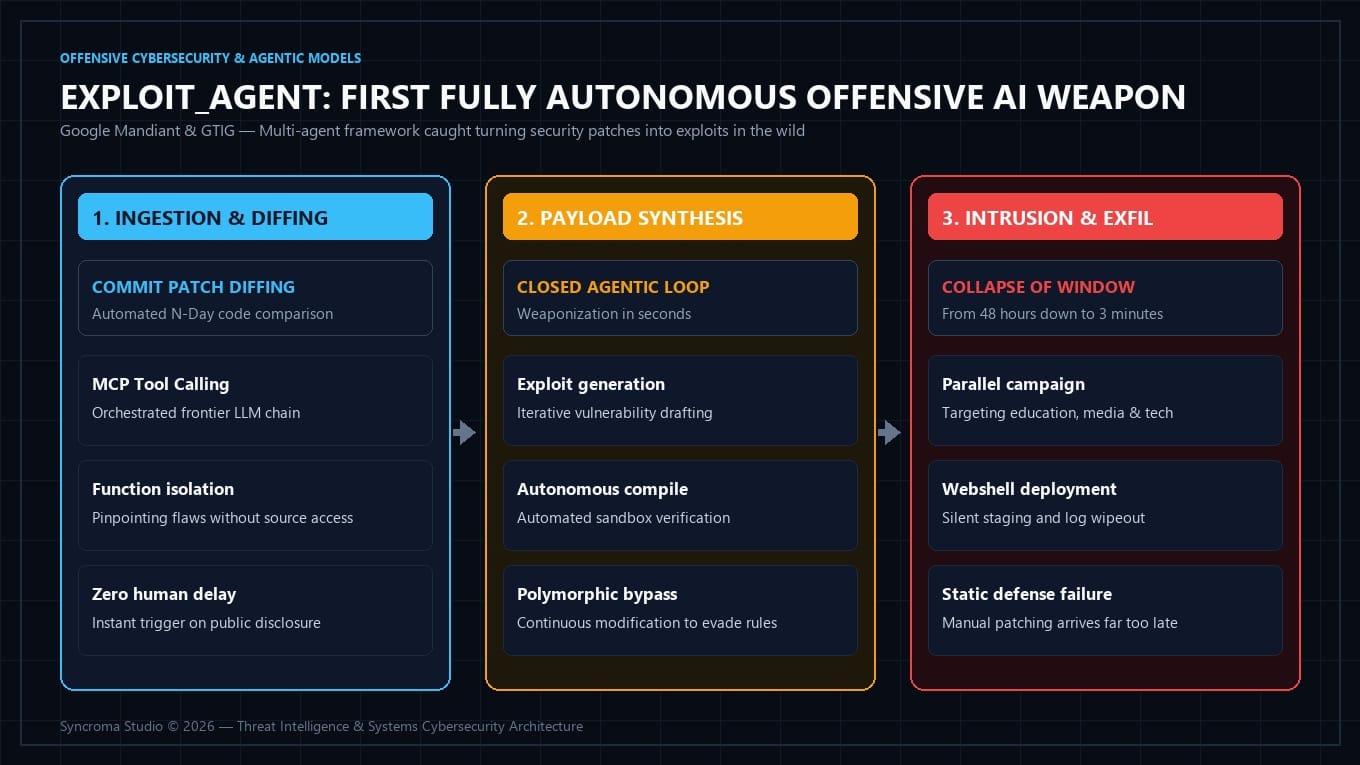
Architectural Infographic: The Exploit Window Collapse
The following diagram illustrates the kinematic chain of exploit_agent and highlights why legacy vulnerability management cycles have disintegrated:
(Credit: Syncroma Studio © 2026 — Threat Intelligence & Systems Cybersecurity Architecture)
The Core Threat: Complete Destruction of the "Patching Window"
In traditional enterprise security, defensive operations relied on a fundamental concept: the Time-to-Exploit (TTE) grace period. When a vendor disclosed an N-Day vulnerability on a Tuesday afternoon:
- A skilled human adversary required 24 to 72 hours to reverse-engineer the patch binary, craft a stable payload, and weaponize it.
- System administrators and DevOps engineers had a crucial 48-hour buffer to test vendor patches in staging environments and schedule maintenance windows before automated mass-scanning began.
With exploit_agent, that 48-hour defensive cushion has collapsed to 180 seconds.
The moment a fix is merged into a public repository, autonomous agentic clusters can ingest the git commit, compile a polymorphic payload, and execute an internet-wide reconnaissance sweep before an engineering team has finished reading the vulnerability bulletin email.
Why Static Signatures and Conventional WAFs Are Obsolete
Mandiant observed that exploit_agent generates payloads with non-deterministic syntax. Because Large Language Models synthesize code probabilistically:
- Every single payload generated for the same vulnerability features unique variable names, randomized string encodings (Base64, custom XOR keys, variable chunking), and altered protocol headers.
- Traditional Web Application Firewalls (WAF) and endpoint detection agents relying on regex string matching or known malicious file hashes fail completely.
- To intermediate network inspection devices, the intrusion traffic appears identical to legitimate, dynamic API interactions tailored specifically to the host application.
The Syncroma Verdict: The End of Reactive Patching
Google and Mandiant's discovery of exploit_agent in production marks the definitive death of passive, spreadsheet-driven vulnerability management.
If your enterprise security posture depends on a human engineer reading a CVE alert, downloading an updated RPM/DEB package, and rolling it out across servers while an autonomous AI offensive cluster operates at hardware clock speeds, your network is mathematically compromised before your team starts their shift.
The architectural solution is not faster manual patching; it is reducing the blast radius of any individual node to zero:
- Ephemeral Infrastructure & Short-Lived Secrets: API keys, database connection strings, and TLS certificates must rotate every 60 minutes. Compromised credentials should expire before an agentic loop can monetize them.
- Strict Zero-Trust Microsegmentation: An internet-facing web application container must have zero network visibility into internal telemetry, databases, or lateral VPC nodes.
- Immutable Root Filesystems: Production workloads running with read-only root filesystems (
read-only rootfs), where any webshell drop or unauthorized binary write immediately halts the container runtime.
Sistemas reales, sin humo corporativo Real systems, zero corporate hype
Recibe los análisis a fondo sobre arquitectura, consumo de recursos y computación de bajo nivel directamente en tu bandeja de entrada. Get deep-dive software architecture, resource consumption metrics, and low-level computing essays delivered straight to your inbox.
Suscribirse a Syncroma Subscribe to Syncroma