
(🇪🇸 Leer la versión en español aquí)
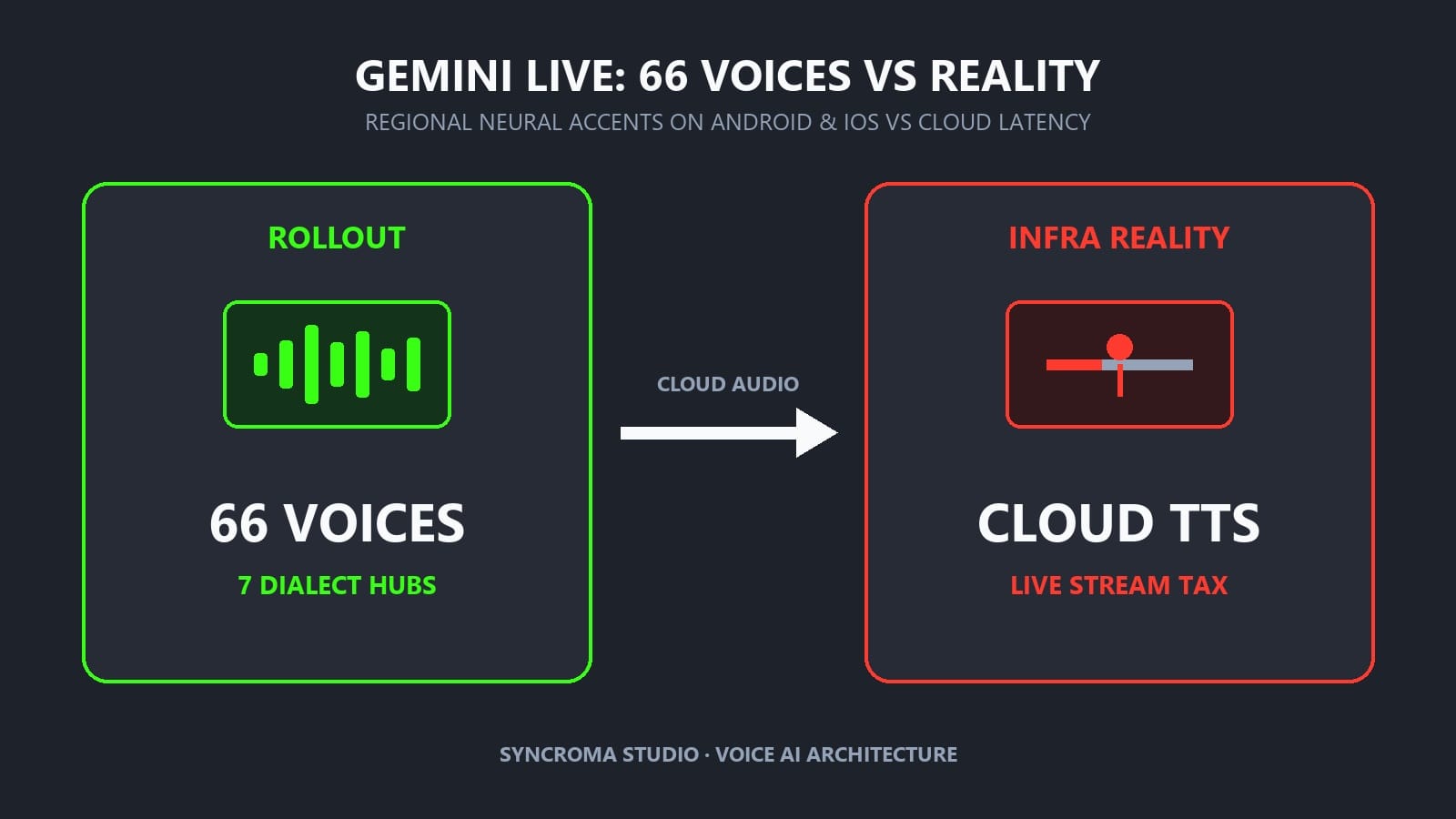
Google just announced on its official Gemini product blog that 66 new regional voices are rolling out across the Gemini app on Android and iOS. Announced by Gemini Live product management director Neel Joshi, the drop replaces the generic sterile assistant cadence with local accents tailored for natural pitch and rhythm across both live Gemini Live voice chats and the Listen read-aloud button.
For mobile users tired of uncanny valley American TTS defaults, it is a welcome quality-of-life tweak. Still, peeling back the rollout list highlights two stubborn engineering trade-offs: major global languages like Spanish got skipped entirely in this drop, and richer dialectal voice prosody keeps mobile users glued to remote cloud inference instead of local offline speech.
What Actually Shipped (and Who Was Left Out)
As detailed in Google's rollout post and dialect breakdown from 9to5Google, the 66 presets span seven language/dialect buckets, leaning heavily into UK regional speech (over 10 British dialects including Scottish, Welsh, Northern Irish, Scouse, Geordie, Brummie, and Multicultural London English):
| Included Language Hub | Gemini Surface | Dialect Coverage |
|---|---|---|
| English (US, UK, India) | Gemini Live + Listen | Over 10 UK accents plus US & Indian regional cadences |
| Hindi | Gemini Live + Listen | Regional voice profiles tuned for natural cadence |
| Brazilian Portuguese | Gemini Live + Listen | Localized options across Brazil |
| Indonesian | Gemini Live + Listen | Native cadence presets selectable in settings |
| Korean | Gemini Live + Listen | Everyday inflection presets via 3-dot voice menu |
| Spanish (Spain & LatAm) | Unchanged in this drop | Zero new regional voices included in wave 1 |
Notice the broader consumer-AI pattern too: just days ago, Spotify pulled the same regional voice localization lever with nine curated DJ voices while quietly adding a button to silence AI chatter altogether.
The Architecture Tax Behind "Natural" Cloud Voices
Delivering expressive regional accents in real-time voice conversations changes the runtime bottleneck completely compared to legacy 30 MB downloaded Android offline TTS packs:
- Tail latency over mobile networks: Real-time prosody adaptation in Gemini Live streams audio frames bidirectionally between handset microphones and remote TPU clusters. Step into a subway tunnel or congested cell tower, and no amount of Scouse or Geordie charm stops audio stalls once RTT spikes past 200 ms.
- Audio token & inference overhead: Native speech generation consumes orders of magnitude more compute per conversation turn than emitting 400 bytes of compressed markdown text. Google treats expressive voices as a retention moat to justify recurring cloud AI subscriptions—if you want to see how multimodal session tokens add up on production budgets, model them in our LLM token cost and prompt caching calculator.
- Cloud mic exposure vs. offline utilities: Voice-first apps encourage casual always-open microphone habits that stream spoken context to vendor servers by default. Compare that with deterministic offline browser math—whether verifying code hashes or projecting a monthly home budget in our new monthly mortgage payment and amortization schedule calculator—where zero user input ever touches a remote cloud endpoint.
Verdict
Rolling out 66 regional Gemini voices is a sharp UX upgrade if you live in the UK, US, India, Brazil, Indonesia, or South Korea and use Gemini Live hands-free. Yet for hundreds of millions of Spanish speakers left empty-handed—and anyone wanting crisp on-device voice synthesis that works instantaneously on airplane mode without round-tripping audio streams to data centers—local hardware independence still takes a back seat to cloud lock-in.
Visual Credit: Cover photo of Google Pixel hardware adapted from "Pixel 9 & Pixel 9 Pro Hands-On Impressions" by ShoAndTech (Wikimedia Commons, CC BY 3.0). Infographic created by Syncroma Studio.

Sistemas reales, sin humo corporativo Real systems, zero corporate hype
Recibe los análisis a fondo sobre arquitectura, consumo de recursos y computación de bajo nivel directamente en tu bandeja de entrada. Get deep-dive software architecture, resource consumption metrics, and low-level computing essays delivered straight to your inbox.
Suscribirse a Syncroma Subscribe to Syncroma

