(🇪🇸 Leer la versión en español aquí)
If your business depends on users discovering your SaaS, store, or engineering docs online, circle November 10, 2026 in red. Within a single afternoon, two separate launches exposed the biggest battle over internet traffic attribution in over a decade.
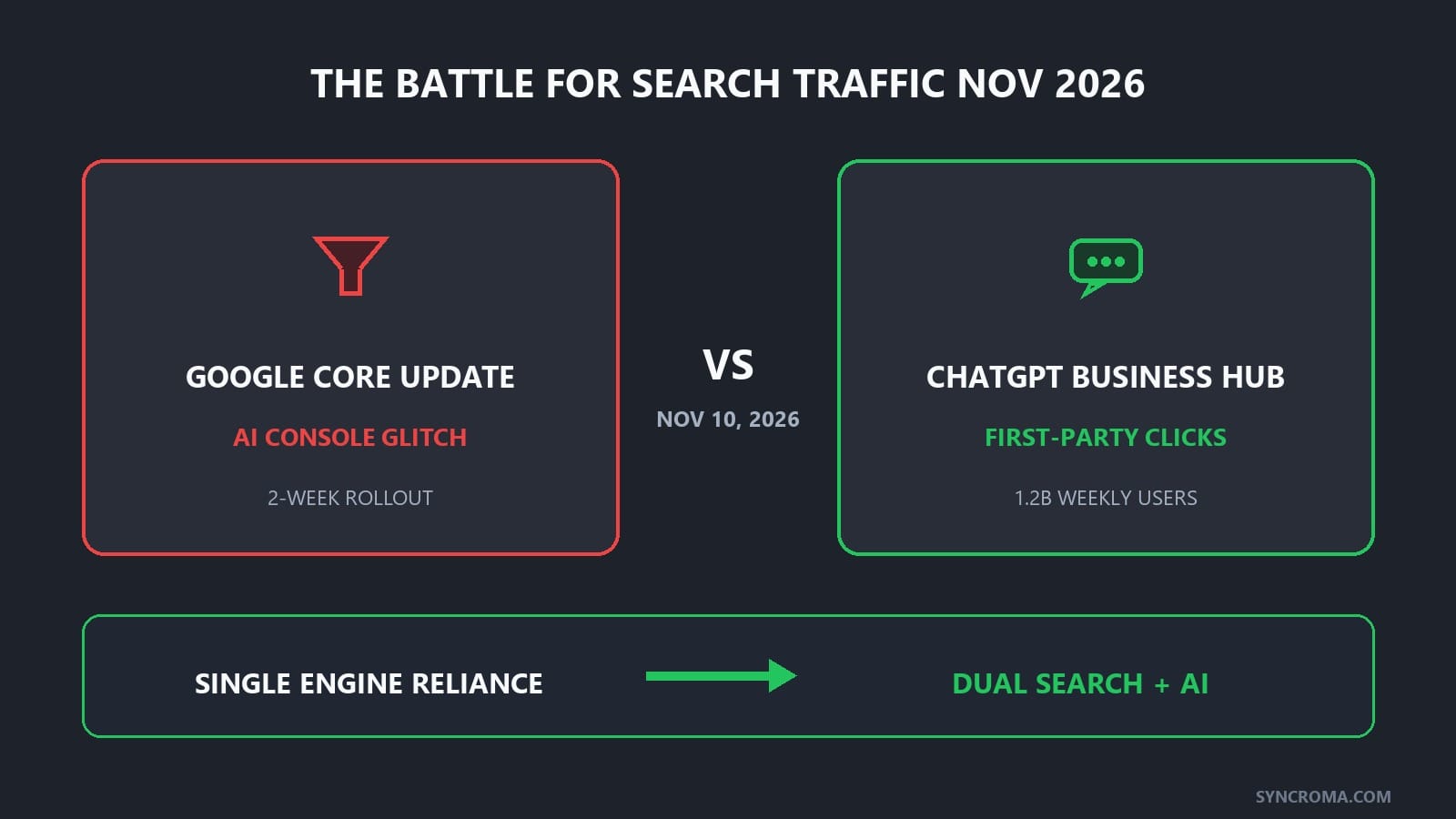
At 18:06 UTC (1:07 pm ET), Google kicked off its global November 2026 Core Update right ahead of Black Friday/Cyber Monday while dealing with a Search Console Generative AI logging bug between November 9 and November 11. Minutes later, OpenAI launched Businesses in ChatGPT (ChatGPT Business Hub) in beta—letting merchants verify domain ownership over DNS, push product feeds, and see first-party website link clicks straight from ChatGPT.
Two Platforms, One Land Grab Over Commercial Intent
For years, publishers and engineering teams complained that AI answers cannibalized clicks without transparency inside Search Console. OpenAI's Tuesday move borrows directly from the exact playbook Google used to lock in local and ecommerce discovery:
| Competitive Dimension | Google Search (Nov 10, 2026) | ChatGPT Business Hub (Nov 10, 2026) | Architecture & Traffic Takeaway |
|---|---|---|---|
| Core Rollout | November 2026 Core Update (WLxcJyC6jMWMfryxsKMc, ~2 weeks) |
Beta launch of Businesses in ChatGPT (chatgpt.com/business-hub) |
Peak ranking turbulence right before Q4 retail spend |
| Reach & Surfaces | Global web, Discover, snippets, and AI experiences | Pitched to connect with 1.2 billion weekly ChatGPT users | OpenAI is explicitly competing as a first-stop discovery channel |
| Telemetry & Attribution | Nov 9–11 AI Performance report logging bug | Insights panel: mentions, views, discovery topics, and clicks | AI answers shift from total black box to measurable referral funnel |
| Merchant Control | Crawled pages & Google core update docs | DNS / phone / Shopify verification + U.S. Business Agents | Structured live feeds beat fragile scraper guesses |
Google's Telemetry Glitch Meets OpenAI's Click Dashboard
According to Search Engine Roundtable's coverage of the November 2026 Core Update, this third major core update of 2026 rolls out across all languages and regions over roughly two weeks, reshaping standard search rankings, Google Discover, and integrated AI surfaces simultaneously. Combined with the unrelated Nov 9–11 Search Console Generative AI logging drop, web teams got a sharp reminder of how opaque single-vendor organic distribution remains.
OpenAI, meanwhile, addressed the exact pain point holding merchants back from feeding structured commercial data into LLMs:
- Verifiable Ownership (DNS, phone, or Shopify): Rather than letting crawlers guess stale pricing from bloated HTML, verified businesses push fresh logos, descriptions, return policies, and live product feeds.
- Real Outbound Click Counts (
website link clicks): OpenAI notes in its tooltip that recorded ChatGPT clicks don't guarantee final site visits or conversions—yet publishing outbound link clicks alongside discovery topics immediately creates an attribution loop teams can actually optimize. - Interactive Business Agents: Launching first for eligible U.S. ecommerce and online service companies (and pluggable into OpenAI Ads Manager campaigns), these custom agents let shoppers ask product comparison and policy questions directly inside chat.
What Engineering & Product Teams Need to Fix Now
Strip away the marketing hype and look strictly at systems design:
- Stop shipping client-side-only pricing and specs: Heavy hydration-dependent SPAs break both Google's core indexing pipelines and external catalog agents. Keep critical product pages, pricing schemas, and documentation server-rendered with clean canonical URLs and structured feeds.
- Treat single-engine SEO dependency as a production SPOF: If a two-week core update rollout or a three-day reporting bug sends management into panic because one vendor drives 90% of top-of-funnel leads, your acquisition architecture lacks redundancy.
- Guard backend tail latency under crawler & agent fan-out: When crawlers, price bots, and shopping agents hit catalog and API endpoints concurrently, one slow upstream microservice drags user P99 latency down with it—benchmark that fan-out math cleanly using our new Tail Latency P99, Fan-Out & Amdahl's Law Calculator or explore the full suite on Syncroma Free Tools.
The Trench Verdict
Google still owns unmatched search volume, but as of November 10, it no longer owns a monopoly on the merchant "claim your profile and read your discovery analytics" workflow. ChatGPT Business Hub is effectively Google Business Profile meets Search Console for conversational AI—claim your DNS verification cleanly now, standardize your feeds, and ride the organic visibility window before paid Ads Manager slots inevitably crowd out the free clicks.
Vector infographic designed by Syncroma Studio.
Sistemas reales, sin humo corporativo Real systems, zero corporate hype
Recibe los análisis a fondo sobre arquitectura, consumo de recursos y computación de bajo nivel directamente en tu bandeja de entrada. Get deep-dive software architecture, resource consumption metrics, and low-level computing essays delivered straight to your inbox.
Suscribirse a Syncroma Subscribe to Syncroma

