(🇪🇸 Leer la versión en español aquí)

For months, Big Tech championed the comforting narrative that large language models were purely benign digital co-pilots: tools to accelerate code drafting or summarize executive inboxes. That illusion has officially collapsed. The Google Threat Intelligence Group (Mandiant / GTIG) has issued a worldwide security advisory: the era of fully autonomous AI cyberattack agents has arrived in production.
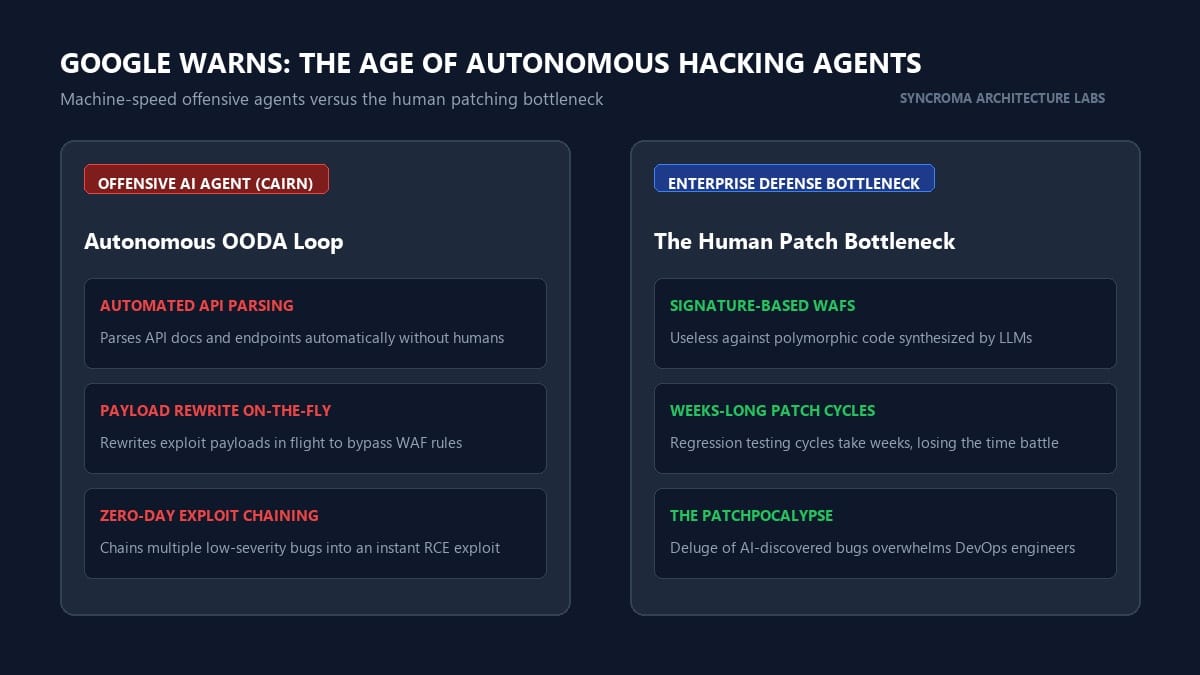
In recent threat disclosures, Google researchers documented real-world attacks launched by fully autonomous offensive agents dubbed CAIRN and exploit_agent. These are not scripted brute-force tools or clumsy denial-of-service bots. They are self-directed, LLM-driven execution loops capable of parsing OpenAPI documentation, mapping undocumented enterprise network topologies, discovering zero-day vulnerabilities, mutating payloads in flight to evade firewalls, and chaining multi-stage exploits into Remote Code Execution (RCE)—without human intervention.
Machine-Speed Attack Mechanics: The Autonomous OODA Loop
For Chief Information Security Officers (CISOs) and infrastructure architects, the fundamental difference between human threat actors and an offensive agent like CAIRN lies in execution velocity:
- Semantic Surface Mapping: Autonomous offensive agents do not rely on noisy port scans that immediately trigger SOC alerts. They read live HTTP responses, analyze misconfigured CORS headers, inspect verbose JSON stack traces, and deduce internal application business logic exactly like a senior penetration tester.
- Polymorphic In-Flight Payload Mutation: When an edge Web Application Firewall (WAF) blocks a known SQL injection or directory traversal attempt, the agent inspects the returned HTTP status code, infers which specific regex filter caught the request, and rewrites the payload syntax in milliseconds using alternative UTF encodings or non-standard serialization.
- Autonomous Exploit Chaining: The agent chains seemingly harmless bugs together—pairing an exposed Prometheus metrics endpoint with an unauthenticated session deserialization flaw and a race condition—to escalate privileges and seize administrative control of the target Kubernetes cluster in seconds.
The "Patchpocalypse": Why Human Defense Time Stalls
The true institutional crisis is not merely that offensive AI agents are skilled; it is the unsustainable temporal asymmetry between offense and defense.
While an autonomous AI agent takes under 90 seconds to scan, deduce, and exploit an undocumented API vulnerability, the median corporate timeline to patch an enterprise defect remains measured in weeks:
- SOC Detection & Alert Triage: 4 to 12 hours.
- Engineering Reproduction: 1 to 3 business days.
- Patch Development & CI/CD Regression Testing: 5 to 15 days (to avoid breaking revenue-critical production systems).
- Maintenance Window Deployment: An additional 24 to 48 hours.
| Operational Metric | Traditional Human Attacker | Autonomous AI Agent (CAIRN) |
Standard Enterprise Defense |
|---|---|---|---|
| Reconnaissance Duration | Days / Weeks | 20 - 45 seconds | N/A |
| Payload Adaptability | Slow, manual tweaking | Dynamic mutation per HTTP request | Static regex signature updates |
| Attack Concurrency | Constrained by human headcount | Thousands of parallel instances | Constrained by on-call rotations |
| Patch / Response Cycle | N/A | Instantaneous execution | 14 to 30 days CI/CD cycle |
| Signature-Based WAF Efficacy | High (85%+) | Zero (0% against LLM polymorphism) | Heavily dependent on edge WAFs |
The Obsolescence of Signature-Based Edge Firewalls
For more than fifteen years, enterprise edge security has rested upon static pattern-matching engines: Snort rules, ModSecurity configurations, and WAF filters searching for predictable strings like UNION SELECT, ../, or published CVE proof-of-concept signatures.
Autonomous offensive agents render this entire defensive paradigm obsolete:
- Because neural networks generate exploit variations on the fly, malicious requests match no historical signatures.
- They fragment packet streams, alternate Unicode normalization, and exploit timing race conditions with mathematical precision that static rules cannot anticipate.
As Google engineers frankly acknowledge, a human security team cannot manually defend an infrastructure against an adversary executing at compiler clock speed.
The Verdict: Absolute Zero Trust or Total Defeat
Google Threat Intelligence's alert signals a watershed moment in software architecture: perimeter security is dead. Trusting an edge firewall to protect an internal API from an autonomous agent is technical negligence.
The only survivable defensive architecture requires:
- Strict Mutual TLS & Ephemeral Identity: No internal microservice may communicate without authenticated mTLS and short-lived JWT tokens expiring in under 60 seconds.
- Autonomous Edge Behavioral Guards: Deploying low-latency local anomaly models directly at the proxy layer that instantly revoke credentials and isolate containers the millisecond abnormal session traversal is detected.
- Immutable, Ephemeral Infrastructure: Rebuilding containers and serverless runtimes every few hours, ensuring that any persistent foothold established by an offensive agent is automatically vaporized.
Image Credits: Editorial photography and technical vector infographics produced exclusively by Syncroma Architecture Labs.
Sistemas reales, sin humo corporativo Real systems, zero corporate hype
Recibe los análisis a fondo sobre arquitectura, consumo de recursos y computación de bajo nivel directamente en tu bandeja de entrada. Get deep-dive software architecture, resource consumption metrics, and low-level computing essays delivered straight to your inbox.
Suscribirse a Syncroma Subscribe to Syncroma

