
(🇪🇸 Leer la versión en español aquí)
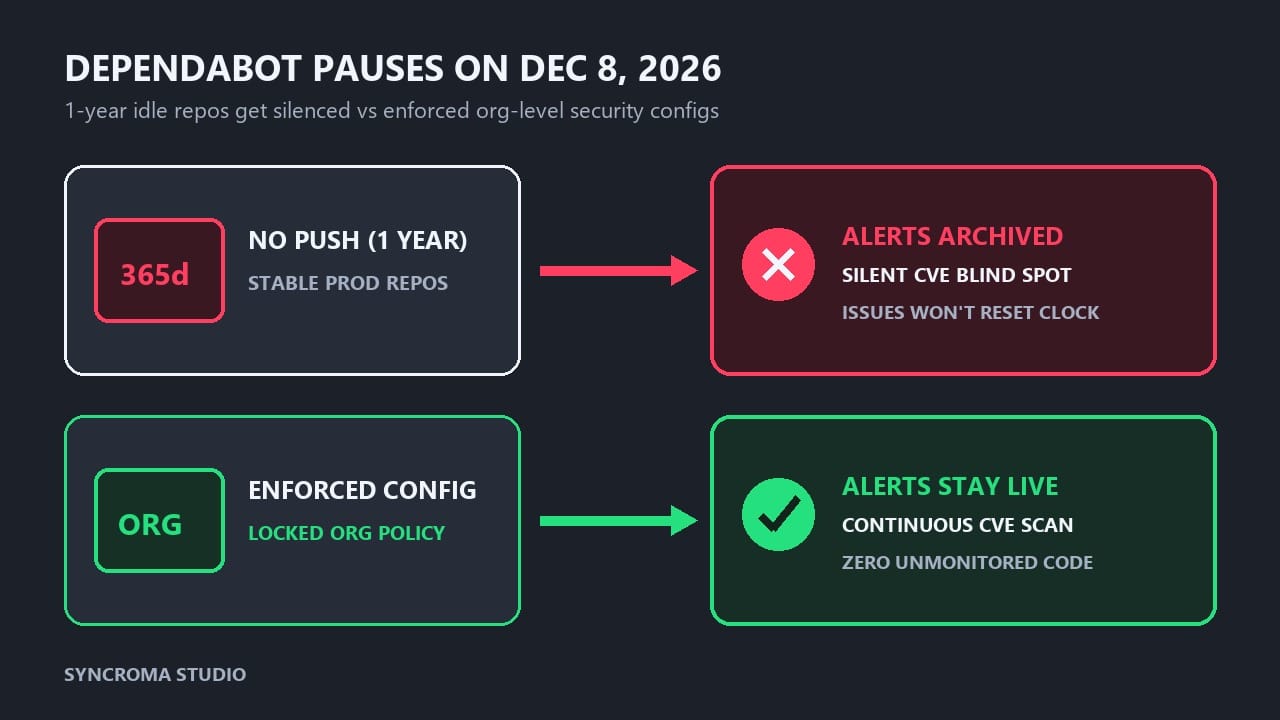
If your company runs stable "done and untouched" microservices in production—the ones engineers leave alone specifically because they never crash—mark December 8, 2026 in red on your security calendar. According to an official GitHub Changelog notice, GitHub will begin automatically disabling and archiving Dependabot vulnerability alerts on most repositories that have logged zero qualifying activity over the previous 12 months.
From a pure platform-infrastructure standpoint, GitHub's rationale makes total sense: rising automated CVE volume creates massive dependency-graph compute costs across millions of abandoned side projects. Yet the narrow definition GitHub chose for "active" creates a silent production blind spot for lean engineering teams.
What Counts as "Activity" (And What Silently Times Out)
Reading the fine print of GitHub's inactivity policy announcement—paired with a follow-up November 16 rule expiring alert dismissal requests after one year—reveals why reading issues or running deploys won't reset your timer:
| Action on Repository | Keeps Dependabot Live After Dec 8? | Real GitHub Behavior |
|---|---|---|
| Push to any branch or tag | Yes | Resets the 1-year clock & restores archived alerts |
| Create repo or toggle Dependabot on | Yes | Keeps monitoring active for another 12 months |
| Open Issues, review PRs, clone/pull | NO — Ignored | Repo is still flagged inactive and paused |
| Repo under Enforced Security Config | Yes (Exempt) | Org-enforced policy keeps Dependabot alerts active |
The cutoff applies across all plans on github.com plus GitHub Enterprise Cloud with data residency (only self-hosted GitHub Enterprise Server is unaffected).
The Quiet Production Trap: "Stable Code" Isn't Immune Code
The danger isn't dead hackathon repos from 2022—it's mature production services running quietly behind load balancers: authentication proxies, PDF exporters, webhook bridges, or container base definitions nobody needed to modify over the last 13 months:
- Zero-days don't check
git logdates: If a critical OpenSSL, Jackson, or npm transitive vulnerability drops in January on an untouched service still serving live traffic, Dependabot won't email anyone unless alerts are kept active. - Archived means silent: Existing alerts remain archived rather than deleted and snap back upon a new
git pushor manual settings toggle—leaving you completely blind during the gap before someone pushes code. - Skip dummy commit hacks—use Enforced Security Configurations: Rather than rigging messy CI cron jobs to bump whitespace files, apply an Enforced Security Configuration across your GitHub organization enabling Dependabot alerts globally (which GitHub explicitly exempts from auto-pausing). And if you self-host staging racks or backup nodes internally, verify electrical circuit headroom beforehand with our Circuit Breaker Load & 80% Amps Calculator or audit storage endurance with the NVMe SSD TBW & DWPD Lifespan Calculator.
Verdict
Shutting off Dependabot on year-idle repos saves GitHub huge backend compute, yet silently strips CVE coverage off stable production services that happen not to need weekly commits. Before December 8, lock Dependabot on via an organization-wide Enforced Security Configuration so finished production repos stay monitored when the next critical supply-chain CVE hits.
Visual credits: Cover photograph "Laptop coding programs (Unsplash)" via Wikimedia Commons (CC0 Public Domain). Infographic by Syncroma Studio.

Sistemas reales, sin humo corporativo Real systems, zero corporate hype
Recibe los análisis a fondo sobre arquitectura, consumo de recursos y computación de bajo nivel directamente en tu bandeja de entrada. Get deep-dive software architecture, resource consumption metrics, and low-level computing essays delivered straight to your inbox.
Suscribirse a Syncroma Subscribe to Syncroma

