(🇪🇸 Leer la versión en español aquí)
Millions of engineers and everyday workers click "Temporary Chat" (or switch off activity history) inside Google Gemini under the assumption it works like a digital shredder before pasting stack traces, financial drafts, or internal company notes. If you thought those prompts vanished after 72 hours, check Google's updated privacy documentation before pasting anything else today.
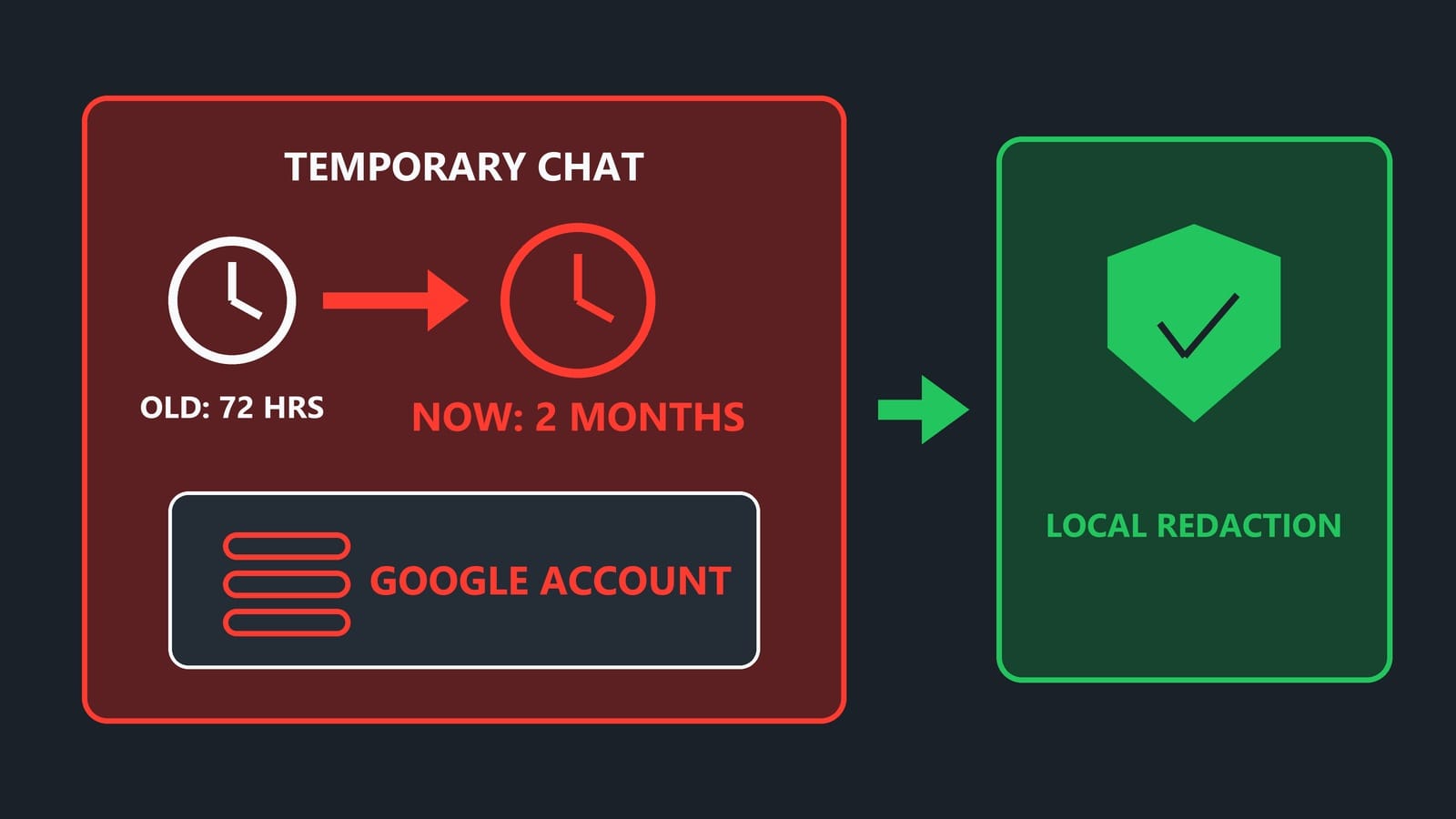
In a quiet November 2026 update to the Gemini Apps Privacy Hub —reported by TechCrunch on November 17, 2026, ExplainX, and MLQ— Google extended retention for Temporary Chats and History-off sessions from 72 hours to roughly two months (~60 days) tied directly to the user's Google account.
What Actually Stays Stored for Two Months (Even With History Off)
Google simultaneously split chat history toggles from independent AI training settings, yet its cloud retention footprint for supposedly "temporary" sessions jumped 20x compared with the prior three-day limit:
| Gemini Privacy Setting | Previous Policy | Updated Policy (November 2026) | Real-World Production Risk |
|---|---|---|---|
| Temporary Chat / History-off retention | 72 hours | ~2 months (~60 days) | Prompts and uploaded files remain tied to your Google account for eight weeks |
| Session context & abuse logging | Short rolling window | Uses prior 24 hours for context while storing copy for feedback & safety | Closing the tab does not purge data from Google's servers |
| Default AI model training | Excluded | Still excluded unless feedback is submitted or training toggle enabled | "Not used for training" does not mean E2E encrypted or deleted |
| Human safety review | Applies on abuse/feedback | Explicitly active alongside automated safety enforcement | Never paste .env secrets, customer PII, or unredacted production logs |
In security engineering, confusing "excluded from base model training" with "zero retention" is a classic compliance footgun. Stretching server-side exposure from 3 days to 60 days materially widens legal discovery, account-compromise, and GDPR shadow-AI blast radius across every team member using consumer Gemini tiers at work.
Three Practical Privacy Controls That Don't Rely on "Incognito" Toggles
- Scrub PII, API keys, and emails locally before sending a prompt: Once plaintext leaves your browser over HTTPS, vendor retention timelines are outside your control. Strip IPs, secrets, and customer identifiers purely inside local RAM before pasting logs anywhere using our Private Offline PII & Log Anonymizer.
- Put production code strictly behind contractual ZDR (Zero Data Retention) APIs: Consumer web chat interfaces routinely expand safety logging windows; enterprise workloads require contractual ZDR API agreements or isolated VPC endpoints.
- Run the unit economics on local inference for sensitive workflows: For teams processing HR, legal, or telemetry datasets daily, self-hosting quantized open models eliminates third-party retention risk altogether — benchmark hardware costs via our AI API vs. Self-Hosted GPU Cost Calculator and LLM VRAM Calculator.
FAQ: Google Gemini's Two-Month Chat Retention Update
Does Google now train AI models on Gemini Temporary Chats?
No by default: per the Gemini Apps Privacy Hub and TechCrunch, Temporary Chats and conversations created with activity history disabled remain excluded from generative model training unless you submit explicit feedback or separately enable training.
Why is Google keeping Temporary Chats for around two months instead of 72 hours?
Google states it retains those account-linked sessions for roughly two months to process requests (relying on the past 24 hours as context), handle user feedback, and protect Google, its users, and the public — including human review mechanisms.
Writing and infographic by Syncroma Studio. Cover photograph: Google campus sign at 1565 & 1585 Charleston Road, Mountain View, by Dietmar Rabich via Wikimedia Commons (CC BY-SA 4.0).

Sistemas reales, sin humo corporativo Real systems, zero corporate hype
Recibe los análisis a fondo sobre arquitectura, consumo de recursos y computación de bajo nivel directamente en tu bandeja de entrada. Get deep-dive software architecture, resource consumption metrics, and low-level computing essays delivered straight to your inbox.
Suscribirse a Syncroma Subscribe to Syncroma

