(🇪🇸 Leer la versión en español aquí)
The glossy keynote pitch for phone AI agents sounds effortless: tell Gemini "book a ride to the airport" or "add milk and eggs to my cart," close the chat, and let the phone run errands in the background. Pull back the curtain on Android 17 QPR2 and Google's own Pixel support docs, however, and the reality looks far less like an open agent web and far more like a tightly gated 134-app server-side allowlist locked to Google Play signing certificates (Android Authority, SammyGuru).
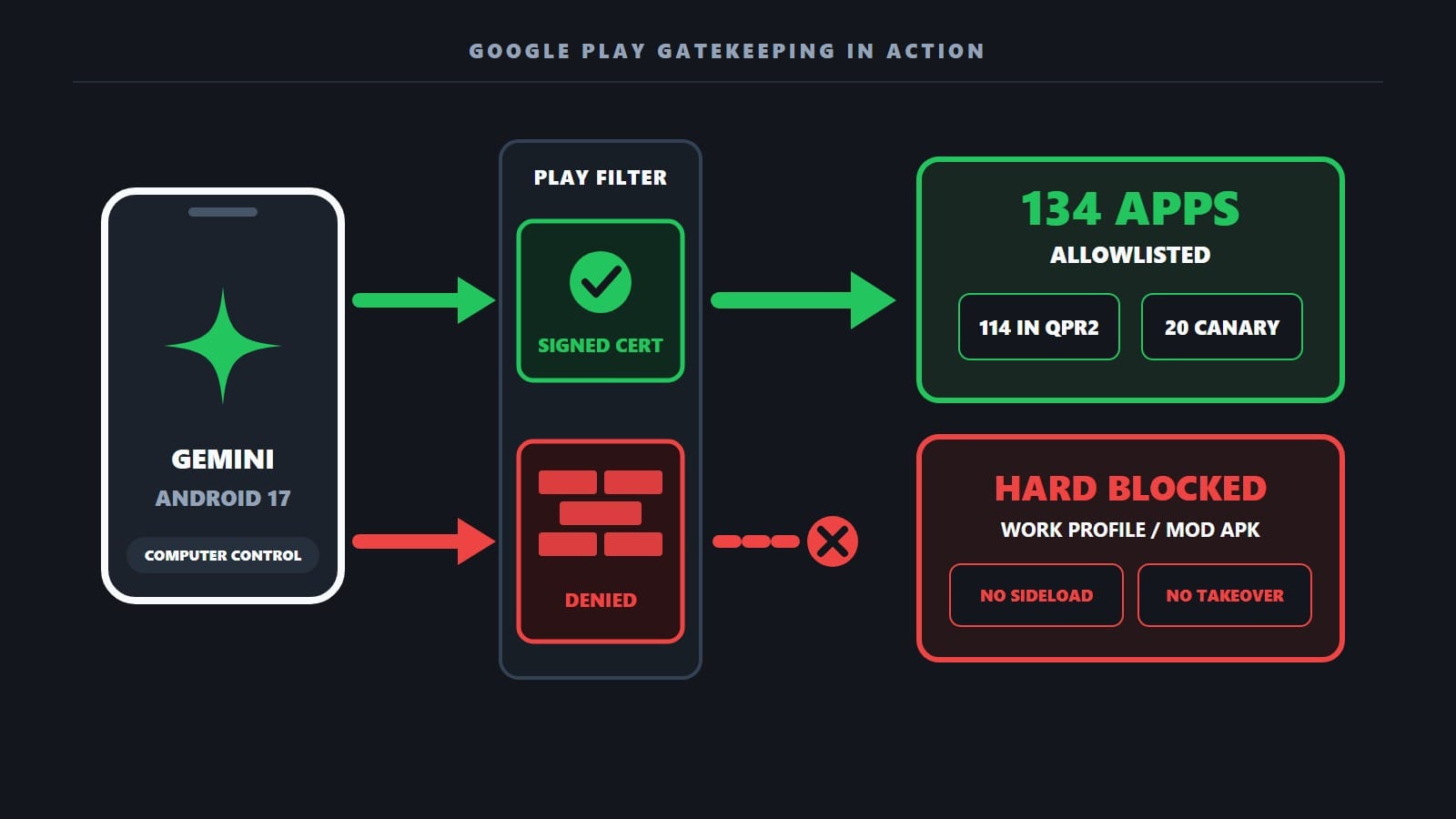
According to an exclusive teardown published by Android Authority (Nov 12–13, 2026), stable Android 17 QPR2 contains 114 target apps in its remote configuration — up from 106 just two days earlier in QPR1 — plus another 20 apps under testing in Android Canary 2611 (Android Authority, SammyGuru).
Inside Android Computer Control: Virtual Displays Instead of Open APIs
Under the hood, Gemini screen automation does not speak to Uber or Starbucks over an open intent schema. As Google's official Pixel Phone Help documentation explains, Gemini launches apps inside an "on-device virtual phone environment" powered by Android's Computer Control framework — tapping UI widgets on a hidden virtual display and pausing right before final checkout (Pixel Phone Help, Android Authority).
To control blast radius, Google binds every package ID in that remote JSON allowlist to its official Google Play Store signing certificate (Android Authority, SammyGuru).
| Marketing Pitch | Real Behavior in Android 17 (Nov 2026) | Production Tradeoff for Users & Devs |
|---|---|---|
| "Works across your favorite apps" | Hard-capped at 114 QPR2 + 20 Canary server-fetched targets | Unlisted apps never launch in the virtual environment |
| "Android stays open" | Enforces Google Play signing certificates per target | Sideloaded APKs, modified builds, and F-Droid installs fail outright |
| "Built for everyone's workflow" | Blocked on Work, school, or supervised Google accounts (Google) | Enterprise MDM phones locked out; Word & Outlook listed yet inactive |
| "Jump in and take over anytime" | On Pixel 10 & Galaxy S26, live takeover is disabled — you can only stop tasks (Google) | Manual takeover works only on Galaxy Z Flip 8 / Fold 8 (with a 10-min timeout) |
Three Engineering Red Flags Behind Screen-Scraping Agents
Limited so far to English, Japanese, and Korean in select markets (Pixel Phone Help, Android), this rollout exposes three structural flaws any mobile architect should recognize immediately:
- Platform kingmaking at the OS layer: Android Authority notes that in India, delivery platforms like Zomato and Blinkit already sit on Google's allowlist while head-to-head rivals Swiggy and Zepto remain absent (Android Authority). When an AI agent discovers merchants through a server-controlled JSON gate instead of open intents, OS gatekeeping quietly decides who gets automated orders.
- UI-scraping burns RAM and battery for brittle clicks: Spinning up a virtual display, rendering full retail React Native or Compose trees, and running vision-guided taps consumes orders of magnitude more memory, GPU cycles, and battery than structured local IPC calls — and breaks whenever an app ships an A/B-tested checkout button.
- Device fragmentation inside Google's own flagships: Shipping a feature where Galaxy Z Flip 8 / Fold 8 owners can interactively take over a stalled checkout screen while Pixel 10 and Galaxy S26 owners can only hit Cancel underlines how fragile live virtual-display handoff still is (Pixel Phone Help).
Takeaways for Mobile Engineers & Security Teams
Driving consumer apps by simulating finger taps inside hidden virtual screens is an awkward bridge, not an end-state architecture. Until mobile operating systems expose verifiable, user-consented action schemas directly inside apps without binding execution to a single app store's signing key, "autonomous mobile AI" remains gated by a remote configuration file.
If your mobile clients exchange signed session tokens with backend APIs or deploy compact on-device models, inspect session payloads safely offline with our Private JWT Decoder & WebCrypto HMAC Auditor or size local model footprints in the Local LLM VRAM Calculator.
Graphics by Syncroma Studio. Cover photograph: ShoAndTech / Wikimedia Commons (CC BY 3.0).

Sistemas reales, sin humo corporativo Real systems, zero corporate hype
Recibe los análisis a fondo sobre arquitectura, consumo de recursos y computación de bajo nivel directamente en tu bandeja de entrada. Get deep-dive software architecture, resource consumption metrics, and low-level computing essays delivered straight to your inbox.
Suscribirse a Syncroma Subscribe to Syncroma

