(🇪🇸 Leer la versión en español aquí)
In corporate boardrooms and high-level architecture reviews, there is a magic acronym that lets compliance officers and CISOs sign off on third-party cloud tools with complete peace of mind: ZDR (Zero Data Retention).
The commercial pitch is delightfully comforting: you route your application prompts through a multi-model broker—such as OpenRouter—with the zero-retention flag toggled on. In theory, your proprietary codebase queries, industrial trade secrets, and internal database schemas pass through an ephemeral pipe, get processed in GPU VRAM, and vaporize into digital ether without ever touching persistent disk or contaminating future training corpora.
Yet anyone who has spent more than ten minutes operating production infrastructure knows a cold, hard truth: a contractual privacy policy in a SaaS terms-of-service document has never stopped a core dump, a proxy routing misconfiguration, or a credential leak.
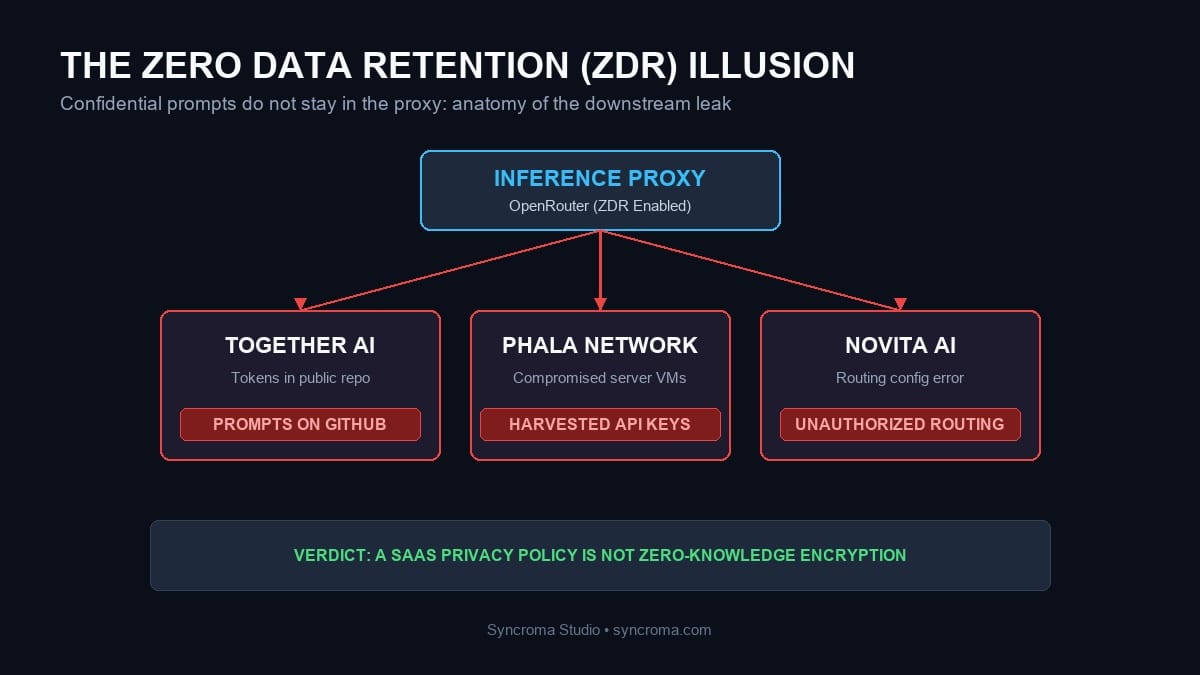
A sweeping threat-intelligence investigation led by Dragos and HD Moore's research team has just detonated that corporate fantasy. By seeding roughly two million test prompts loaded with canary tracking tokens and decoy AWS credentials into multi-provider inference pipelines, they proved downstream providers were actively logging, exposing, and leaking user prompts. OpenRouter’s response was immediate and decisive: an outright expulsion of Together AI, Phala Network, and Novita AI, alongside the revocation of Zero Data Retention certification across 125 model endpoints.
1. The Two-Million-Canary Sting Operation
To uncover what was actually happening on the wire, the researchers did not rely on academic theorizing. Between July and November 2026, they orchestrated an airtight technical sting:
- Massive Synthetic Injection: They routed over two million structured prompts through OpenRouter targeting popular open-weights models (DeepSeek, MiniMax, Qwen, GLM).
- Canary Tokens & Decoy Cloud Keys: Embedded inside the prompt text were unique HTTP/DNS tracking endpoints and dedicated Amazon Web Services IAM credentials generated solely for this experiment (inactive access keys wired to real-time CloudTrail tripwires).
- The Tripwires Triggered: It did not take long before Dragos’s monitoring infrastructure registered external unauthorized entities attempting to authenticate using the leaked decoy AWS keys and pinging the canary URLs.
The data had not evaporated in ephemeral RAM. It was circulating through unauthorized servers, public code repositories, and breached virtual machines.
2. Anatomy of the Failure: Three Downstream Culprits
The investigation confirmed that OpenRouter’s core platform itself was not penetrated. Rather, the compromise occurred at the downstream inference provider tier—the third-party infrastructure companies contracted to physically host and execute model weights. Each of the expelled providers suffered from fundamental operational failures:
A. Together AI: The Coding Agent That Committed Prompts to GitHub
Together AI disclosed that an automated AI coding assistant used by its internal engineering team committed a repository access token to a public GitHub repo. Through that exposed secret, unauthorized third parties were able to download cached prompt logs from June and July (involving models like MiniMax M3 and Kimi K2.6). Zero retention had quietly morphed into an open public download.
B. Phala Network: Compromised Inference Virtual Machines
Phala Network, a provider heavily marketing confidential computing and Trusted Execution Environments (TEEs), suffered a direct compromise across virtual machine instances processing DeepSeek traffic. Attackers breached the operational environment and harvested live application credentials and raw user prompts that should never have hit unencrypted disk storage.
C. Novita AI: The Silent Proxy Routing Misconfiguration
Novita AI committed a textbook routing mistake: an erroneous proxy rule silently redirected thousands of user prompts (including sensitive MiniMax traffic) to external, unvetted third-party APIs over a period of several months, completely demolishing the data boundary.
3. The Supply-Chain Trap: A Proxy Is Only as Safe as Its Weakest Node
The fundamental lesson from this incident is not merely that three providers stumbled; it is that modern AI architecture suffers from severe supply-chain opacity.
Development teams celebrate inference proxies like OpenRouter, LiteLLM, or Portkey because they eliminate multi-cloud plumbing. From an API standpoint, it feels magical: a single OpenAI-compatible interface, automated failover across regions, and dynamic cost routing down to the sub-cent.
However, from an operational security perspective, you have introduced an unverified multi-tier supply chain. When your production service executes:
# The ZDR optical illusion in production
client = OpenAI(
    base_url="https://openrouter.ai/api/v1",
    api_key=os.environ["OPENROUTER_API_KEY"],
    default_headers={"HTTP-Referer": "https://syncroma.com", "X-Title": "Production Service"}
)

# Sending proprietary code assuming ZDR is foolproof is an architectural hazard:
response = client.chat.completions.create(
    model="deepseek/deepseek-chat",
    messages=[{"role": "user", "content": f"Optimize this proprietary kernel query: {sensitive_code}"}],
    extra_body={"provider": {"data_collection": "deny"}}  # Zero Data Retention flag
)
That data_collection: deny flag is a software signal handed off across upstream networks. If the downstream bare-metal host running the GPU inference worker has misconfigured logging daemons, internal latency telemetry scrapers, or an exposed debugging endpoint, your proprietary data is at the mercy of the least secure container in the fleet.
4. Production Hardening: Practical Rules for Engineers
If you are deploying production software with real intellectual property, client PII, or regulatory exposure, heed these hard rules:
- Strip Infrastructure Secrets Upstream: Session cookies, internal database connection strings, API tokens, and customer PII must never enter an LLM context window without strict, automated client-side redaction and tokenization before the network request leaves your perimeter.
- Self-Host for Sensitive Workloads: If the data is critical to enterprise survival, run the model inside your own private VPC (vLLM, TensorRT-LLM, or Ollama on dedicated bare-metal or private cloud instances with strict egress firewalls).
- Continuous Canary Auditing: Follow Dragos’s playbook. If your architecture must rely on third-party model aggregators, seed your CI/CD test prompts with active canary tokens and decoy monitored credentials. If a canary triggers from an unknown IP address, you will know your upstream provider is leaking data long before it hits the security news headlines.
Software systems do not forgive naive optimism. In modern AI infrastructure, unless you control and verify the physical memory of the machine processing your prompt, treat every request as publicly broadcast by default.
Technical research and visual breakdown by Syncroma Studio.
Sistemas reales, sin humo corporativo Real systems, zero corporate hype
Recibe los análisis a fondo sobre arquitectura, consumo de recursos y computación de bajo nivel directamente en tu bandeja de entrada. Get deep-dive software architecture, resource consumption metrics, and low-level computing essays delivered straight to your inbox.
Suscribirse a Syncroma Subscribe to Syncroma