
(🇪🇸 Leer la versión en español aquí)
If there is a single database on the planet where an intrusion is measured not in leaked credit card numbers but in human lives and split-second firearm decisions, it is the FBI’s National Crime Information Center (NCIC). For more than half a century, it has served as the omniscient backbone of American law enforcement: every time a state trooper initiates a traffic stop on a Texas interstate or verifies a license plate in New York, their patrol vehicle’s mobile data terminal queries this centralized cluster in milliseconds.
Now, national security alarms are blaring at maximum volume. Multiple federal intelligence sources confirmed to outlets including the Associated Press and CNN that the FBI is actively conducting an emergency investigation into an unauthorized cyber intrusion targeting the core NCIC architecture. Following closely on the heels of the recent credential compromise of the agency’s recruitment portal (FBIJobs.gov), this event is not a superficial denial-of-service outage—it represents a direct, catastrophic threat to the data integrity of a superpower’s law enforcement apparatus.
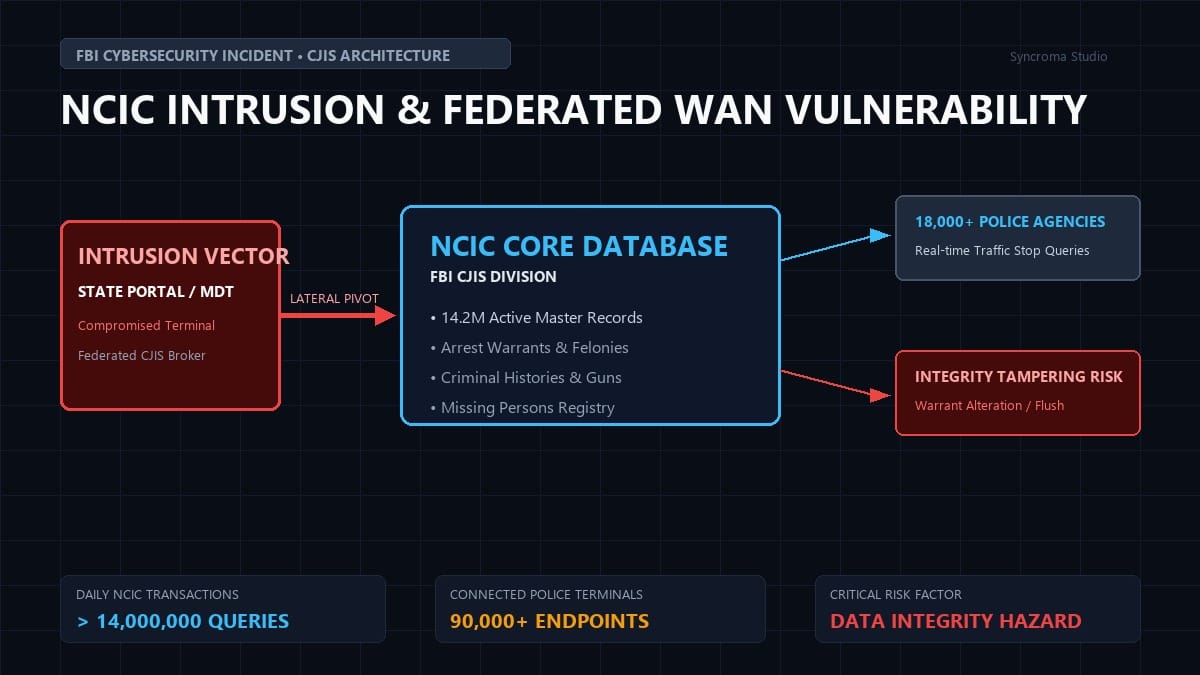
The Police Nervous System: 14 Million High-Stakes Master Records
To understand the severity of this breach from a systems engineering perspective, one must examine the infrastructure managed by the FBI’s Criminal Justice Information Services (CJIS) Division in Clarksburg, West Virginia:
- 14.2 million active master records: Nationwide felony arrest warrants, criminal history rap sheets linked to automated fingerprint identification, domestic violence protection orders, missing persons registries, stolen firearms databases, and vehicle theft lookups.
- 14 million transactions per day: Over 90,000 mobile data terminals (MDTs) mounted in cruisers, dispatch centers, courthouse terminals, and border inspection checkpoints bombard the NCIC cluster with real-time read and write transactions 24/7.
- Vast federated topology: The NCIC does not sit inside an air-gapped vacuum. It communicates across the CJIS WAN and the NLETS interstate messaging consortium with law enforcement systems in all 50 states, federal agencies (DEA, ATF, US Marshals), and international partners via Interpol.
The Real Nightmare: Not Data Exfiltration, but Record Tampering
In conventional corporate breaches, confidentiality is the primary casualty: attackers exfiltrate user credentials or financial records to monetize on dark web forums. In a federated law enforcement database like the NCIC, confidentiality is secondary; the true catastrophe is the loss of data integrity.
What happens if an adversary achieves arbitrary write privileges or alters database records in transit through a compromised state-level broker?
- Silent Warrant Evaporation: A high-level cartel figure or international fugitive subject to an active Red Notice could have their active warrant wiped. When pulled over for a routine traffic infraction, the patrol cruiser terminal returns
NO RECORD FOUND, allowing the fugitive to walk away unhindered. - Weaponized False Hits (Lethal Swatting): Injecting fraudulent felony warrants flagged as "armed and dangerous" against judges, investigative journalists, or political adversaries ensures that responding patrol officers arrive with unholstered weapons at high-stress felony stops.
- Chain-of-Custody Poisoning: Altering historical serial numbers on stolen weapons databases invalidates forensic ballistics chains of custody in active federal capital murder trials.
The Architectural Achilles' Heel: Implicit Trust in Federated WANs
How does an adversary compromise a hardened FBI data repository? Public safety network architects know the uncomfortable truth: the outer security boundary is never the central repository; it is the weakest link in the federation.
While the FBI enforces rigorous CJIS Security Policy mandates—requiring FIPS 140-3 cryptographic modules and multi-factor authentication—the operational reality demands federated interoperability with fifty distinct state message switches and thousands of municipal police departments. Many of these state endpoints rely on legacy software, patched terminal emulators bridging IBM 3270 mainframes over TCP/IP, and commercial dispatch vendors operating with questionable access governance.
If an attacker compromises operator credentials or exploits an unpatched edge router at a regional state hub, they can pivot laterally across the CJIS WAN directly into the central NCIC message broker, masquerading as legitimate law enforcement telecommunications traffic.
When police officers on the street cannot trust whether the felony warrant on their dashboard is authentic or altered by a remote hacker, the foundational integrity of the justice system dissolves in real time.
Syncroma Studio — Architectural analysis, cybersecurity reality, and critical systems infrastructure.
Sistemas reales, sin humo corporativo Real systems, zero corporate hype
Recibe los análisis a fondo sobre arquitectura, consumo de recursos y computación de bajo nivel directamente en tu bandeja de entrada. Get deep-dive software architecture, resource consumption metrics, and low-level computing essays delivered straight to your inbox.
Suscribirse a Syncroma Subscribe to Syncroma

