(🇪🇸 Leer la versión en español aquí)
Over 11,000 U.S. flights delayed or canceled, packed airport terminals from Chicago to JFK, and more than 3,500 airborne aircraft safely steered to their destinations while every commercial departure across the country froze in place. Friday's Federal Aviation Administration (FAA) shutdown marks only the third nationwide ground stop in U.S. history, joining September 11, 2001 and the 2023 NOTAM outage.
Yet the scariest detail about the November 13, 2026 disruption—spanning 3:54 PM to 8:15 PM EST (4 hours and 21 minutes) per Wikipedia and The Guardian—is that no hostile hacker lifted a finger. Both Homeland Security Secretary Markwayne Mullin and the White House confirmed zero signs of a cyberattack. What actually grounded American aviation was every senior network engineer's worst nightmare: plugging modern fiber gear into a 1980s copper-era routing fabric without blast isolation.
What Actually Broke Inside the FAA Telecommunications Infrastructure (FTI)
Based on technical reporting from CircleID, Business Insider, and CBS News, radio and radar instability started around 3:36 PM EST near Chicago O'Hare and Midway before cascading across all 22 Air Route Traffic Control Centers (ARTCCs) linked over FTI—the private network operated by defense contractor L3Harris Technologies:
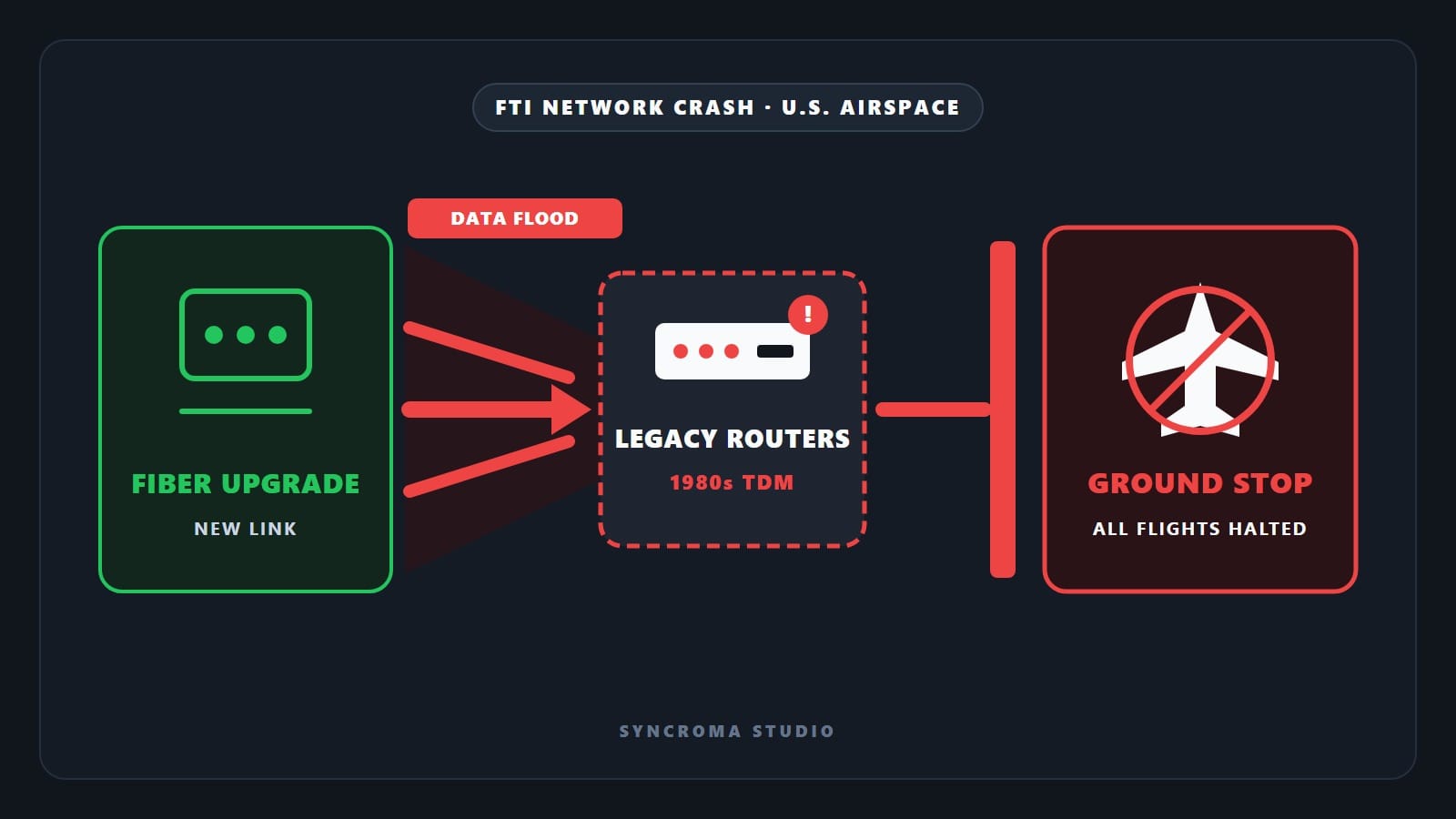
- The maintenance trigger: During routine upgrades at a remote facility swapping aging 1980s Time-Division Multiplexing (TDM) copper trunks for modern fiber optics, an upgraded router began blasting more than 1,000 connection requests every few seconds toward neighboring nodes.
- The control-plane bottleneck: That storm of status and session updates hammered aging legacy Cisco switches and routers (early-2000s-era hardware inside the legacy FTI fabric), causing static on air-to-ground voice channels and inconsistent radar data across centers.
- The safety kill switch: When air traffic controllers see conflicting radar feeds, redundancy stops helping—you pull the emergency brake. The FAA halted all domestic departures for over four hours while technicians isolated the runaway segment.
The Production Networking Lesson Every Architect Recognizes
Distributed infrastructure fails hardest at generational seams. Bridging a modern high-throughput link onto legacy control planes without strict control-plane policing, rate limits, and isolated fault domains turns a routine firmware or interface bounce into a self-inflicted internal DDoS.
| Outage Metric | Verified Data (Nov 13, 2026) | Real Engineering Takeaway |
|---|---|---|
| Total outage window | 4h 21m (261 minutes) | Burns nearly 5× the annual downtime budget of a 99.99% SLA |
| Flight disruption | >10,000 delays, ~8,000 cancellations | Multi-day crew and aircraft repositioning cascade |
| Blast radius | All 22 ARTCCs impacted | Shared signaling/control planes defeat regional geographic redundancy |
| Funding spike | Ask jumped $30B → $50B | Sec. Sean Duffy requested $30B on Nov 12, then $50B after the crash |
To put 261 minutes of dead airspace into hard production numbers, run your own availability math in our SLA Uptime & Error Budget Calculator or carve strict network blast-radius boundaries using Syncroma's IPv4 CIDR & VLSM Subnet Calculator.
Filtering Out the Noise (And the $50 Billion Price Tag)
Several early rumors proved red herrings: Weather Service radar screenshots circulating online came from stale static webpages, independent Nav Canada systems stayed up without issue, and both the FAA and aviation analysts dismissed any link to the agency's SMART AI traffic rollout earlier in the week, as summarized by The Guardian.
The starkest irony sits in the budget timeline: just one day earlier (November 12), Transportation Secretary Sean Duffy had urged Congress for $30 billion to overhaul U.S. air traffic infrastructure. Hours after stranded travelers overwhelmed even Amtrak's booking servers, Duffy and Mullin raised that request to $50 billion.
Verdict
You do not need zero-day nation-state malware to paralyze a superpower's skies. Connecting modern fiber hardware onto forty-year-old TDM routing fabrics without blast-radius isolation will happily DDoS your own network for free. Until critical systems retire 1980s single points of failure instead of wrapping shiny fiber around them, Friday afternoons remain one bad router loop away from another national standstill.
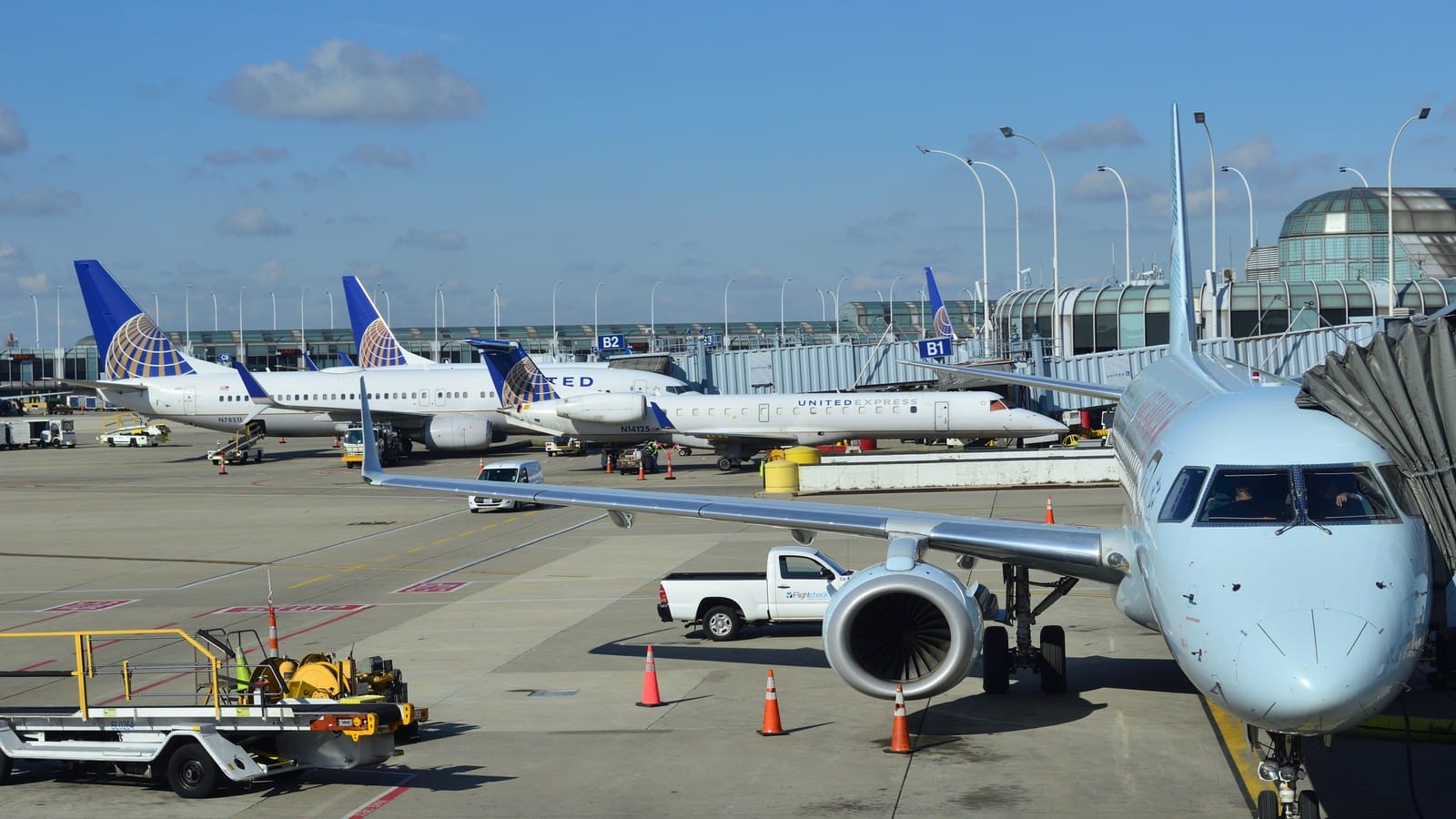
Infographics created by Syncroma Studio. Cover photo: Wikimedia Commons (CC0) (Chicago O'Hare International Airport, editorial crop).

Sistemas reales, sin humo corporativo Real systems, zero corporate hype
Recibe los análisis a fondo sobre arquitectura, consumo de recursos y computación de bajo nivel directamente en tu bandeja de entrada. Get deep-dive software architecture, resource consumption metrics, and low-level computing essays delivered straight to your inbox.
Suscribirse a Syncroma Subscribe to Syncroma

