
(🇪🇸 Leer la versión en español aquí)
For decades, the foundation of enterprise network security has rested upon an inviolable architectural dogma: the strict separation of planes. System architects are instructed to isolate management interfaces (eth0, SSH, and the administrative GUI) inside an out-of-band, non-routable management VLAN. The assumption seemed airtight: so long as administrative ports remain hidden from the outside world, the Data Plane (the Virtual Servers listening on ports 80 and 443 to balance high-volume traffic) only processes sanitized customer traffic and is virtually unbreachable.
This week, that foundational assumption was shattered.
F5 Networks issued a critical out-of-band security advisory cataloged in the NIST NVD database as CVE-2026-123637 with a catastrophic CVSS score of 9.8 out of 10 (CVSS v3.1) / 9.3 (CVSS v4.0). This is not another vulnerability in the web management portal; it is an unauthenticated Stack-Based Buffer Overflow (CWE-121) located directly within the Data Plane. An external attacker can crash the load balancer into a permanent Denial of Service (DoS) loop or achieve Remote Code Execution (RCE) by dispatching a crafted HTTP request directly against exposed public Virtual Servers.
No credentials required. No access to the management network needed. And most alarming of all: completely unblockable by standard Web Application Firewall (WAF) inspection rules.
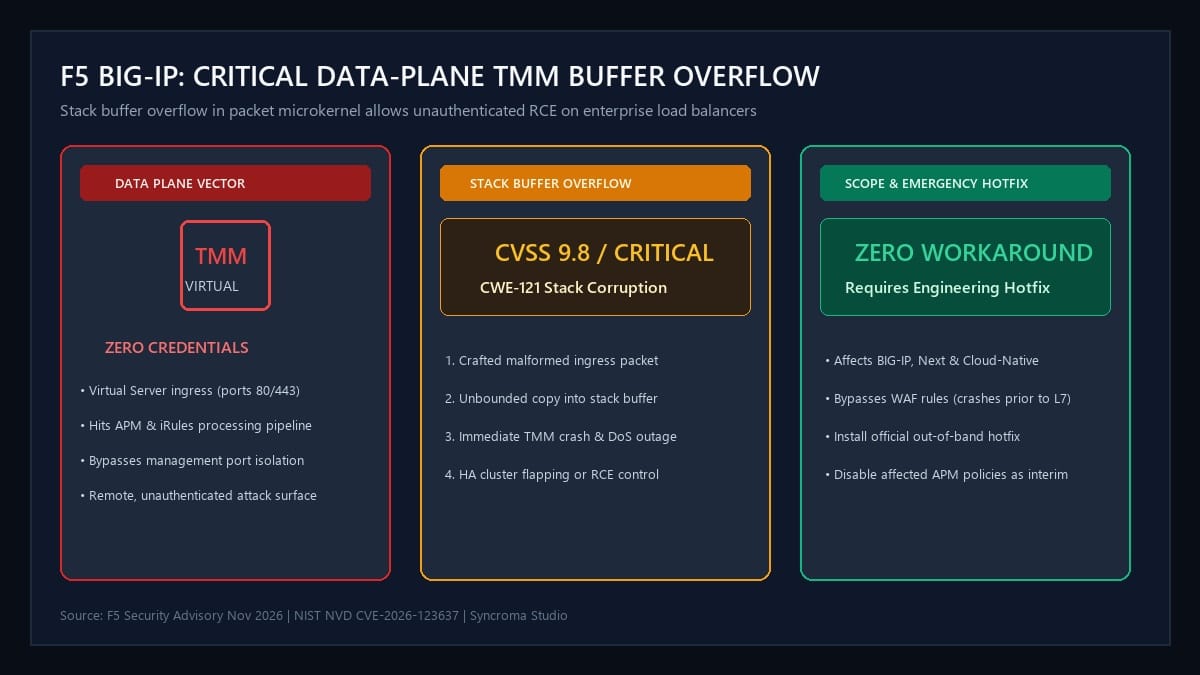
Anatomy of TMM: The High-Speed Packet Engine and the Zero-Day Flaw
To grasp the architectural blast radius of this vulnerability, one must understand how F5 BIG-IP processes packets. Unlike general-purpose reverse proxies running on Linux network stacks (like Nginx, HAProxy, or Envoy), F5 relies on a monolithic, proprietary user-space processing daemon known as the Traffic Management Microkernel (TMM).
TMM directly maps physical network interface card (NIC) memory rings via DPDK-like polling drivers, completely bypassing the Linux kernel network stack to achieve line-rate throughput exceeding 100 Gbps. It executes as a real-time, heavily optimized C process.
According to F5's official security advisory K000140228, the flaw is triggered within BIG-IP Access Policy Manager (APM) evaluation agents and specific iRule execution pipelines:
- Ingress Frame Ingestion: The load balancer accepts an incoming TCP/HTTP connection on an active Virtual Server configured with APM client inspection or message routing directives.
- Unbounded Stack Memory Copy: During parsing of malformed packet attributes and session metadata, the low-level C parser fails to validate destination buffer boundaries (
bounds check). Excess bytes spill past the allocated memory region and overwrite adjacent stack frames. - TMM Microkernel Panic: When the overwritten memory corrupts execution return pointers or stack canaries, TMM triggers an emergency abort to prevent silent data corruption, creating a memory core dump.
- Cascading High-Availability (HA) Failover Flap: Upon TMM termination, the hardware watchdog and failover daemon detect a heartbeat loss and immediately transfer virtual traffic to the passive peer. If the attack traffic is repeated or sustained, the secondary node crashes identically within milliseconds, blinding the entire corporate network edge.
If an attacker chains this buffer overflow with ASLR bypasses and tailored Return-Oriented Programming (ROP) sequences, the exploit transitions from a Denial of Service into arbitrary code execution running with full TMM system privileges—granting complete access to the appliance decrypting corporate TLS traffic and hosting master certificates.
The WAF Failure: Why Software Signatures Cannot Mitigate It
Whenever an RCE vulnerability hits conventional application servers, SecOps teams quickly deploy a regex signature to their WAF to scrub malicious parameters at the perimeter.
In CVE-2026-123637, that defensive layer fails entirely:
- Corruption Occurs Before Layer 7 Evaluation: The stack buffer overflow occurs in the low-level ingestion and serialization stage of TMM itself. The microkernel crashes the moment it unpacks the malformed frame. Advanced WAF and ASM inspection rules never execute because the process assigned to evaluate them is already dead.
- Official "No Workaround" Status: In its technical disclosure, F5 explicitly confirmed that no generic configuration workarounds exist. Disabling specific APM policy agents or applying an emergency Engineering Hotfix directly to the operating system firmware are the only viable remediation paths.
Systemic Impact: Global Financial and Cloud Topologies at Risk
F5 BIG-IP appliances are not edge-case network devices; they anchor the ingress infrastructure of over 85% of Fortune 500 corporations, tier-one global financial institutions, telecommunication cores (4G/5G mobile signaling), and major cloud platforms.
The vulnerability affects traditional physical hardware (BIG-IP iSeries and VIPRION chassis), virtual editions (VE), and modern cloud-native architectures including BIG-IP Next for Kubernetes and Cloud-Native Network Functions (CNF).
| Deployment Target | Exposure Vector | Operational Fallout |
|---|---|---|
| Online Banking & Payment Portals | HTTPS Virtual Servers (443) | Complete transaction outage and RCE risk |
| Kubernetes Ingress (BIG-IP Next) | Cluster Ingress Controller | Loss of pod routing and microservice isolation |
| Telecommunication Cores (CNF) | Diameter, SIP & PEM interfaces | Disruption of cellular data and carrier signaling |
| Enterprise Remote Access | SSL VPN & APM Gateway portals | Disconnection of enterprise workforce |
Architectural Verdict
CVE-2026-123637 represents an unmistakable wake-up call for network architecture: high-speed packet processing engines written in legacy C/C++ remain fundamentally vulnerable to spatial memory corruption bugs. Sacrificing compile-time memory safety in the name of extracting raw switching latency creates critical single points of failure where a single malformed packet can slice through the entire enterprise perimeter. Infrastructure and SecOps teams must audit their Virtual Server configurations immediately and deploy F5's emergency hotfixes before automated threat actors weaponize data-plane scanning at scale.
Infographic and research credits: Syncroma Studio.
Sistemas reales, sin humo corporativo Real systems, zero corporate hype
Recibe los análisis a fondo sobre arquitectura, consumo de recursos y computación de bajo nivel directamente en tu bandeja de entrada. Get deep-dive software architecture, resource consumption metrics, and low-level computing essays delivered straight to your inbox.
Suscribirse a Syncroma Subscribe to Syncroma

