
(🇪🇸 Leer la versión en español aquí)
During marquee video game releases and global digital platform events (such as the launch of GTA 6, seasonal Steam sales, or peak concurrency on PlayStation Network and Xbox Live), the broader gaming community routinely assumes servers buckle because "the internet simply cannot handle that many terabytes of traffic."
The operational truth inside production trenches is entirely the opposite: Content Delivery Networks (CDNs like Cloudflare, Akamai, or Fastly) ingest and distribute petabytes of static pre-load binaries without breaking a sweat, leveraging distributed edge caches running at tens of terabits per second. What disintegrates modern infrastructure is not the 150 GB file download; it is a tiny 400-byte HTTP POST request sent to the /api/v1/auth/token endpoint.
What we witness during every major online meltdown is a classic, merciless distributed systems defect: the Cache Stampede and Thundering Herd problem.
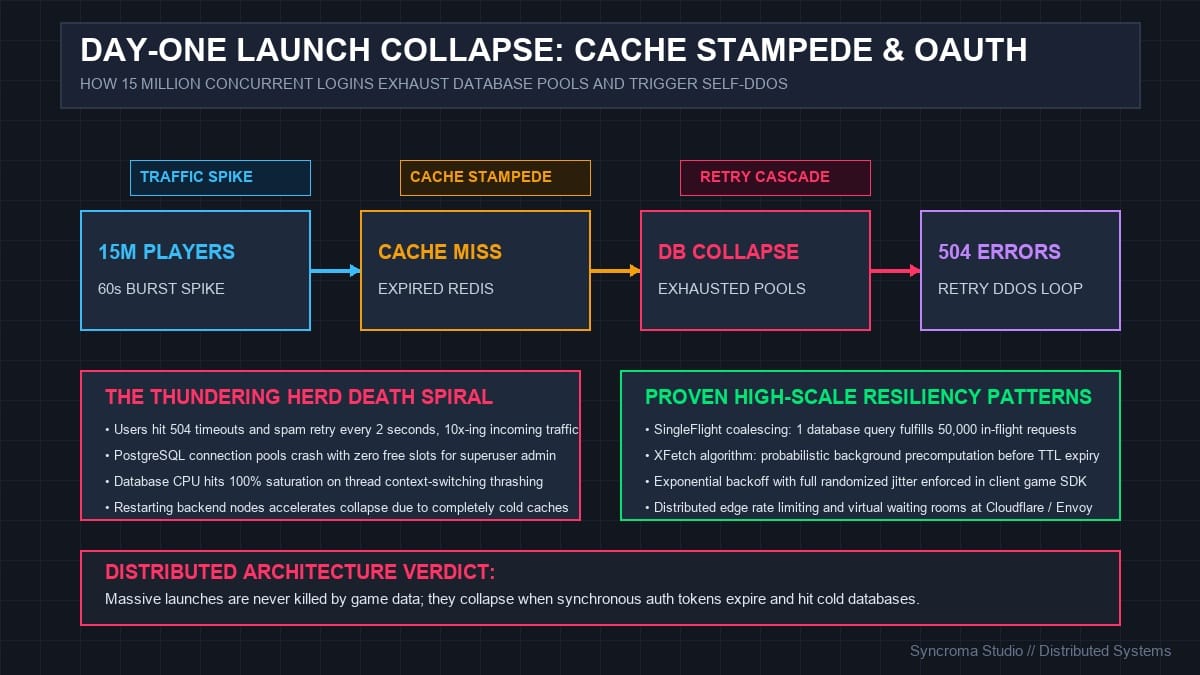
Infographic: From Redis key expiration to primary database connection pool exhaustion and user-driven retry DDoS loops. Credit: Syncroma Studio.
1. Anatomy of the Meltdown: How 15 Million Requests Pierce Redis
At precisely 00:00 on launch night, between 10 and 15 million gaming consoles and PCs initialize the executable simultaneously. Every single client must validate digital entitlement certificates, hydrate social profile graphs, and acquire a cryptographically signed JSON Web Token (JWT) to access multi-user game modes.
Under nominal production workloads, an in-memory caching layer (Redis or Memcached) caches user sessions, permissions, and licensing states with a 15-to-30-minute Time-To-Live (TTL), resolving 99.8% of read operations in sub-millisecond latency:
Client -> API Gateway -> Redis Cache (HIT: 0.8 ms) -> 200 OK Response
Catastrophe strikes when one of three conditions manifests:
- Key Expiration Under Peak Concurrency: The TTL on a shared licensing catalog or global session partition expires at 00:01. In that single millisecond, 80,000 in-flight requests experience a
CACHE MISS. - Cold Cache Following Service Restarts: An authentication microservice experiences memory exhaustion, prompting Kubernetes to recycle the pods. Upon reboot, local in-memory caches are 100% cold.
- Absence of Distributed Request Locking: Instead of a single thread querying the underlying database to repopulate the missing key, all 80,000 concurrent requests punch straight through Redis and slam the primary relational database cluster at once.
2. Asphyxiating the Relational Database Cluster
When the Redis caching dam breaks, the shockwave crashes directly into the transactional storage engine (PostgreSQL, CockroachDB, or Amazon Aurora):
- Instant Connection Slot Exhaustion: Within two seconds, microservice connection pools deplete PostgreSQL's
max_connectionsceiling. Application logs are overwhelmed with the fatal error:FATAL: remaining connection slots are reserved for non-replication superuser connections. - CPU Thrashing from Context Switching: Rather than executing SQL queries with silicon running at peak efficiency, the database CPU hits 100% utilization simply shuffling thread context switches and invalidating CPU L3 cache lines as it attempts to juggle thousands of concurrent transactions.
- The Impatient User Auto-DDoS Loop: When the API Gateway finally times out and returns an
HTTP 504 Gateway Timeoutafter 10 seconds of queue stall, frustrated gamers repeatedly hammer the "Retry" button every two seconds. Legitimate paying players morph into an accidental botnet, magnifying incoming API traffic tenfold.
3. Battle-Tested Engineering: Production Resiliency Patterns
Surviving a massive launch day without global operational embarrassment requires abandoning naive backend designs:
| Naive Pattern (Fragile) | Battle-Tested Resiliency Pattern | Architectural Impact |
|---|---|---|
| Direct DB query on cache miss | Request Coalescing (Go SingleFlight) | 1 database query fulfills 50,000 in-flight requests |
| Hard static TTL expiration | XFetch Algorithm (Probabilistic Precompute) | Keys refresh in background prior to TTL death |
| Immediate client retry loops | Exponential Backoff with Full Jitter | De-synchronizes client retry waves across time |
| Unrestricted API Gateway entry | Edge Virtual Waiting Rooms (Cloudflare/Envoy) | Enforces strict admission rate matching DB limits |
Request Coalescing (SingleFlight)
In concurrent runtimes like Go, the golang.org/x/sync/singleflight package guarantees that if 10,000 goroutines request the identical cache key that just expired, exactly one execution hits the database. The remaining 9,999 goroutines wait on an in-memory channel, receiving the shared result simultaneously upon completion.
The XFetch Algorithm (Vattani et al.)
Rather than waiting for the TTL to expire, the XFetch algorithm probabilistically evaluates whether a read operation should asynchronously compute and refresh the cached entry ahead of schedule: $$\Delta \times \beta \times \ln(\text{rand}()) > \text{TTL} - \text{now}$$ Where $\Delta$ represents the computational cost of the query and $\beta > 0$ governs aggressiveness. This mathematical guarantee ensures hot keys are recalculated in the background seconds before expiration, eliminating cache stampedes entirely.
Backoff with Full Jitter
When an API request fails, the client game SDK must never retry on static intervals. It must apply randomized exponential backoff: $$t_{\text{sleep}} = \text{random}(0, \min(M, T_{\text{base}} \times 2^{\text{attempt}}))$$ Breaking up the temporal synchronization of retries is the only mathematical method that allows a saturated database cluster to clear its I/O queues and recover.
Sistemas reales, sin humo corporativo Real systems, zero corporate hype
Recibe los análisis a fondo sobre arquitectura, consumo de recursos y computación de bajo nivel directamente en tu bandeja de entrada. Get deep-dive software architecture, resource consumption metrics, and low-level computing essays delivered straight to your inbox.
Suscribirse a Syncroma Subscribe to Syncroma

