(🇪🇸 Leer la versión en español aquí)
Every padlock icon on the web — online banking, SaaS logins, software updates — rests on one mathematical assumption: given a public elliptic-curve point (d × G on P-384), recovering the secret scalar d is practically impossible because d lives inside 2³⁸⁴ possibilities (~10¹¹⁵, over 100 random digits).
Unless a globally trusted Certificate Authority accidentally picks the integer 4.
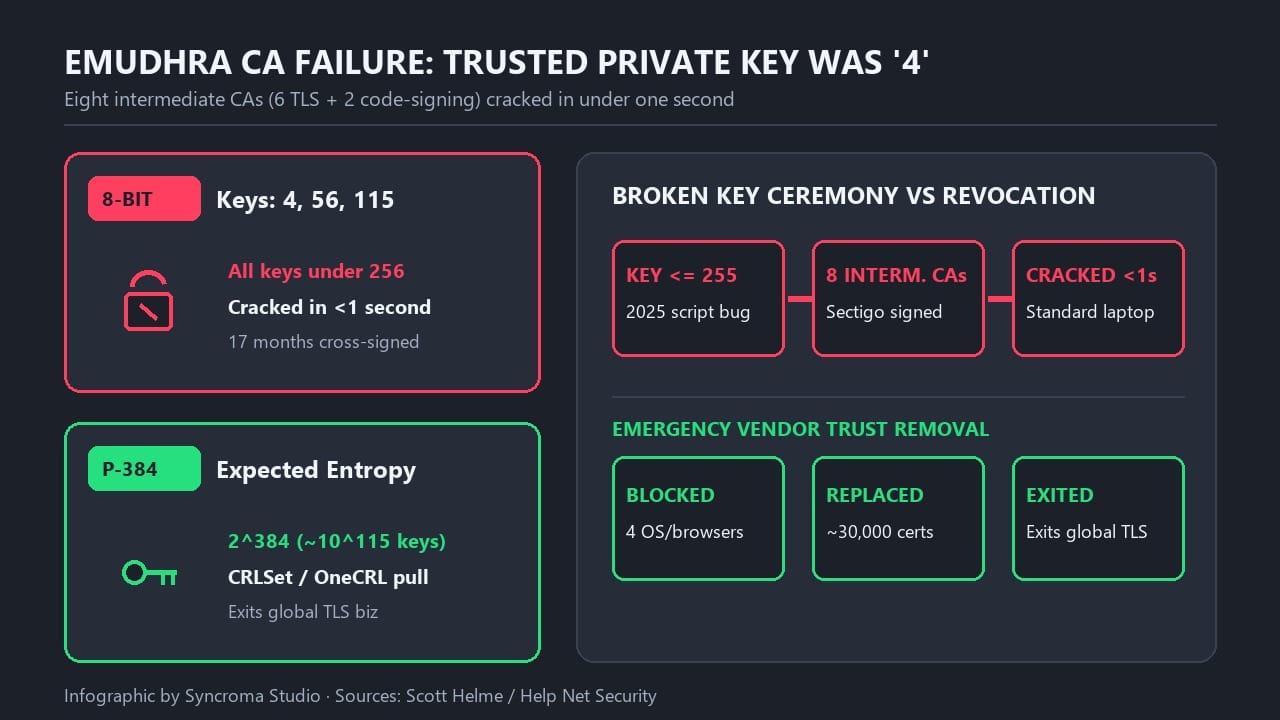
That is the catastrophic operational mistake that ended eMudhra's global SSL/TLS business: eight trusted intermediate CAs carried single-byte private keys smaller than 256 — literally 4, 56, and 115 — allowing anyone with the public certificate to recover the private signing key on a normal laptop in under a second, per Help Net Security and cryptographic researcher Scott Helme.
Inside the Broken Key Ceremony & 17-Month Exposure
The blunder began during an April 30, 2025 key ceremony. A faulty script generated test-grade weak scalars whose labels resembled properly randomized production keys — and operators selected the weak batch:
| Verified Incident Metric | Technical Detail | Real-World PKI Blast Radius |
|---|---|---|
| Compromised Intermediates | 8 CAs (6 TLS DV/OV/EV + 2 code-signing) | Any public CT log copy leaked the private key immediately |
| Actual Key Entropy Used | Integers < 256 (including 4, 56, 115) |
Exhaustive brute force tests at most 256 scalars vs. 10¹¹⁵ on P-384 |
| External Cross-Signing | Cross-signed by Sectigo (AAA Certificate Services) |
Inherited out-of-the-box trust in Apple, Google, Microsoft, Mozilla & Cloudflare |
| Silent Exposure Window | 17 months (April 2025 -> Oct 17, 2026) | Researcher Wayne proved ownership by signing "We have a problem here" |
| Browser & CA Fallout | Immediate CRLSet/OneCRL block; Chrome Root v43 & NSS removal |
~30,000 customer certs replaced; eMudhra exited global SSL/TLS on Oct 22 |
As Scott Helme put it bluntly: normally when a CA key is compromised, somebody stole it at an identifiable moment. Here, nobody needed to steal anything — the key was effectively public the millisecond the certificate existed.
The Silent Long-Tail Risk: Devices That Don't Check Revocations
Desktop Chrome (CRLSet), Firefox (OneCRL), Apple (Oct 19), and Microsoft (Oct 20) slammed the door fast on modern OS updates. The lingering operational exposure, as Mozilla's Dennis Jackson warned, sits everywhere else:
- Headless appliances, legacy IoT & frozen Docker images: Old containers, embedded HTTP clients, and pinned trust stores rarely fetch
CRLSet/OneCRLcleanly, meaning stale systems keep trusting weak cross-signed chains unless rebuilt against freshca-certificates. - Process hygiene > compliance badges: Audits and ceremonies look great on paper until a script generates dual key sets with ambiguous labels and zero automated cryptographic entropy sanity-check gates the signing pipeline.
- Why eMudhra walked away: Facing roughly 30,000 forced customer certificate replacements, global SSL/TLS accounted for only ~1% of eMudhra's global revenue against rising compliance burdens and zero-margin free automated CAs.
Concrete Hygiene Checks for Engineering Teams
- Rebuild containers & audit pinned CAs: Refresh OS
ca-certificatespackages across base images and replace any remaining eMudhra-issued TLS certificates immediately. - Keep cryptographic sanity checks local & explicit: Verify binary checksums with our private SHA-256 & HMAC verifier, inspect token signing claims inside the private WebCrypto JWT auditor, and audit cross-origin API policies via our private HTTP CORS header builder.
Elliptic-curve math over P-384 gives you 2³⁸⁴ reasons to feel safe — right up until a sloppy script writes 4 into the ceremony key file.
Article and infographic by Syncroma Studio. Cover photo: Chromebook laptop running browser on wooden desk, photographed by Edoderoo on Wikimedia Commons (CC BY-SA 4.0).

Sistemas reales, sin humo corporativo Real systems, zero corporate hype
Recibe los análisis a fondo sobre arquitectura, consumo de recursos y computación de bajo nivel directamente en tu bandeja de entrada. Get deep-dive software architecture, resource consumption metrics, and low-level computing essays delivered straight to your inbox.
Suscribirse a Syncroma Subscribe to Syncroma

