
(🇪🇸 Leer la versión en español aquí)
Throughout the history of speculative technology bubbles, extreme financial leverage always relies on a seductive narrative convincing Wall Street that "this time is different". Over the past twenty-four months, Silicon Valley’s prevailing gospel held that artificial intelligence compute was an invincible asset class completely decoupled from standard depreciation: buy every Nvidia GPU allocated, pledge the hardware racks to secure debt facilities from private credit syndicates, purchase more silicon, and rent it to foundation model startups at four dollars an hour.
No corporate entity embodied that playbook more aggressively than CoreWeave, the former Ethereum cryptocurrency mining venture that pivoted to become the largest dedicated AI neo-cloud operator on earth. Backed by institutional giants including Blackstone, Magnetar, Coatue, and Carlyle, the company has constructed a towering debt architecture that has surged past $47 billion in leveraged borrowing commitments and credit facilities (The Guardian, Financial Times, Reuters).
The underlying collateral backing these loans is not commercial real estate or enterprise software patents: it is the physical racks of Nvidia H100 and H200 GPUs pledged as legal security.
Yet in data center hardware engineering, the laws of physics and semiconductor replacement cycles are unforgiving. And with private credit coupons running between 9% and 12%, the liquidity trap is beginning to close.
1. The Financing Mechanism: Treating Silicon Like Commercial Aircraft
To understand the fundamental fragility of CoreWeave's financial mechanics, one must examine the operational nature of the underlying physical asset.
In commercial aviation, major airlines finance fleets of Boeing 737 or Airbus A320 aircraft through 20-to-25-year sale-and-leaseback agreements. That financing model reflects solid economic reality: an airframe maintained to FAA specs operates reliably for a quarter of a century, exhibits predictable linear depreciation, and retains robust secondary resale value worldwide.
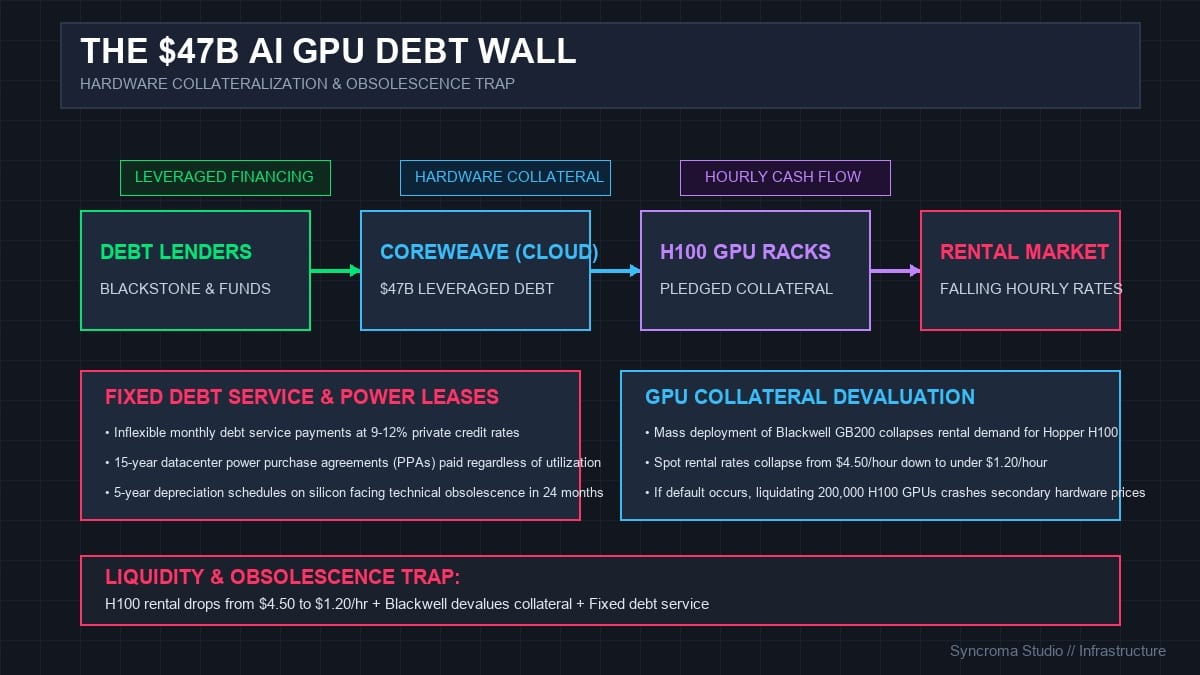
In high-performance accelerated computing, treating a GPU cluster like a commercial passenger jet is a catastrophic conceptual error:
- The Law of Brutal Technological Obsolescence: An Nvidia H100 based on the Hopper architecture does not preserve economic value for two decades. Its competitive peak profitability window spans 24 to 36 months. The mass arrival of the Blackwell architecture (such as GB200 NVL72 liquid-cooled racks) offers 3x to 5x inference efficiency per megawatt. No frontier AI laboratory will pay premium rates for legacy H100 nodes when Blackwell delivers equivalent token throughput at a fraction of data center power costs.
- The Collapse of Spot Rental Rates: In late 2023, extreme semiconductor shortages enabled neo-clouds to command spot prices reaching $4.50 to $5.00 per GPU-hour. In late 2026, the spot market for H100 clusters has plunged to $1.20 to $1.80 per hour—a crushing drop of over 65% in gross revenue generation per server node.
- Inflexible Debt Service: While hourly rental revenue drops precipitously, the fixed monthly debt service checks that CoreWeave must wire to Blackstone and its private credit consortium remain entirely unchanged.
2. The Twin Trap: 15-Year Power Purchase Agreements and 5-Year Depreciation Schedules
CoreWeave’s financial exposure extends far beyond silicon invoices. To energize hundreds of thousands of 700-watt GPUs, the company committed to multi-gigawatt utility contracts and long-term Power Purchase Agreements (PPAs) stretching across 10-to-15-year terms.
In mission-critical infrastructure, these energy contracts operate under strict "take-or-pay" covenants: CoreWeave is legally obligated to fund substation capacity reservations regardless of whether its compute nodes are running at 98% utilization or sitting entirely unutilized due to tenant churn.
Compounding this utility overhead is the depreciation mismatch:
- On public balance sheets, cloud infrastructure providers typically capitalize servers across a 4-to-5-year depreciation lifecycle to avoid penalizing near-term operating income.
- But in production engineering reality, an H100 cluster subjected to continuous 24/7 matrix multiplication workloads suffers from thermal stress on HBM3 stacks, InfiniBand transceiver failures, and near-total commercial obsolescence well before year four of the accounting schedule.
3. The Systemic Fallout: What Happens If Wall Street Seizes 200,000 GPUs?
The central question keeping infrastructure architects and debt analysts awake is not simply whether CoreWeave can refinance its near-term maturities at lower coupon rates. It is what happens to the broader AI economy if the capital loop breaks down:
- The Lender's Dilemma: If CoreWeave encounters debt service distress, private equity funds like Blackstone acquire the contractual right to foreclose on hundreds of thousands of H100 and H200 accelerators deployed across facilities in Texas, New Jersey, and Europe.
- Secondary Market Supply Shock: Private debt funds are not Kubernetes cluster administrators; they have zero appetite for managing data center optical interconnects or customer SLAs. Their rational move would be liquidating that silicon inventory to the highest bidder to claw back liquidity.
- Cratering Nvidia’s Pricing Power: If hundreds of thousands of second-hand H100s flood the wholesale market at liquidation pricing ($6,000 to $8,000 rather than $30,000 list MSRP), Nvidia’s ability to command historic gross margins on next-generation silicon will experience immediate, severe downward pressure.
Production Verdict: When Architecture Overrules Financial Modeling
CoreWeave's meteoric ascent was the purest reflection of zero-interest-rate mentality colliding with the generative AI boom. Wall Street models assumed that token demand would grow exponentially and that GPU hourly rental prices would remain permanently elevated.
In real-world software architecture, physical hardware degrades, thermal efficiency dictates total cost of ownership (TCO), and inference workloads migrate steadily toward specialized ASIC silicon.
CoreWeave must now prove that its cloud revenues can generate enough cold, hard operating cash flow to climb a $47 billion wall of debt. If it falters, it will serve as the definitive case study that durable digital infrastructure cannot be built by mortgaging hardware that devalues faster than the paper loans used to buy it.
Infographic: Syncroma Studio // Infrastructure. Sources: Financial Times, The Guardian, Reuters, Bloomberg News, SEC Disclosures.
Sistemas reales, sin humo corporativo Real systems, zero corporate hype
Recibe los análisis a fondo sobre arquitectura, consumo de recursos y computación de bajo nivel directamente en tu bandeja de entrada. Get deep-dive software architecture, resource consumption metrics, and low-level computing essays delivered straight to your inbox.
Suscribirse a Syncroma Subscribe to Syncroma

