(🇪🇸 Leer la versión en español aquí)
The product boxes for modern PCIe 5.0 NVMe SSDs boast staggering numbers designed to dazzle buyers: 14,000 MB/s sequential read and 12,000 MB/s sequential write. For anyone provisioning a local PostgreSQL cluster, an AI fine-tuning rig, or an extreme engineering workstation, the pitch sounds irresistible: saturate four lanes of PCIe Gen 5 and eliminate I/O wait times once and for all.
Yet in the reality of physical hardware, the laws of thermodynamics do not read marketing blurbs.
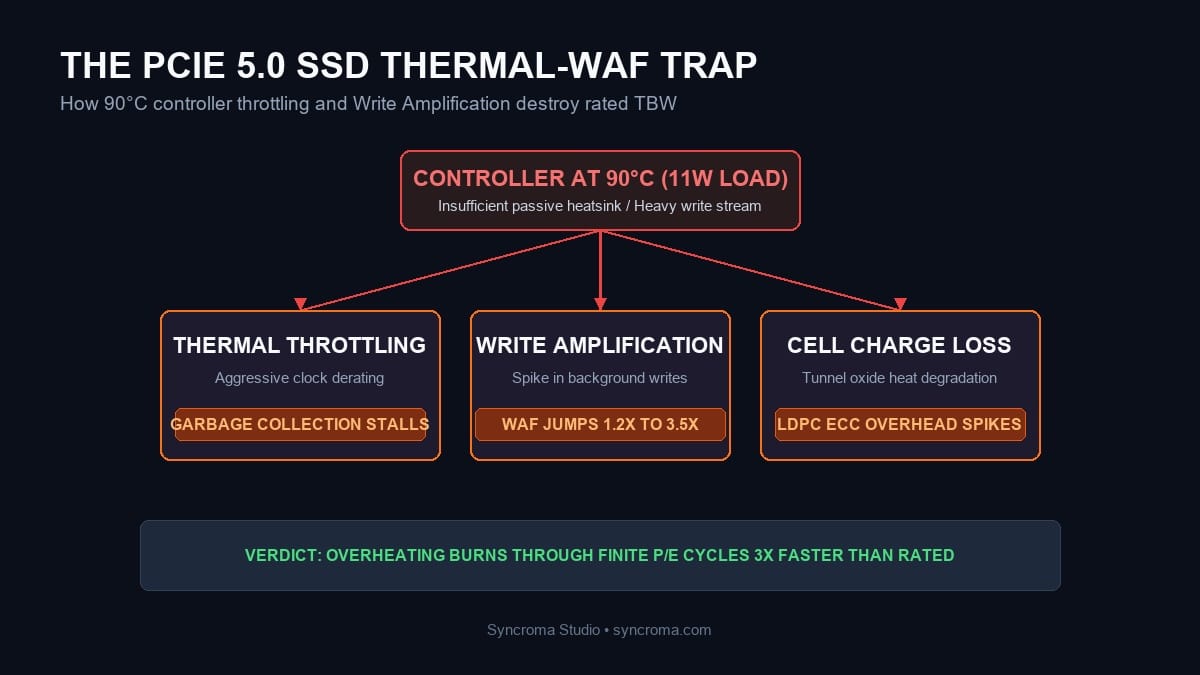
To achieve those transfer speeds across four Gen 5 lanes, current-generation flash controllers (such as the widespread Phison PS5026-E26) draw between 9.5W and 11.5W of power inside a tiny M.2 2280 form factor. If you mount one of these drives beneath the stock decorative aluminum shield that came with your motherboard, reality catches up with you in under four minutes of continuous writes: controller temperatures shoot toward 90°C, thermal throttling kicks in, and the operational lifespan of your NAND flash begins to vanish.
1. The Spec Sheet Mirage: TBW vs Real-World WAF
Every storage vendor advertises an endurance rating called TBW (Terabytes Written)—the total volume of cumulative data you can write to the drive before exhausting warranty terms. For a typical 2 TB drive using modern 3D TLC flash, manufacturers generally guarantee between 1,200 and 1,400 TBW.
The mathematical formula governing that endurance number looks simple on paper:
$$\text{TBW} = \frac{\text{Physical Capacity} \times \text{NAND P/E Cycles}}{\text{WAF}}$$
Where P/E (Program/Erase) Cycles represent the finite physical endurance of the floating-gate or charge-trap flash cells (typically 1,500 to 3,000 cycles for 3D TLC), and WAF (Write Amplification Factor) measures the ratio between the bytes your host operating system requests to write and the actual bytes the SSD controller physically commits to flash pages.
In a clean, climate-controlled laboratory setting running pure sequential writes, WAF hovers around an ideal 1.05x to 1.2x. But when an SSD is pushed under heavy, sustained production workloads in a hot chassis, the math completely breaks down.
2. The 90°C Vicious Cycle: Why WAF Surges to 3.5x
What actually happens inside a PCIe 5.0 drive when the controller climbs past 85°C–90°C during heavy ingestion—such as compiling massive monolithic repos, uncompressing 150 GB asset archives, or streaming high-throughput database WAL logs?
- Severe Controller Clock Derating: To keep silicon from permanently destroying itself past 100°C, the controller drastically drops its clock frequencies. Throughput plummets from 14,000 MB/s down to 1,200 MB/s or even 500 MB/s.
- Garbage Collection Gridlock: The SSD must continuously clear dirty NAND blocks and consolidate valid pages in the background using TRIM and internal garbage collection routines. When the controller is thermally suffocated, those maintenance tasks are delayed and fragmented, creating severe contention with incoming host write requests.
- Emergency SLC Cache Eviction: The drive is forced to dump data out of its dynamic pseudo-SLC cache into slower TLC blocks under emergency conditions. The Write Amplification Factor escapes the nominal 1.2x envelope and surges to 2.5x–3.8x.
The consequences are brutal: for every 100 GB your operating system thinks it wrote to disk, the overheated controller is physically grinding down the NAND flash cells with up to 380 GB of internal write cycles. You are burning through your hardware's finite P/E budget at nearly three times the rate calculated by the vendor.
3. Tunnel Oxide Cell Leakage & LDPC Engine Stress
Extreme thermal soak does not merely degrade firmware scheduling; it directly assaults the physical stability of solid-state memory:
- Accelerated Charge Loss: At 90°C, electrons trapped inside the floating gates experience accelerated leakage through the tunnel dielectric oxide. The programmed threshold voltage levels drift away from their nominal states, degrading raw data retention.
- LDPC Error-Correction Overhead: When the controller attempts to read those thermally stressed blocks, it encounters sharp spikes in Raw Bit Error Rates (RBER). The internal Low-Density Parity Check (LDPC) engine must shift from fast hard-decision decoding to complex, iterative soft-decision decoding. This introduces latency spikes, draws more controller power, and generates even more internal heat.
4. Hardware Directives for Production Storage
If you are deploying PCIe 5.0 drives in developer rigs, local database nodes, or high-throughput homelabs, follow these four pragmatic rules:
- Ditch Flat Motherboard Covers: A PCIe 5.0 drive cannot survive under a cosmetic flat aluminum strip. It demands a dedicated multi-fin radiator tower (such as a Thermalright HR-09 Pro) or active cooling with a dedicated 20–30 mm fan aligned with system airflow. Controller junction temperatures should never exceed 70°C under maximum sustained write load.
- Apply 15% Manual Over-Provisioning: When partitioning the drive, leave 10% to 15% of total capacity completely unallocated. That permanent free space guarantees the controller has pristine NAND blocks for background garbage collection, preventing WAF from spiking even as the drive fills past 80% capacity.
- The Pragmatism of PCIe 4.0: Ask yourself whether your software actually benefits from 14 GB/s sequential bursts. In 95% of real-world developer workloads, compiling tasks, and transactional databases, the decisive metric is low-queue-depth random 4K read performance (QD1/QD4). A top-tier PCIe 4.0 SSD (such as a Samsung 990 Pro or WD Black SN850X) delivers virtually identical random I/O responsiveness, draws half the power (5W), and never experiences a thermal crisis.
Raw speed without thermodynamic headroom is merely an expensive exercise in accelerated hardware wear. In storage infrastructure, engineers who do not monitor controller temperatures eventually pay the bill in reallocated sectors.
Technical analysis and architectural breakdown by Syncroma Studio.
Sistemas reales, sin humo corporativo Real systems, zero corporate hype
Recibe los análisis a fondo sobre arquitectura, consumo de recursos y computación de bajo nivel directamente en tu bandeja de entrada. Get deep-dive software architecture, resource consumption metrics, and low-level computing essays delivered straight to your inbox.
Suscribirse a Syncroma Subscribe to Syncroma