(🇪🇸 Leer la versión en español aquí)
The free-market myth in enterprise artificial intelligence is officially over. In a coordinated industrial policy maneuver led by the U.S. Department of Commerce, the American federal government is finalizing the formal designation of more than two dozen tech firms as "National AI Champions."
The elite roster includes the expected corporate heavyweights: Nvidia, Microsoft, OpenAI, Anthropic, Amazon, and Broadcom.
Framed diplomatically as a national security initiative to counter the global expansion of Chinese tech conglomerates like Huawei, the program establishes a de facto state-backed technological cartel. Participating companies will receive expedited export licensing, direct federal financing, and U.S. diplomats functioning essentially as overseas enterprise sales representatives.
However, in the engineering trenches of production systems architecture, the operational trade-off is stark: the institutionalization of a mandatory bundled export stack designed to dismantle digital sovereignty for foreign buyers.

1. The Bundled Stack: How the Captive AI Pipeline Works
Until now, enterprise engineering teams and sovereign governments in Europe, the Middle East, or the Asia-Pacific region could purchase raw hardware (such as Nvidia H100 or Blackwell servers), deploy them inside sovereign local data centers, and run open-weight foundation models (Llama, Mistral, Qwen, DeepSeek) with complete governance over data and code execution.
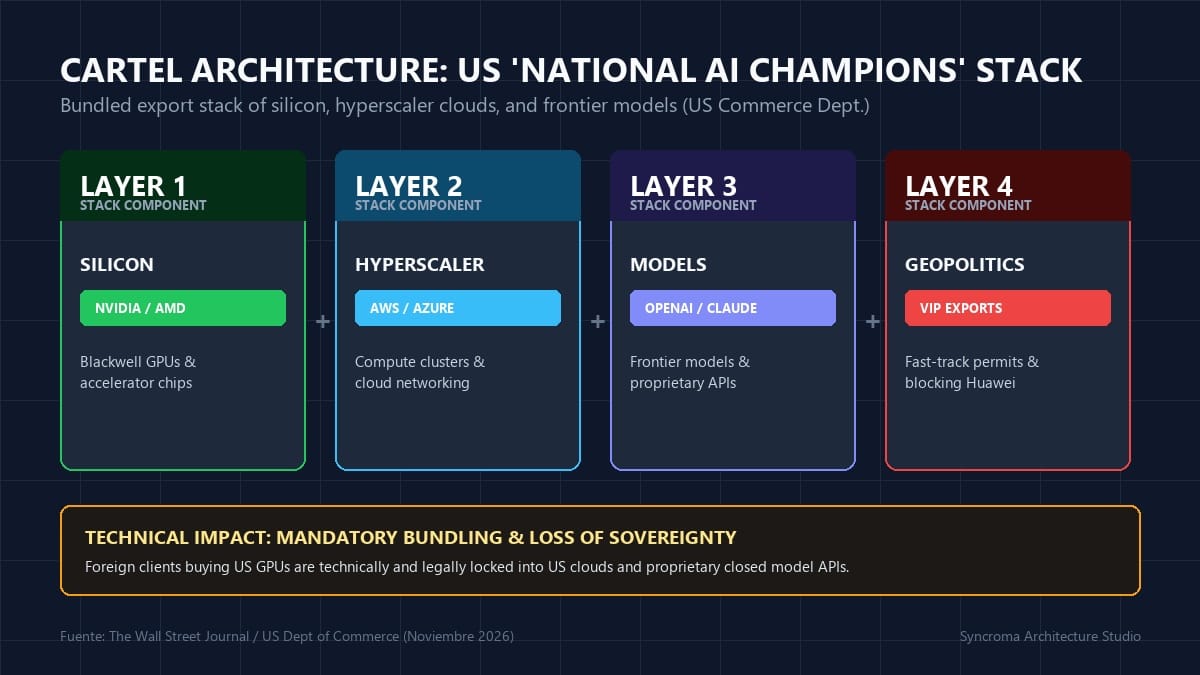
The "National AI Champions" initiative aims to replace that modular freedom with an indivisible vertical stack:
- Silicon Priority Tied to Cloud Lock-In: To bypass months of bureaucratic export license reviews by the Bureau of Industry and Security (BIS) for next-generation accelerators (Blackwell Ultra, Rubin GPUs, and high-throughput Broadcom switching silicon), foreign buyers are pressured to adopt the complete U.S. stack.
- The Indivisible Trinity: American Silicon + American Hyperscaler Cloud (AWS or Azure) + American Proprietary Frontier Models (OpenAI or Anthropic).
- Marginalizing Sovereign Open-Source Deployments: If an overseas government or enterprise attempts to procure large GPU clusters strictly to run autonomous open-source models outside the umbrella of designated champions, export clearance faces indefinite administrative hurdles.
2. The Circular Economics of the AI Megacloud
The cynicism behind the "National Champions" designation aligns seamlessly with the recent wave of cross-corporate balance sheet maneuvers:
- Amazon holds an approximate 15% equity stake in Anthropic following tens of billions committed in compute partnerships.
- Google maintains nearly 14% equity in Anthropic.
- Microsoft retains deeply embedded preferential commercial rights and Azure infrastructure exclusivity with OpenAI.
- Anthropic recently committed to a monumental $100+ billion, 10-year cloud compute expenditure spent exclusively inside AWS data centers.
Capital circulates in a closed financial loop: hyperscalers inject billions into frontier model labs, the labs return 100% of that cash back to the hyperscalers as inflated GPU rental revenue, and the federal government now safeguards this cartel using foreign policy levers and priority export permits.
3. The Death Blow to European Digital Sovereignty
For chief technology officers (CTOs) and infrastructure architects operating in Europe and international enterprise markets, this state-backed cartel redefines production risk:
| Architectural Metric | Modular Market Model (Pre-2026) | National Champions Hegemony |
|---|---|---|
| Data Governance | Sovereign on-premise hardware, localized air-gapped inference. | Exposure to U.S. Cloud Act subpoenas and remote regulatory access. |
| Hardware Agility | Heterogeneous servers, open networking, mixed accelerators. | Captive proprietary stacks (Nvidia NVLink + Broadcom + US Cloud). |
| Token Cost Economics | Self-hosted compact quantized models, custom Triton kernels. | Monopoly pricing across closed pay-per-token API endpoints. |
| Geopolitical Kill Switch | Absolute continuity: you own the physical server chassis. | Remote kill switches or service revocation if foreign policy shifts. |
If your enterprise AI stack relies on closed proprietary weights hosted inside an American hyperscaler whose executive leadership sits on government advisory councils, you do not possess an infrastructure: you possess a leased terminal subject to foreign executive orders.
4. The Engineering Path Forward: Self-Hosting & Decoupled Stacks
Pragmatic infrastructure engineers are already adapting by architecting robust defensive mitigations:
- Deploy Open-Weight Models on Sovereign Infrastructure: Run foundation models (Llama 3/4, DeepSeek, Mistral) on neutral, independent cloud and bare-metal providers (e.g., Hetzner, OVHcloud, Scaleway) that remain outside captive cartel agreements.
- Optimize Local Inference Density: Leverage modern quantization (FP8, INT4), adversarial distillation, and speculative decoding to squeeze frontier-level intelligence out of accessible hardware.
- Enforce Provider-Agnostic Gateways: Route all inference requests through self-hosted, multi-provider API proxy gateways, preventing proprietary vendor SDKs from entangling your core application logic.
To evaluate real infrastructure economics and calculate the financial break-even between cloud token APIs and dedicated on-premise hardware, use our AI API vs Self-Hosted GPU TCO Calculator or simulate production context caching limits with our LLM Token Cost & Prompt Caching Calculator.
Photo credits: Syncroma Architecture Studio / Natural daylight editorial technology and trade policy photography.
Sistemas reales, sin humo corporativo Real systems, zero corporate hype
Recibe los análisis a fondo sobre arquitectura, consumo de recursos y computación de bajo nivel directamente en tu bandeja de entrada. Get deep-dive software architecture, resource consumption metrics, and low-level computing essays delivered straight to your inbox.
Suscribirse a Syncroma Subscribe to Syncroma

