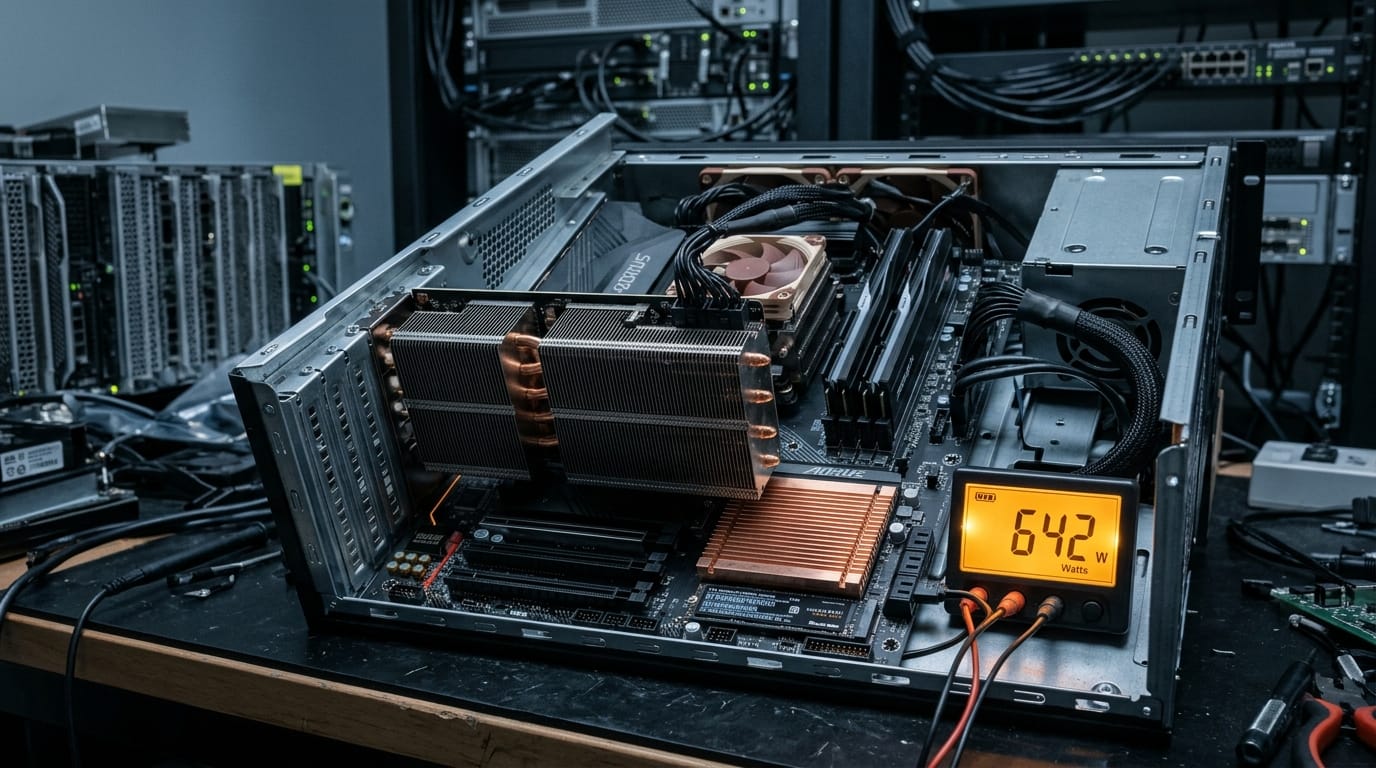
(🇪🇸 Leer la versión en español aquí)
Every few weeks, a viral headline promises the exact same free lunch: "Run a 145-billion-parameter frontier model locally on 29 GB of memory" (Emergent). This week's front-page star on Hacker News is Edge0-145B, dropped on November 13 alongside its edge0-strata runtime (GitHub Edge0, Hacker News).
Under the hood, the systems engineering is genuinely impressive. But once you skip the demo hype and inspect the official model card, the real numbers on VRAM + host RAM residency, PCIe/NVMe tail penalties, and licensing tell a much sharper story (Edge0 Model Card, AI/TLDR).
How Edge0-145B Actually Fits — and Where the Hidden Memory Bill Lives
Edge0-145B does not shrink a dense 145B transformer by magic. It is a Latent Mixture-of-Experts (MoE) derivative of Qwen3.8-Flash-Next built with 48 layers (36 linear-attention layers and one indexed-attention layer every four), 512 routed experts + 1 shared expert per layer, and top_k = 10 — putting 10.12B active parameters per token in the hot path (Edge0 Model Card).
To survive single-GPU constraints, expert inputs are compressed from 2560 down to 1792 dimensions, paired with one Multi-Token Prediction (MTP) layer for speculative decoding inside edge0-strata (a fork of Strata tuned around CPU/GPU/PCIe overlap) (Edge0 Model Card).
Now read the actual residency footprint when you turn residency on so you aren't thrashing cold storage:
Q3_Kbuild (40.81 GiBweight payload): holds23.14 GiBin GPU VRAM +31.28 GiBin host RAM =54.42 GiBactive memory total (Edge0 Model Card).NVFP4build (47.79 GiBweight payload): consumes23.25 GiBin GPU VRAM +38.27 GiBin host RAM =61.52 GiBactive memory total (Edge0 Model Card).
So where did the viral "~29 GB" or ultra-lean claim come from? From testing an RTX 5090 D throttled via Linux cgroup to a strict 16 GiB VRAM + 20 GiB RAM budget, forcing cold weights out over NVMe/PCIe. And the moment you hit that wall, throughput falls off a cliff.
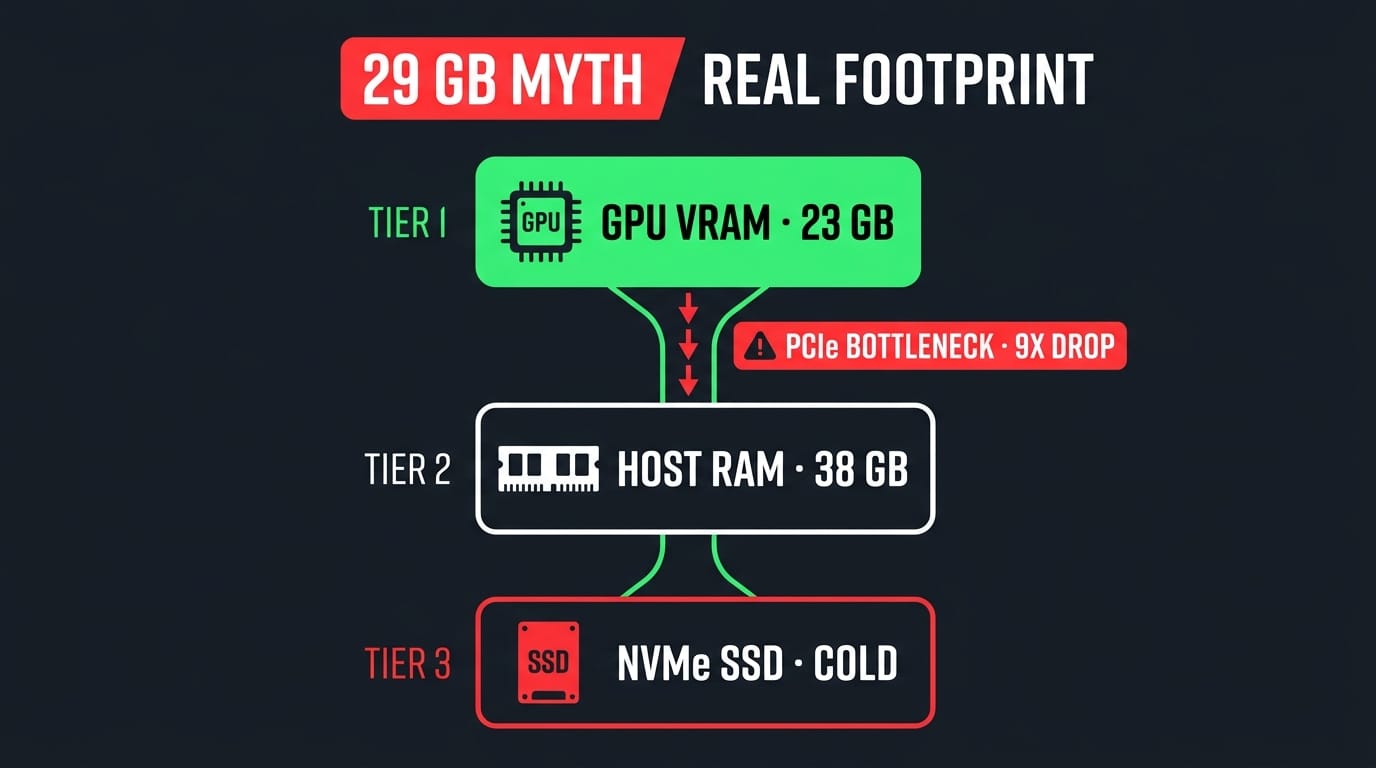
The Throughput Cliff: Nearly 9x Slower Prefill Under Tight Memory Budgets
Edge0's own published benchmarks expose exactly what happens when cold experts miss VRAM/RAM residency and have to stream across the PCIe bus (Edge0 Model Card):
| Test Hardware | Build | 4K Prefill (tok/s) | 16K Prefill (tok/s) | Chat Decode (tok/s) | Agent Decode (tok/s) |
|---|---|---|---|---|---|
| RTX 5090 D (24 GB VRAM) | Q3_K |
2,169.9 | 3,554.9 | 99.7 | 121.2 |
| RTX 5090 D (24 GB VRAM) | NVFP4 |
1,839.6 | 3,165.7 | 79.6 | 98.3 |
| RTX 4090 (24 GB VRAM) | Q3_K |
2,042.0 | 3,179.4 | 69.9 | 91.7 |
| Apple M2 Ultra (Metal) | Q3_K |
755.6 | 800.3 | 60.9 | 57.0 |
| RTX Spark N1X (60 GiB) | NVFP4 |
821.2 | 922.4 | 40.1 | 46.0 |
Capped 16 GiB VRAM + 20 GiB RAM |
Q3_K |
249.0 | 335.0 | 36.8 | 44.9 |
Notice two production realities buried inside that table:
- Prefill collapses by 88.5% under memory pressure: dropping from full residency on an RTX 5090 D (
2,169.9 tok/sat 4K;3,554.9 tok/sat 16K) down to the16 GiB VRAM + 20 GiB RAMcgroup profile (249and335 tok/s) cuts prompt ingestion nearly 9x (Edge0 Model Card). In real coding agents pushing 32K–64K of diffs and tool outputs every turn, cold prefill latency dominates wall-clock time. - Everyday laptops aren't hitting 100 tok/s: actually hitting
91–121 tok/sagent decode requires a 24 GB NVIDIA RTX 4090/5090 paired with 64 GB+ of system DDR5 so Linux page cache and host-side experts don't thrash NVMe.
Frontier Coding Scores — Plus Three Footguns Senior Engineers Caught Immediately
On coding and agent evaluations, Edge0-145B posts headline-grabbing numbers: 86.5% on Terminal-Bench 2.1 (edging out Qwen3.8-Flash-Next at 83.3%, DeepSeek-V4-Flash-0731 at 82.7%, and Claude-Opus-4.6 at 78.2%), 64.6% on DeepSWE 1.1, and 90.4% on GPQA-Diamond (Edge0 Model Card).
Yet engineers dissecting the release on Hacker News surfaced three non-trivial caveats right away (Hacker News, AI/TLDR):
- Benchmaxxing and missing per-quant evals: Because it is fine-tuned from
Qwen3.8-Flash-Nextwhile trailing slightly on general instruction/reasoning suites likeIFBench(80.6vs81.3) andHLE(35.4vs35.9), skeptics flagged potential narrow fine-tuning toward SWE/terminal leaderboards (Edge0 Model Card, Hacker News). Worse, the quality table reports only model-level scores — not separate accuracy loss for 3-bitQ3_KvsNVFP4. - Single-vendor CUDA lock-in (and broken AMD HIP): Despite broader cross-platform claims in earlier Edge0 previews, 145B and 120B explicitly target a single NVIDIA GPU, with commenters flagging broken AMD HIP support out of the box (Edge0 Model Card, Hacker News).
- Community weights, not pure OSI open source: While the
edge0inference codebase ships under Apache-2.0, the Edge0-145B weights are dual-encumbered under the Edge0 Community Model License 1.0 and the Qwen Community License (AI/TLDR). Check the commercial clauses before baking it into customer infrastructure.
The Bottom Line
Edge0-145B is a legitimate systems milestone: proving that hot/cold MoE expert placement, latent projection compression, and speculative decoding over PCIe can pull a 145B-class model down onto a single workstation GPU without paying cloud token rent.
Just ignore the "fits in 29 GB on your laptop" clickbait. In real life, keeping PCIe from strangling your prefill speed still demands 24 GB of NVIDIA VRAM plus ~31–38 GiB of free host RAM — physical memory hierarchy still collects its tax.
Visuals and conceptual infographics by Syncroma Studio.
Sistemas reales, sin humo corporativo Real systems, zero corporate hype
Recibe los análisis a fondo sobre arquitectura, consumo de recursos y computación de bajo nivel directamente en tu bandeja de entrada. Get deep-dive software architecture, resource consumption metrics, and low-level computing essays delivered straight to your inbox.
Suscribirse a Syncroma Subscribe to Syncroma

