(🇪🇸 Leer la versión en español aquí)
Cloud marketing loves selling the illusion that compute instances live above physical hardware. Then Zen 5 reminds everyone that leaky abstractions still bleed through L1 cache.
Google Cloud published a security bulletin covering 5th Gen AMD EPYC processors (codenamed "Turin") after three Transient Scheduler Attack (TSA) side-channel flaws were disclosed: CVE-2026-0004 (TSA-Fill), CVE-2024-36350 (TSA-SQ), and CVE-2024-36357 (TSA-L1) (Google Cloud Security Bulletins, RedSide Security).
Here is the operational footgun tucked inside Google's mitigation guide: patching your Linux/Windows kernel and issuing sudo reboot is not enough.
Inside the Turin Side-Channel and Affected Machine Series
Unlike textbook memory-corruption bugs, these aren't bugs you squash with a library bump. Transient scheduler side channels allow attacker-controlled code executing on the same physical CPU core to statistically infer sensitive data—cryptographic keys, session tokens, kernel secrets—from the L1D cache (RedSide Security).
| Boundary / Resource | Confirmed Scope | Mitigation Status |
|---|---|---|
| Compute Engine Series | C4D, N4D, H4D, Z4D, and G4 (including C4D/Z4D bare metal) | Powered by AMD EPYC Turin / Zen 5 silicon (Google Cloud Security Bulletins). |
| Cross-VM & Host Boundary | Tenant-to-tenant and VM-to-host attacks | Already mitigated at Google Cloud's hypervisor layer (RedSide Security). |
| Intra-VM Residual Exposure | Local process-to-process or user-to-kernel leaks | Requires customer action: guest OS patch + full Stop & Start cycle (Google Cloud Security Bulletins, RedSide Security). |
Notice that distinction: Google already locked down the cross-tenant hypervisor boundary. The blast radius sits inside your own VMs—meaning multi-tenant app servers, shared CI runners, and GKE worker nodes scheduling untrusted containers onto the same guest core remain exposed until mitigated.
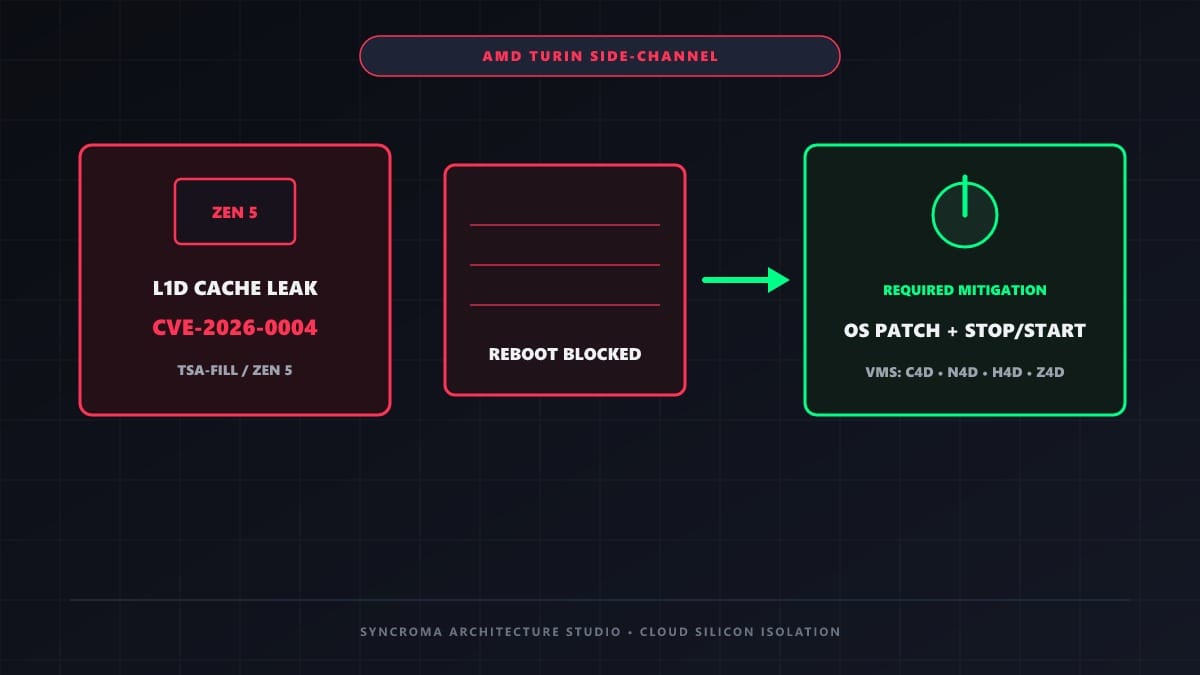
Why reboot Fails in Public Cloud (and the Production Tax)
Platform engineers routinely roll out kernel patches via unattended-upgrades, kick off an in-OS reboot, and close the compliance ticket. That assumption fails here.
A soft guest reboot keeps the VM pinned to its pre-existing virtualized CPU descriptor state. For your patched guest OS kernel to detect updated CPU flags and activate internal microcode/software mitigations cleanly, the VM must go through a complete Stop and Start cycle in Google Cloud so the updated CPU topology attaches at boot (Google Cloud Security Bulletins, RedSide Security).
Operationally, that hurts more than a rolling kernel reboot:
- Ephemeral IPs & RAM caches get wiped: A full Stop/Start drops in-memory state, forces host re-placement, and rotates non-static IPs.
- Potential context-switch tax: Just like Spectre/Meltdown generations before it, flushing or fencing speculative L1 state rarely comes with zero tail-latency cost under heavy multi-process workloads.
Production Runbook for GCP Series-D & G4 Teams
- Inventory Turin nodes immediately: Audit every VM, managed instance group, bare-metal host, and GKE node pool running on C4D, N4D, H4D, Z4D, or G4 (Google Cloud Security Bulletins).
- Ship the guest kernel patches first: Ensure your OS image includes the vendor's TSA mitigations before bouncing infrastructure.
- Drain and run staged Stop/Start cycles (
gcloud compute instances stop/start): Do not rely on guest reboots—drain availability zones gracefully so you don't turn a silicon CVE into a self-inflicted production outage.
Visuals and layout by Syncroma Studio.
Sistemas reales, sin humo corporativo Real systems, zero corporate hype
Recibe los análisis a fondo sobre arquitectura, consumo de recursos y computación de bajo nivel directamente en tu bandeja de entrada. Get deep-dive software architecture, resource consumption metrics, and low-level computing essays delivered straight to your inbox.
Suscribirse a Syncroma Subscribe to Syncroma

