
(🇪🇸 Leer la versión en español aquí)
If your production fleet serves traffic from binaries built with Go 1.24 or newer on an unpatched Linux host, your sockets silently enable Multipath TCP (MPTCP) by default—even if nobody on your team ever asked for MPTCP. That runtime default collided squarely with CVE-2026-98432 (CVSS 9.8), a critical IPv4 TCP race condition lurking in upstream Linux ever since kernel 4.4 (commit 079096f103fa, January 2016).
The disclosure turned heads because Anthropic's Frontier Red Team demonstrated an unreleased Claude model autonomously chaining the bug into a two-stage remote root exploit against MPTCP listeners—bypassing KASLR in roughly 53 minutes. Yet the operational takeaway for engineers has nothing to do with AI hype: it is how cleanly this bug leaks kernel memory without triggering a panic, and how modern language runtime defaults widen legacy kernel exposure.
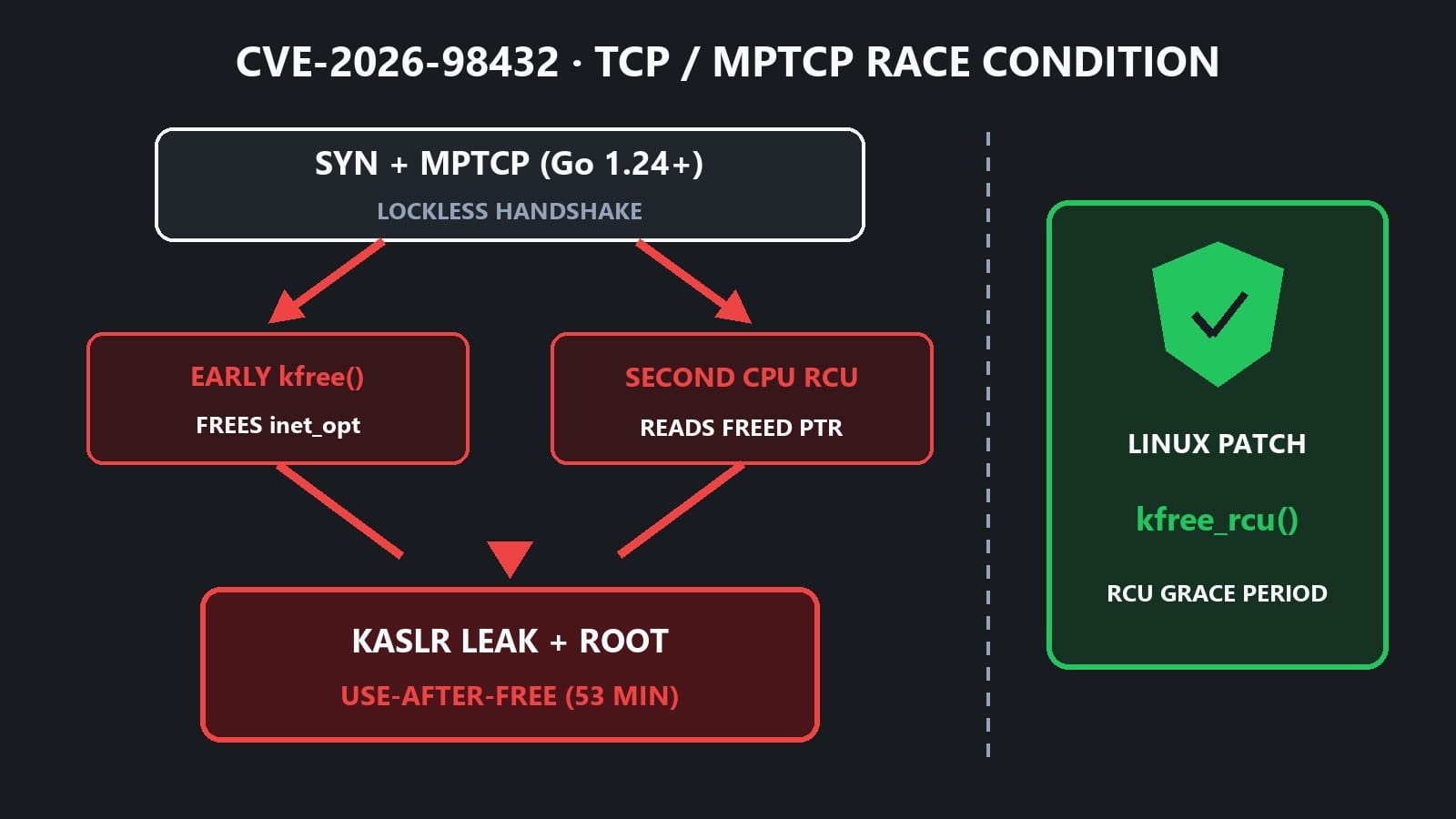
Inside the Race: Handing Off ireq_opt and Calling kfree() Early
When lockless SYN handling completes a handshake in Linux 4.4+, tcp_v4_syn_recv_sock() passes ownership of the IPv4 request socket options pointer (ireq->ireq_opt) straight onto the child socket (newinet->inet_opt) without allocating a copy:
- If a duplicate
SYNcarrying IPv4 options lands concurrently on another CPU,ip_options_build()along thetcp_check_req -> tcp_rtx_synack -> tcp_v4_send_synackpath dereferences that options structure underrcu_read_lock(). - When the child socket tears down rapidly on the first CPU,
inet_sock_destruct()frees the options object with plainkfree()instead of waiting for an RCU grace period. - The sibling CPU is left reading freed slab memory (use-after-free), giving remote attackers a primitive to harvest kernel pointers and defeat KASLR.
Reproduction Benchmarks: 128 Leaks on Stock Ubuntu Without a Single Kernel Panic
Operators often assume memory-corruption probes will at least spike oops counters or crash nodes loudly in dmesg. Independent reproduction tests published on GitHub show the opposite:
| Test Environment | Observed Behavior | Measured Rate / Time | Crash / Panic Visibility |
|---|---|---|---|
| Linux 6.12.0 + KASAN | Fires slab-use-after-free in inet_csk_route_req+0x5f4/0x680 |
197,505 attempts (~145s) | Explicit KASAN report |
Stock Ubuntu 24.04.5 (6.8.0-147-generic) |
128 verified leak detections over 5 loopback runs | 1.5–4 leaks per 100k attempts | Zero crashes / zero panics |
Upstream Commit e3f33b0a1d89 |
Replaces kfree() with kfree_rcu() on destructors |
Full RCU grace period enforced | Dangling read closed cleanly |
Read that middle row twice: a stock uninstrumented Ubuntu kernel leaks heap data 1.5 to 4 times per 100,000 handshake attempts while uptime monitors stay green. Backports of commit e3f33b0a1d89 ("ipv4: free inet_opt and ireq_opt after an RCU grace period") have already rolled out across stable branches (5.10, 5.15, 6.1, 6.6, 6.12), Ubuntu, and AlmaLinux.
Production Mitigation While Rolling Kernel Reboots
Stateful fleets cannot reboot instantaneously across every availability zone. While draining hosts:
- Shut off default MPTCP in Go 1.24+ binaries: if you do not explicitly require multipath sockets, set
GODEBUG=multipathtcp=0in runtime environments or disablenet.ListenConfig.SetMultipathTCP(false)in network servers. - Drop unexpected IPv4 header options at the firewall: adding an
nftablesdrop rule matchingip hdrlength != 5blocks malformed handshake options on the wire without restartingsystemdor waiting on kernel livepatches. - Budget reboot maintenance safely: quantify exactly how many downtime minutes your rolling kernel upgrades can spend this quarter inside our SLA Uptime & Error Budget Calculator. And if recurring tooling and cloud sprawl are draining engineering budgets too, run our Annual Subscription Audit Calculator or browse the full kit at Syncroma Tools.
CVE-2026-98432 is a blunt warning from production: AI models did not discover a magical new flaw category—they simply compressed the exploit engineering loop down to 53 minutes on a decade-old race condition amplified by modern runtime defaults.
Visual Credits: Editorial photograph of Dario Amodei (TechCrunch, CC BY 2.0 via Wikimedia Commons) and localized technical infographic by Syncroma Studio.
Sistemas reales, sin humo corporativo Real systems, zero corporate hype
Recibe los análisis a fondo sobre arquitectura, consumo de recursos y computación de bajo nivel directamente en tu bandeja de entrada. Get deep-dive software architecture, resource consumption metrics, and low-level computing essays delivered straight to your inbox.
Suscribirse a Syncroma Subscribe to Syncroma

