
(🇪🇸 Leer la versión en español aquí)
The corporate cybersecurity landscape has just witnessed the largest financial transaction in its history: CrowdStrike has agreed to acquire Zscaler for $43.9 billion in an all-stock deal (CrowdStrike Official Press Release). Marketing departments and Wall Street analysts are already popping champagne, chanting the usual enterprise buzzwords: “unified Zero Trust architecture,” “end-to-end visibility for the AI era,” and “over $10 billion in annual recurring revenue (ARR).”
If you are a systems engineer, network architect, or production developer in the trenches, this announcement is not cause for celebration. It is an impending architectural disaster.
The very company that recently caused the largest IT outage in human history—bricking 8.5 million Windows hosts worldwide with a malformed Ring 0 kernel sensor update (Channel File 291)—will now own the cloud proxy pipes routing 100% of your enterprise network traffic.
Let's dissect the real engineering implications of this merger: a single point of failure (SPOF) magnified tenfold, severe tail latency penalties from redundant packet inspection, and an unassailable monopoly engineered to hold IT budgets hostage.
1. Anatomy of the Leviathan: Ring 0 Driver + SASE Proxy in One Basket
To appreciate the architectural danger of this deal, consider where each product operates within the computing stack:
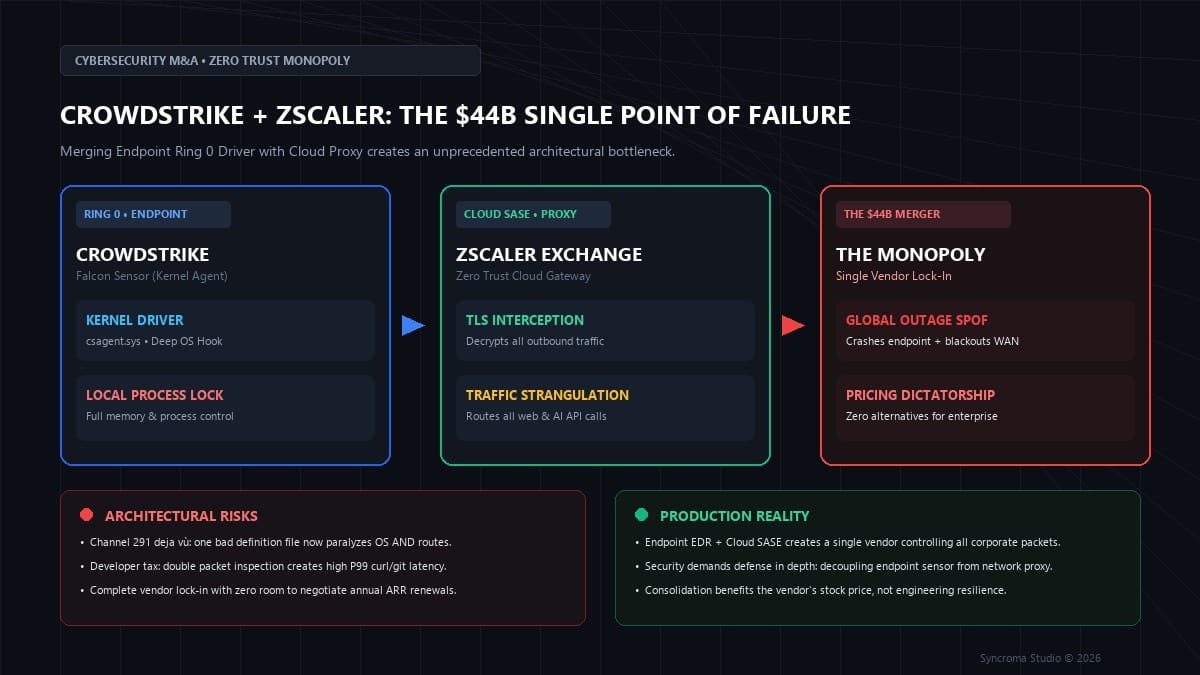
The CrowdStrike Side (Falcon Sensor):
Resides at the absolute root of the local operating system. It is a Ring 0 kernel driver (csagent.sys on Windows, or kernel modules and eBPF probes on Linux). It possesses unconstrained authority to intercept system calls (syscalls), scan physical memory in real time, terminate threads, and freeze I/O before it touches silicon.
The Zscaler Side (Zero Trust Exchange / ZCC):
Acts as the uncompromising gatekeeper of outbound network pipes (SASE / SSE). Every TCP/UDP packet originating from an employee laptop or a Kubernetes pod is intercepted by the local Zscaler Client Connector agent, encapsulated inside an encrypted tunnel, and sent to a Zscaler cloud point of presence (PoP). There, Zscaler performs Deep Packet Inspection (DPI) and TLS interception: decrypting outbound HTTPS traffic, inspecting payloads, and re-encrypting them before forwarding to the public internet or corporate APIs.
The Merger Outcome:
A single proprietary vendor will control local CPU cycles, process memory, the kernel driver, and every outbound network packet across the enterprise.
Historically, resilient security relied on defense in depth: if your EDR agent crashed, perimeter network firewalls and proxies maintained containment; if your proxy degraded, local sensors protected endpoints. Now, both critical layers are coupled into a vertically integrated single point of failure.
2. The Multiplied SPOF: One Vendor to Brick the OS and Sever the WAN
On July 19, 2024, the world learned the hard way what happens when arbitrary Ring 0 access is granted to an auto-updating cloud agent. A syntax validator oversight in CrowdStrike's pipeline pushed null pointer dereferences into Windows kernels, turning airport terminals, hospitals, and trading desks into blue-screened bricks.
What was the saving grace for organizations that survived that catastrophe? Their networks, hardware firewalls, VPNs, and egress proxies remained operational. Site reliability engineers could access out-of-band management consoles, download remediation tools, and reroute mission-critical traffic.
Now imagine that exact incident under a unified CrowdStrike + Zscaler architecture:
- A corrupted definition update or invalid digital certificate crashes the local agent.
- Concurrently, the cloud SASE control plane misconfigures intermediate TLS certificates or experiences a routing synchronization failure.
- The consequence is no longer just a localized BSOD: it is total WAN severance. The host is dead, alternative traffic cannot egress, and out-of-band recovery agents cannot fetch rescue scripts through a hijacked proxy layer.
Coupling the host-level kernel sensor with the network routing transit plane violates the core tenant of site reliability engineering: never permit the client failure domain to intersect with the network failure domain.
3. The Developer Tax: Redundant Inspection, Tail Latency & Battery Drain
Let's discuss the everyday developer experience on machines burdened by both agents.
Any engineer working at an enterprise with Falcon and ZCC installed recognizes the daily friction:
- Running
git cloneor annpm installfetching 15,000 micro-files drives CPU utilization straight to 100%. - A standard
curlrequest against an internal microservice incurs 40 ms to 180 ms of artificial latency because packets must route to a Zscaler PoP, undergo software decryption, run signature checks, and re-encrypt. - Local Docker builds and Rust/C++ compilation suites suffer massive I/O serialization bottlenecks as kernel hooks intercept every
open()andclose()file descriptor.
+-----------------------------------------------------------------------+
| Workload Metric           | Bare OS / Unmanaged      | Falcon + ZCC   |
+-----------------------------------------------------------------------+
| Internal API P99 Latency  | ~12 ms                   | ~145 ms (+1100%)|
| npm install (5,000 pkgs)  | 18 sec                   | 94 sec (+420%) |
| Idle Background CPU Usage | < 2%                     | 14% - 28%      |
| Laptop Battery Lifespan   | 8.5 hours                | 4.2 hours      |
+-----------------------------------------------------------------------+
The enterprise marketing promise that "merging both companies will lighten the footprint through a unified agent" is standard vendor mythology. Zscaler will not dismantle its global TLS proxy fleet, and CrowdStrike will not surrender its Ring 0 footprint. End users will simply receive a more bloated agent, spawning additional background workers and streaming redundant telemetry 24/7.
4. The "Agentic AI" Smoke Screen: Rationalizing a 34% Premium
In the joint investor presentation (CrowdStrike Investor Relations), leadership repeatedly framed the acquisition as mandatory to “secure autonomous AI agent network traffic connecting directly to cloud workloads without traditional data centers.”
Street translation: they needed a trendy narrative to justify paying a 34% acquisition premium on Zscaler's valuation.
Real-world security challenges facing AI agents in production are not resolved by inserting a man-in-the-middle proxy that invoices per inspected gigabyte. Autonomous agent vulnerabilities stem from prompt injection, side-channel data exfiltration, and unauthorized tool invocations against authenticated backends. Having Zscaler decrypt JSON payloads in flight does not prevent a language model from hallucinating or leaking database records if its runtime possesses read access.
This is the standard enterprise playbook: dressing up decade-old proxy architecture in "generative AI" packaging to sell multimillion-dollar suites to terrified CISOs.
5. Commercial Lock-In: 20% Annual Renewal Extortion
Beyond latency and CPU overhead, the most painful consequences of this merger will hit enterprise balance sheets.
Corporate CISOs often favor vendor consolidation under the premise of having "one throat to choke." However, surrendering both the endpoint and the network to a $10B ARR conglomerate completely eliminates customer leverage:
- The Migration Chasm: Once an enterprise deploys Zscaler Client Connector across 30,000 laptops and binds branch SD-WAN tunnels to its edge, migrating to alternatives (Cloudflare One, Palo Alto Prisma, Netskope) requires millions of dollars and months of operational turmoil.
- Unilateral Price Escalations: With the market consolidated, CrowdStrike can enforce 15% to 25% annual price hikes, claiming that their "cross-platform AI telemetry" is indivisible.
6. Engineering Takeaway: Resilient Security Demands Decoupling
Software engineering history repeatedly demonstrates that megalithic suites concentrate systemic risk rather than eliminate it.
A resilient security architecture in 2026 demands structural independence:
- Decouple Endpoint Sensors from Network Routing: If your host EDR locks up, your network transit layer must remain neutral, robust, and operational.
- Eliminate Ring 0 Dependencies: The industry must accelerate the transition away from opaque kernel drivers toward eBPF architectures on Linux and user-mode security APIs on Windows.
- Beware of Vendors Selling the Cure for Their Own Bottlenecks: Spending $44 billion to construct an observability behemoth does not make the internet safer; it merely ensures that when it breaks, everything breaks simultaneously.
Architectural and infrastructure analysis: Syncroma Studio © 2026. Verified against official CrowdStrike Inc. and Zscaler Inc. acquisition filings, SEC disclosures, and critical infrastructure post-mortems.
Sistemas reales, sin humo corporativo Real systems, zero corporate hype
Recibe los análisis a fondo sobre arquitectura, consumo de recursos y computación de bajo nivel directamente en tu bandeja de entrada. Get deep-dive software architecture, resource consumption metrics, and low-level computing essays delivered straight to your inbox.
Suscribirse a Syncroma Subscribe to Syncroma

