(🇪🇸 Leer la versión en español aquí)
The entire multi-tenant economic model of modern cloud computing rests upon a single non-negotiable contract: a guest virtual machine cannot inspect or manipulate a single byte of memory belonging to the physical host or its adjacent hardware neighbors. AWS, Microsoft Azure, Google Cloud, and enterprise on-premises clusters operate under the assumption that hardware-assisted hypervisors provide an impenetrable security perimeter.
That foundation just developed a catastrophic crack.
Security researchers have disclosed the full architecture of CVE-2026-99312, a high-severity vulnerability in the Linux kernel's KVM (Kernel-based Virtual Machine) hypervisor subsystem when operating on AMD processors with Nested Virtualization (AMD SVM) enabled. The flaw allows an unprivileged tenant with root access inside a commodity $15/month guest virtual machine to trigger an arithmetic boundary bypass in nested page table (NPT) emulation, forge host-physical memory mappings directly into Ring 0, and stream up to 127 gigabytes of physical server host RAM in cleartext.
[ GUEST VM (Attacking Cloud Tenant) ]
        │
        ├── Forged VMCB structures (Nested AMD SVM)
        ├── Manipulated NPT (Nested Page Tables) directory
        ▼
[ LINUX KVM HYPERVISOR (Boundary Validation Failure) ]
        │
        ├── KVM fails physical host memory boundary check
        ▼
[ RAW HOST PHYSICAL RAM DUMP: UP TO 127 GB ]
        ├── Master TLS / SSH private keys in memory
        ├── Production Kubernetes secrets & environment variables
        └── Adjacent tenant databases (Postgres, Redis, MySQL)
Anatomy of the Breach: When Nested Paging Forgets Boundary Checks
To understand why CVE-2026-99312 is devastating in multi-tenant environments, one must look at how AMD processors and the Linux kernel coordinate address translations through Nested Page Tables (NPT).
In standard bare-metal virtualization, hardware translates Guest Physical Addresses (GPA) into Host Physical Addresses (HPA) using CPU-level page-table walking. When developers and enterprise teams enable nested virtualization—standard practice for modern CI/CD runners, container-in-VM workloads, and nested Kubernetes hypervisors—the L0 host hypervisor must software-emulate the virtualization hardware for the inner L1 hypervisor.
The vulnerability resides within arch/x86/kvm/svm/nested.c. While parsing AMD's Virtual Machine Control Block (VMCB) structures, a race condition paired with flawed bounds checking during nested page directory walk calculations permits a malicious L1 guest to tamper with its internal page directory base register (nested_cr3).
By feeding an intentionally misaligned VMCB descriptor immediately prior to executing the VMRUN CPU instruction, the Linux host kernel fails to assert whether the resolved memory page falls inside the allocated QEMU/KVM virtual machine physical range. Instead of halting the offending VM with a General Protection Fault (#GP), KVM treats the out-of-bounds address as legitimate and assigns a page descriptor pointing straight into the physical memory of the host server.
From that moment, the unprivileged guest VM can sequentially suck down raw host physical memory at sustained rates between 1.8 and 3.4 GB/s, draining up to 127 GB before tripping an MMU consistency trap that crashes the physical node.
Architectural Infographic: KVM Hypervisor Isolation Breakdown
The following diagram illustrates the complete exploitation chain allowing an unprivileged tenant to shatter hypervisor boundaries:
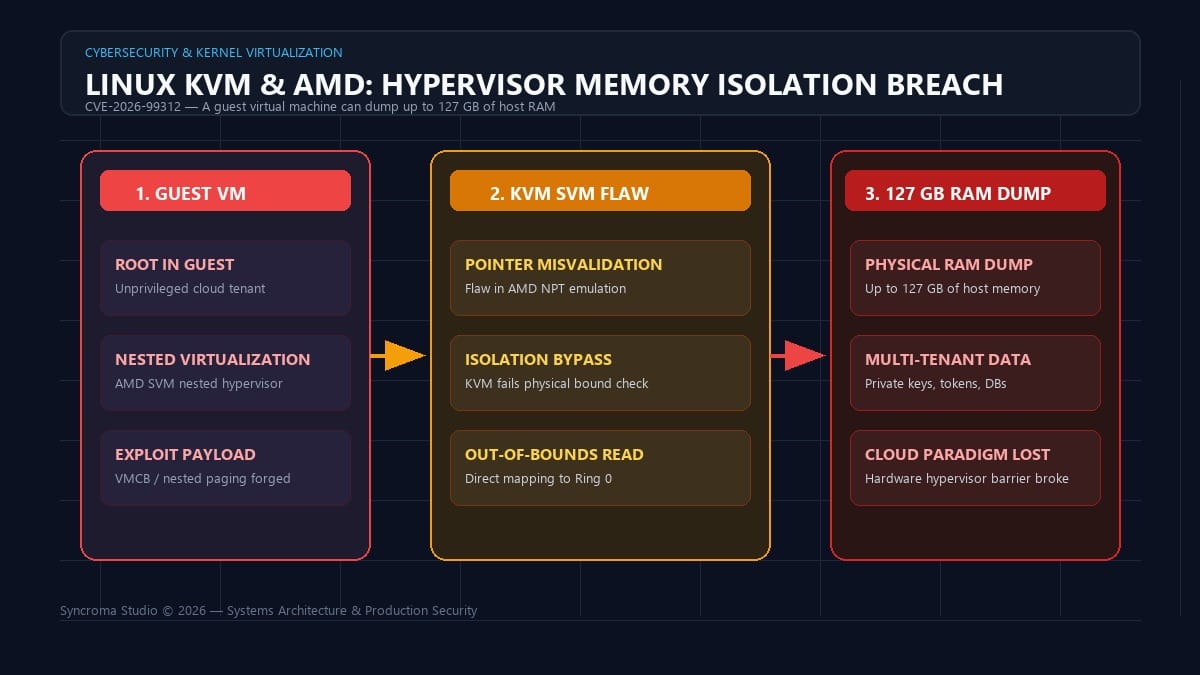
(Credit: Syncroma Studio © 2026 — Systems Architecture & Production Security)
The Host Memory Spoils: What Leaks in a 127 GB RAM Dump?
In an enterprise virtualization node or a shared public cloud host running AMD EPYC silicon, 127 GB of physical host RAM is not an abstract concept. It represents the real-time operational heart of everything running on that physical box:
- Master Cryptographic Keys: Unencrypted TLS termination private keys, Kubernetes cluster tokens, JWT session signing secrets, and filesystem encryption keys resting in host kernel slab caches and adjacent QEMU address spaces.
- Production Databases in Memory: Database memory buffers (PostgreSQL Shared Buffers, Redis key-value stores, MySQL InnoDB pools) belonging to other companies hosting their workloads on the exact same physical server.
- Total Evaporation of Multi-Tenant Trust: The hypervisor ceases to be a hardware sandbox and turns into an open file descriptor.
Patch Status & Immediate Production Mitigations
Kernel patches addressing CVE-2026-99312 have been merged into mainline Linux and backported across major enterprise distributions (RHEL, Ubuntu LTS, Debian, SUSE).
The fix implements strict physical bounds assertion (npt_address_bounds_check()) within svm_check_nested_events() prior to allowing any nested AMD SVM context switch.
1. Zero-Downtime Immediate Mitigation:
If you manage production clusters powered by AMD EPYC or Ryzen processors and cannot immediately reboot your hypervisors to deploy the updated kernel, disable nested virtualization at runtime. This neutralizes the attack surface instantly (nested VMs will fail to start until patched):
# Check if AMD nested virtualization is enabled on the hypervisor host
cat /sys/module/kvm_amd/parameters/nested

# If returns 1, disable persistently in /etc/modprobe.d/kvm-amd.conf:
options kvm_amd nested=0
2. Distribution Upgrades:
- Debian / Ubuntu: Update
linux-image-*to the latest security point release and perform rolling reboot orchestration. - RHEL / Rocky / AlmaLinux: Run
dnf update kerneland use KVM live-migration to evacuate physical nodes before applying kernel restarts.
🛠️ Recommended Storage Engineering Tool:
Managing enterprise storage pools? Estimate exact disk rebuild hours and catastrophic URE read failure risk using our ZFS Resilver & Rebuild Time Calculator.
The Syncroma Verdict: The Hidden Tax of Frictionless Cloud
The enterprise software industry has spent a decade assuring CIOs that multi-tenant cloud virtualization is indistinguishable from bare-metal isolation in private cages. Systems engineering tells a different story: a hypervisor is not a fundamental law of physics; it is millions of lines of C code running in Ring 0, constantly optimized for latency and throughput.
Nested virtualization is a massive developer convenience for CI pipelines and local test environments. But leaving it enabled by default in multi-tenant production clusters shared across untrusted tenants is operational roulette. If your architecture relies on the perfection of hypervisor bounds checking to protect sensitive customer databases on shared hardware, you are always exactly one pointer arithmetic bug away from handing your entire company's memory space to the tenant next door.
Sistemas reales, sin humo corporativo Real systems, zero corporate hype
Recibe los análisis a fondo sobre arquitectura, consumo de recursos y computación de bajo nivel directamente en tu bandeja de entrada. Get deep-dive software architecture, resource consumption metrics, and low-level computing essays delivered straight to your inbox.
Suscribirse a Syncroma Subscribe to Syncroma