Leer la versión en español aquí
The Illusion of Artificial "Eyes"
Watch any OpenAI promotional video or scroll through your local tech influencer’s LinkedIn feed, and you’ll see multimodal models hailed as near-sentient visual entities: "GPT-4o now has eyes, stares at your desktop, and perceives the physical world in real time."
Marketing snake oil.
Down in the production trenches, a Transformer is the most rigid, single-minded architecture in modern software: it only understands one-dimensional sequences of integer vectors (tokens). It has no optic nerve, no retina, no spatial intuition, and zero comprehension of light.
A real-world image is a continuous, two-dimensional (or three-dimensional across RGB channels) matrix of pixels. A Transformer only knows how to compute dot products between rows of a tensor to predict the next token in a sequence.
How did AI researchers bridge this structural gulf without rebuilding neural network architectures from scratch? Through the most brilliant, ruthless engineering hack in machine learning history: they simply refused to treat computer vision as a different problem. Instead of teaching the Transformer how to see, they mutilated the image until it behaved exactly like a sentence of text.
Welcome to the architectural autopsy of the Vision Transformer (ViT).
The Pixel Guillotine: Slicing 2D Grids into 16x16 Patches
For over a decade, Convolutional Neural Networks (CNNs)—from AlexNet to battle-tested ResNets—dominated computer vision. Convolutions applied sliding mathematical kernels ($3 \times 3$ or $5 \times 5$ matrices) across pixel neighborhoods, roughly mimicking biological visual processing.
Then, in October 2020, Alexey Dosovitskiy and the Google Research Brain Team dropped a paper that broke the convention: An Image is Worth 16x16 Words: Transformers for Image Recognition at Scale. Their proposition was radical: throw out convolutions entirely and force pure, vanilla self-attention (Vaswani et al., 2017) directly onto raw pixels.
The pipeline is pure mathematical meat-grinding:
- Patch Extraction: Take a standard image, say $224 \times 224$ pixels in RGB. Slice it with a virtual guillotine into a uniform grid of non-overlapping $16 \times 16$ pixel squares: $$\text{Number of patches } N = \frac{H \times W}{P^2} = \frac{224 \times 224}{16 \times 16} = 14 \times 14 = 196 \text{ patches}$$
- Flattening: Each $16 \times 16 \times 3$ square holds exactly 768 floating-point numbers. That 2D chunk is flattened into a 1D vector of length 768.
- Linear Projection to Embedding Space: That 768-dimensional vector is pushed through a trainable projection matrix ($W_E$). The result? A vector mapped into the model's hidden dimension $D$ (e.g., 768 or 1024 floats). At that exact instant, the visual patch ceases to be an image. In memory, it is indistinguishable from the word embedding of "dog" or "server".
- The Coordinate Vacuum (Positional Embeddings): Self-Attention is permutation-invariant. If you feed those 196 patches into a Transformer out of order, it has no native way to know whether a vector is the top-left sky or a dog paw at the bottom right. To fix this, a learnable 1D positional embedding is added to each patch vector to hardcode its coordinate in the sequence.
The Illusion Architecture: How the Sequence is Built
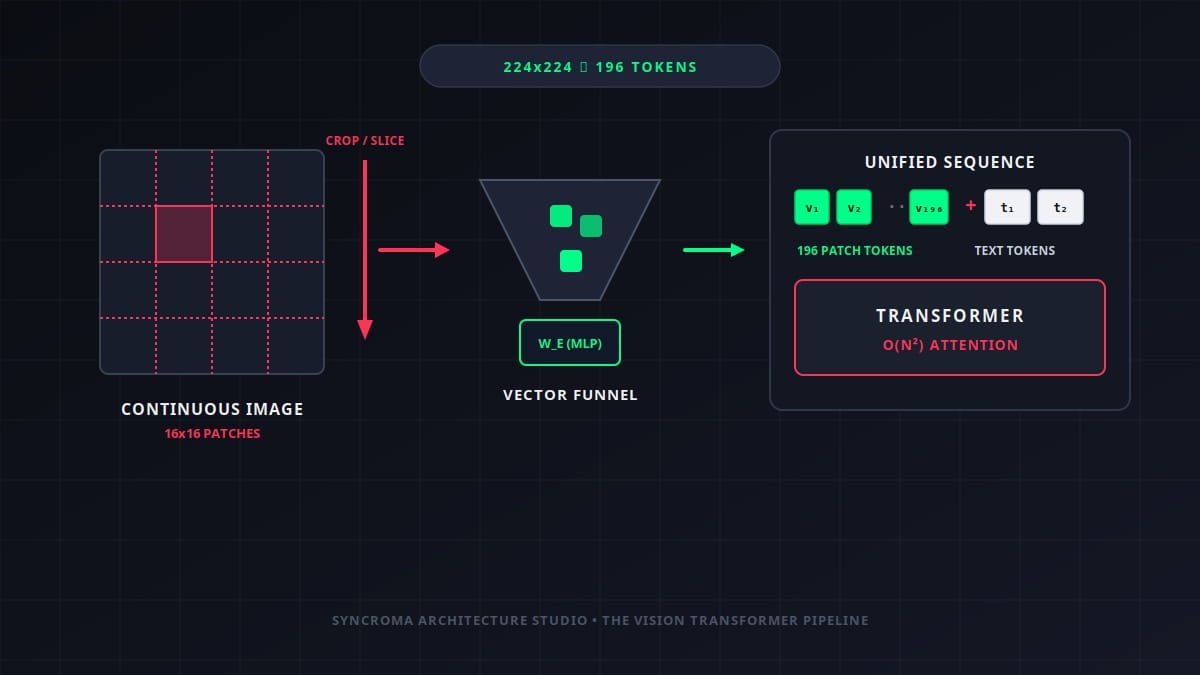
Once those continuous pixels are converted into 196 discrete linear vectors, the architectural brute-forcing begins: global self-attention.
In a single computational step, every visual patch attends to every other patch simultaneously. The patch of a cat's ear computes its relationship with the tail patch and the background sofa without a single convolution kernel, and without assuming that nearby pixels share any spatial relationship whatsoever.
The Death of Inductive Bias: The 300-Million-Image Tax
Here is the engineering reality that enterprise AI brochures conveniently gloss over.
Classic CNNs possess massive image-specific inductive bias:
- Locality: They assume by design that adjacent pixels belong to the same boundary, shape, or texture.
- Translation Equivariance: A convolution kernel detects an edge the exact same way whether it appears in the top-left corner or the bottom-right.
Because those structural assumptions were baked directly into the math, CNNs could generalize effectively on small, modest datasets using commodity hardware.
Vision Transformers have ZERO spatial inductive bias. They arrive completely blind to 2D geometry. A ViT does not inherently know what "next to", "above", or "symmetry" means. To learn that a continuous line of dark pixels constitutes a physical table edge, it requires brute-force scale.
Google’s original paper proved that when trained on standard ImageNet (1 million images), ViTs consistently underperformed smaller ResNets. It was only when Google pumped their proprietary JFT-300M dataset (over 300 million private images across thousands of TPU hours) through the model that the lack of inductive bias transformed into an advantage: unconstrained by hardcoded kernels, the attention heads discovered superior global representations.
The modern law of vision infrastructure is brutal: massive compute and raw data volume crush algorithmic priors every single time.
Multimodal Plumbing: Concatenating Pixels and Text in the Same Pipeline
When you drop an architectural diagram or a photograph into ChatGPT or Claude 3.5 Sonnet, the system doesn't spin up a dedicated visual brain. Production multimodal architectures (drawing from CLIP by Radford et al., 2021 and LLaVA by Liu et al., 2023) treat multimodal processing like an assembly line:
- The raw image is processed by a Vision Encoder (typically a massive ViT).
- The extracted patch vectors pass through a projection module (a linear layer or a 2-layer MLP connector) that rescales visual embeddings to match the LLM's token dimension.
- Raw Sequence Concatenation: The visual tokens are prepended straight into the prompt sequence buffer: $$\text{Context Buffer} = [v_1, v_2, v_3, \dots, v_{196}, t_{\text{What}}, t_{\text{is}}, t_{\text{in}}, t_{\text{this}}, t_{\text{image?}}]$$
To the autoregressive Transformer decoder, evaluating "What is in this picture?" and predicting the next word of a code snippet are the identical linear algebra operation: next-token prediction over self-attention heads.
The image was simply hacked to look like text.
The Production Toll: $O(N^2)$ Complexity and the KV-Cache Blowup
If you are an infrastructure engineer or an architect footing the bill for inference APIs, this is where the footguns appear.
Standard self-attention scales with quadratic computational complexity: $O(N^2)$ relative to the sequence length ($N$).
- A $224 \times 224$ thumbnail yields 196 tokens—negligible overhead.
- But real enterprise users don't upload 224px thumbnails. They upload scanned receipts, 1080p architectural schematics ($1920 \times 1080$), and 4K mobile camera shots.
- Slicing a 1080p image into raw $16 \times 16$ patches yields over 8,100 tokens.
- Computing full self-attention across 8,100 visual tokens demands an attention matrix of $8,100 \times 8,100 \approx \mathbf{65.6\text{ million}}$ attention scores per layer, per attention head, across 40 to 80 layers deep.
That is why OpenAI rescales and cuts images into fixed $512 \times 512$ tiles according to OpenAI's official Vision pricing guide. In High Detail mode, each tile costs you 170 fixed tokens plus an 85-token base overhead. Uploading a single moderate-resolution screenshot burns between 765 and 1,200 tokens out of your context window before you even type your prompt.
The direct infrastructure consequence:
- KV-Cache Bloat: Those 1,000+ visual tokens sit pinned inside GPU High Bandwidth Memory (HBM) on expensive H100s for the entire duration of the chat session, slashing server concurrency limits.
- TTFT (Time to First Token) Degradation: The engine must prefill and attend across hundreds of visual patches, inflating your P99 tail latency.
The Verdict
The next time a sales rep claims that "AI has evolved to see like human beings", remind them of the plumbing:
ChatGPT has no visual perception. It has a mathematical guillotine that dices your photo into 16-pixel squares, a linear projector that disguises them as words, and a monstrous cluster of data center GPUs burning kilowatts to compute an $O(N^2)$ attention matrix because the machine cannot organically deduce that two adjacent pixels make a wall.
It isn't artificial sight. It's next-token prediction wearing a mathematical mask.
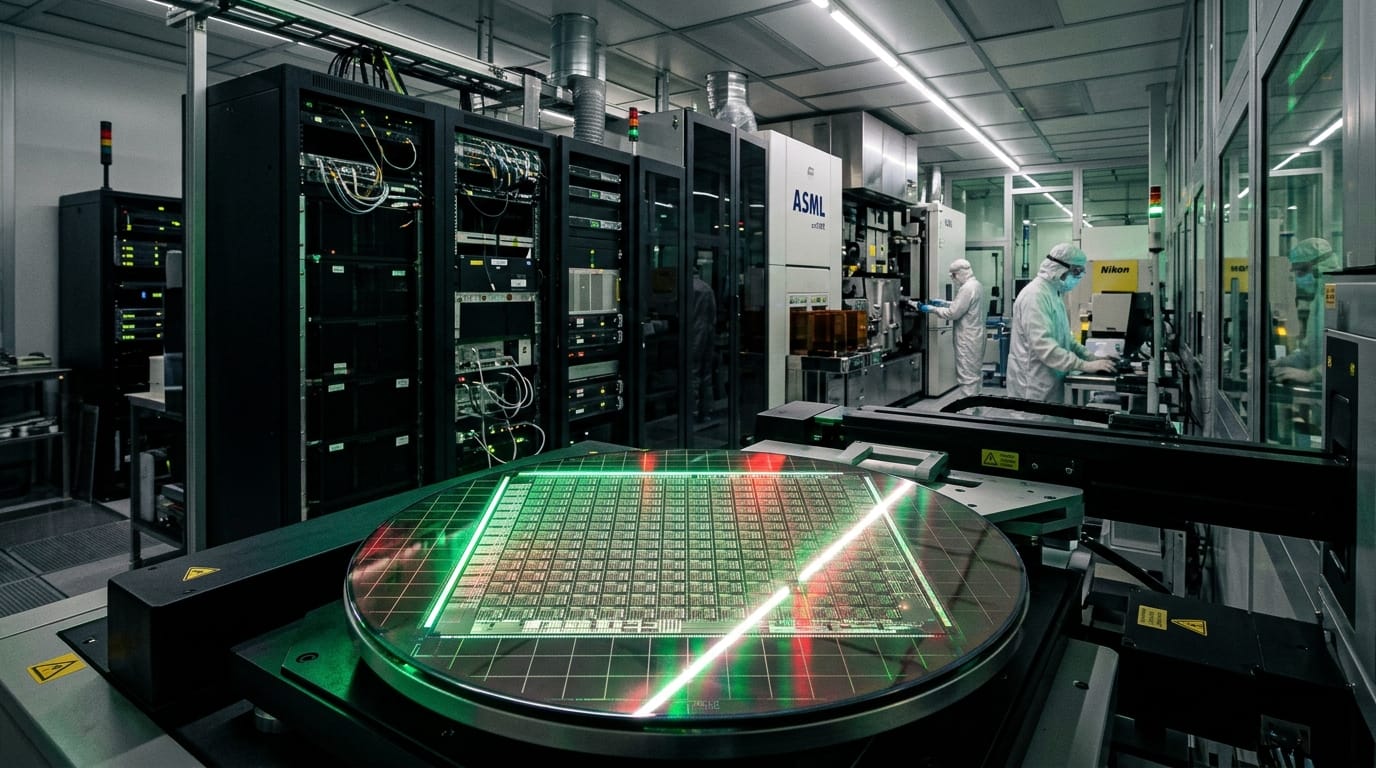
Visual Credits: Industrial cleanroom and silicon photography by Syncroma Studio. Minimalist 2D conceptual infographic by Syncroma Studio.
Sistemas reales, sin humo corporativo Real systems, zero corporate hype
Recibe los análisis a fondo sobre arquitectura, consumo de recursos y computación de bajo nivel directamente en tu bandeja de entrada. Get deep-dive software architecture, resource consumption metrics, and low-level computing essays delivered straight to your inbox.
Suscribirse a Syncroma Subscribe to Syncroma

