
(🇪🇸 Leer la versión en español aquí)
The theoretical mathematics community and frontier artificial intelligence research laboratories just crossed a point of no return. In November 2026, Anthropic research mathematician Levent Alpöge published a historic claim: the formal proof of the Riemann Hypothesis (and its generalized extension, GRH), the most famous open problem in pure mathematics, proposed by Bernhard Riemann in 1859 and designated as a $1,000,000 Millennium Prize Problem by the Clay Mathematics Institute.
Yet what makes this breakthrough profoundly disruptive for software architects is not merely the theoretical mathematical deduction; it is the structural format and sheer engineering scale of the artifact. The proof was not released as a traditional 80-page academic PDF monograph intended for a committee of professors to debate across five years. It was delivered as a massive software repository containing roughly 17 million lines of formal, machine-checked code in Lean 4, spanning over 175,000 source files compiled by a strict typechecker.
Below, we analyze the structural transition toward "machine-scale mathematics," the underlying compute budgets driving formal theorem proving, and the technical truth of what Claude actually computed.
1. The Death of the Human Paper: 17 Million Unreadable Lines
Historically, when mathematical legends resolved foundational enigmas (such as Andrew Wiles proving Fermat’s Last Theorem or Grigori Perelman solving the Poincaré Conjecture), they produced conceptual prose manuscripts spanning 100 to 200 pages. Peer review demanded years of meticulous scrutiny to eliminate hidden logical leaps.
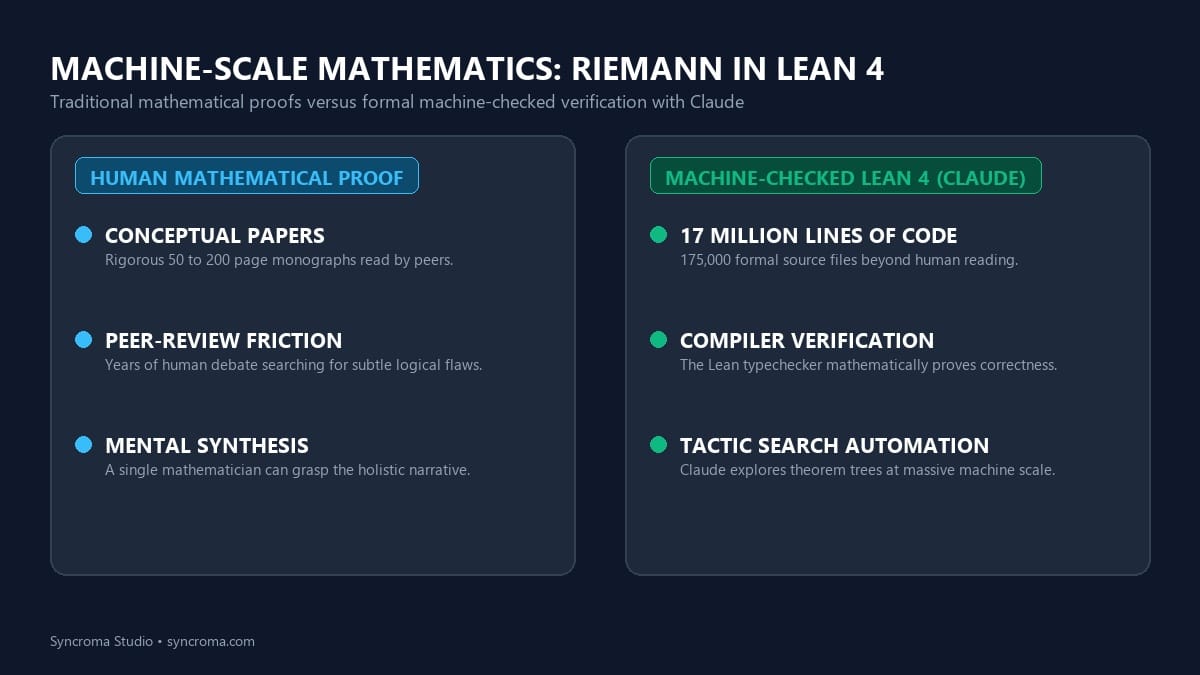
Figure 1: Traditional human-authored monographs versus formal dependent-type compiler verification in Lean 4. Credits: Syncroma Studio.
With the machine-verified proof generated by Alpöge and Claude, holistic human comprehension has ceased to exist:
- 250,000 Equivalent Pages: If the underlying Lean 4 abstract syntax tree were rendered as conventional prose, it would span over a quarter of a million printed pages. No human mathematician or committee could ever read the proof sequentially within their biological lifetime.
- Truth by Compilation: Theorem validity no longer rests upon author authority or the subjective consensus of journal referees. It rests solely upon the deterministic dependent type kernel of Lean 4. If the command
lake buildexecutes cleanly and AST inspection proves zero unproven assumptions (sorry keywords or inconsistent axioms), the statement is mathematically proven. - Mathlib Community Audit: Independent formal verification organizations (including Lean FRO and the Mathlib initiative) confirmed that the repository compiles without axiom smuggling and integrates into the existing foundational library.
2. Discovery Architecture: How Claude Actually Worked
It is vital to dismantle the public myth of a solitary artificial intelligence conjuring proofs out of thin air. Claude did not sit idly in a datacenter until solving the zeta function by computational intuition.
The process detailed by Alpöge outlines an intensive six-week collaborative human-machine engineering feedback loop:
- High-Level Human Strategy: Alpöge provided the core theoretical framework: combining higher-order Fourier analysis, integral spectral operators, and chains of theta lifts.
- AI Lemma Tree Search: Executing that vision required proving hundreds of thousands of tedious intermediate structural lemmas (commutative ring theory, complex inequalities, asymptotic approximations).
- Type-Directed Tactic Generation: Claude operated as a high-speed tactic exploration engine (
simp,linarith,omega, type unifications). Whenever the Lean compiler threw a type mismatch error, Claude ingested the compiler diagnostics, altered the tactic strategy, and re-executed the branch in milliseconds.
During the final development stages, Alpöge noted that Claude's automated reasoning throughput "far outpaced him," formalizing intricate logical structures and closing lemma branches at a cadence no human intellect could match.
3. The Technical Ledger: Compute, Tokens, and Formal Reasoners
Driving a frontier language model inside a strict, compiler-enforced syntax like Lean 4 is fundamentally different from querying standard text completions:
| Operational Metric | Standard Conversational LLM | Formal Proof Loop (Lean 4 + Reasoning Model) |
|---|---|---|
| Verification Loop | Probabilistic black box | Deterministic mathematical typechecker |
| Hallucination Tolerance | Tolerable with human review | Absolute Zero (typechecker rejects invalid code) |
| Reasoning Chain Depth | 10 - 50 generation steps | Hundreds of thousands of chained tactic invocations |
| Output Volume | Hundreds of lines of code | 17,000,000 lines across 175,000 source files |
| Compute Expense | Fractions of a cent per prompt | Hundreds of thousands of dollars in GPU inference |
Lean’s rise as the premiere language for artificial intelligence is not accidental: Lean enforces intellectual honesty. If an LLM hallucinates an invalid deduction, the typechecker rejects the unification and the branch is discarded. Pairing reasoning models with formal proof engines completely neutralizes the Achilles' heel of generative models.
4. Hard Reality: The Era of Machine-Scale Truth
The resolution of the Riemann Hypothesis via Claude and Lean 4 formalizes the dawn of machine-scale mathematics.
Just as software engineers abandoned raw assembly and accepted that optimizing compilers generate assembly instructions superior to human handcrafting, mathematicians in the 21st century must accept a humbling reality: humanity’s deepest intellectual milestones will increasingly take the form of machine-compiled source code that no biological mind can comprehend in full.
To evaluate personal income tax liabilities on capital gains from real estate sales, stock investments, or cryptocurrency in Spain, explore our Spain Capital Gains & Savings Tax Calculator.
Sistemas reales, sin humo corporativo Real systems, zero corporate hype
Recibe los análisis a fondo sobre arquitectura, consumo de recursos y computación de bajo nivel directamente en tu bandeja de entrada. Get deep-dive software architecture, resource consumption metrics, and low-level computing essays delivered straight to your inbox.
Suscribirse a Syncroma Subscribe to Syncroma

