
(🇪🇸 Leer la versión en español aquí)
For two years, OpenAI has operated under the perpetual existential threat haunting all AI infrastructure providers: being treated as an interchangeable utility commodity. When an engineering team or enterprise interacts with ChatGPT solely through a chat prompt window or an API completion endpoint, the switching cost to move workloads over to Anthropic’s Claude 3.5 Sonnet or Google’s Gemini 2.0 is virtually zero. It takes an engineer ten minutes to rewrite a base URL and swap an authorization header.
To eradicate that customer churn at the architectural root, OpenAI has launched the global rollout of ChatGPT Space to all ChatGPT Plus subscribers. What superficially presents as a tidy interface redesign permanently expunging the "Library" tab from the left sidebar is, in operational truth, an aggressive enterprise SaaS enclosure: a collaborative living-document suite designed to cannibalize Notion, Confluence, and Google Docs, underpinned by a ruthless monetization rule: no one can open or review a shared document without paying $20 per month.
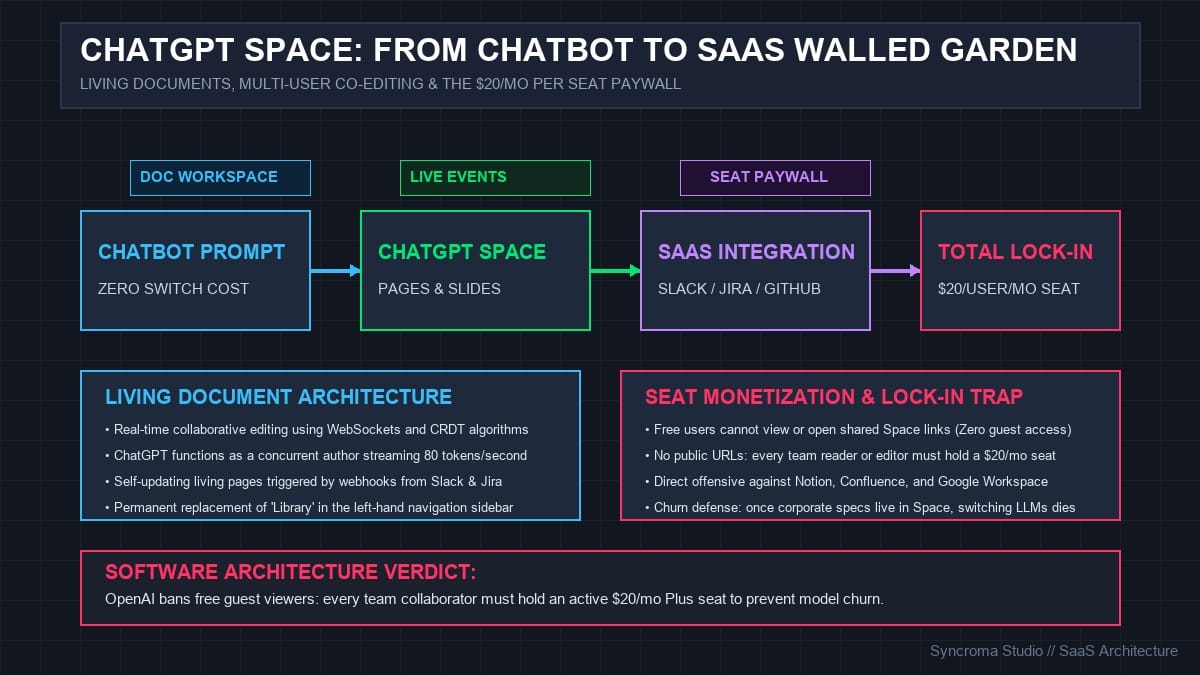
Infographic: The transition from transactional chatbot prompts to the walled garden of living documents in ChatGPT Space. Credit: Syncroma Studio.
1. The Death of Collaborative Freemium: Zero Public Web Links
The explosive viral growth of digital collaboration pioneers—from Google Docs and Figma to Notion—was engineered on frictionless onboarding: a paying user drafts an artifact, generates a public read-only link or invites external stakeholders, and anyone holding a free or anonymous account can participate.
In ChatGPT Space, OpenAI has deliberately broken this precedent:
- Free Accounts Completely Barred: A free-tier ChatGPT user cannot even view a shared Space document. Clicking a collaborator’s URL triggers an immediate hard authentication wall demanding an active Plus ($20/mo), Pro ($200/mo), Business, or Enterprise commercial license.
- Zero Public Web Sharing: There is no "anyone with the link can view" toggle. All workspace data is locked within an authenticated proprietary silo hard-coupled to paying user IDs.
- The Team Tax: If an engineering lead wants product managers, compliance officers, and executive peers to review a technical specification drafted in Space, every single participant must carry a dedicated $20/month seat merely to post an inline comment.
Sam Altman’s corporate calculation is transparent: coerce entire teams into high-margin recurring seat licenses before competing frontier labs can integrate comparable collaborative document canvases into their own ecosystems.
2. Technical Engineering: Merging 80 Tokens/sec Streams with CRDT Trees
Beyond commercial economics, the technical complexity required to operate ChatGPT Space is substantial. In conventional document engines like Notion or Google Docs, multi-user concurrency is mediated via Operational Transformation (OT) or Conflict-free Replicated Data Types (CRDTs) over persistent WebSockets, reconciling human keystrokes arriving at human typing speeds (typically 4 to 8 characters per second).
In ChatGPT Space, the large language model functions as an unpredictable, high-velocity concurrent co-author:
- While a human engineer edits a function signature at the top of a document, ChatGPT may stream code refactoring blocks or markdown tables at 60 to 90 tokens per second via Server-Sent Events (SSE) bound to the collaborative document tree.
- Preventing race conditions and phantom overwrites without freezing the client UI requires fine-grained block-level isolation and strict atomic mutation locks.
- "Living Pages" support asynchronous event ingestion from external SaaS webhooks (such as Jira issue state transitions, GitHub pull requests, or Slack messages), injecting automated structural changes without active human prompting.
3. The Enterprise Vendor Lock-in Trap
Why should engineering leaders and startup founders scrutinize committing their internal Product Requirement Documents (PRDs), meeting transcripts, and system designs to ChatGPT Space?
| Architectural Dimension | Google Workspace / Confluence | Notion AI | ChatGPT Space (2026) |
|---|---|---|---|
| Guest Collaborators | Unlimited free readers & editors | Generous guest allowances | 100% Blocked without paid seat |
| Data Portability | Native Markdown, HTML, PDF | Complete open Markdown export | Proprietary structured JSON silo |
| Model Independence | Multi-model API extensibility | Supports both Claude and OpenAI | Strictly locked to GPT models |
| Minimum Seat Cost | Free to $6/user/month | ~$10/user/month | Mandatory $20/user/month |
When your company's institutional knowledge lives in open markdown files or standard version-controlled repositories, you retain the freedom to benchmark whether Claude, DeepSeek, or open-weight models deliver higher inference ROI each quarter.
Once your team's presentations, live Jira synching, and @ChatGPT inline architectural debates are entrenched in OpenAI’s proprietary database format, moving to a rival provider is virtually impossible. OpenAI is no longer merely selling intelligence; it is selling the digital file cabinets of your company so you can never cancel the subscription.
Sistemas reales, sin humo corporativo Real systems, zero corporate hype
Recibe los análisis a fondo sobre arquitectura, consumo de recursos y computación de bajo nivel directamente en tu bandeja de entrada. Get deep-dive software architecture, resource consumption metrics, and low-level computing essays delivered straight to your inbox.
Suscribirse a Syncroma Subscribe to Syncroma

