
(🇪🇸 Leer la versión en español aquí)
When a hyperscaler the size of Microsoft burns more than 18 hours fighting its own infrastructure across 74 countries and territories—forcing hospitals back onto paper records, disrupting 999/111 emergency handoffs, and sending central banks into fallback chat rooms (The Guardian, UC Today)—the lesson for systems engineers isn't about PR. It's brutally mechanical: multi-region redundancy buys you zero uptime if your control plane shares a cascading failure loop.
The outage kicked off on Thursday, November 12 at 16:17 UTC under Exchange incident EX1550543 before escalating globally to MO1550821 and PP1550869, racking up over 130,000 Downdetector reports for Outlook in the U.S. alone and taking until well into Friday, November 13 to gradually recover region by region across APAC, Europe, and North America (Petri, UC Today, CNET).
And here is the real engineering takeaway: there was no cyberattack and no external traffic spike. Microsoft engineered a textbook distributed-systems death spiral from the inside out.
Anatomy of the Death Spiral: When Health Checks Become the Attacker
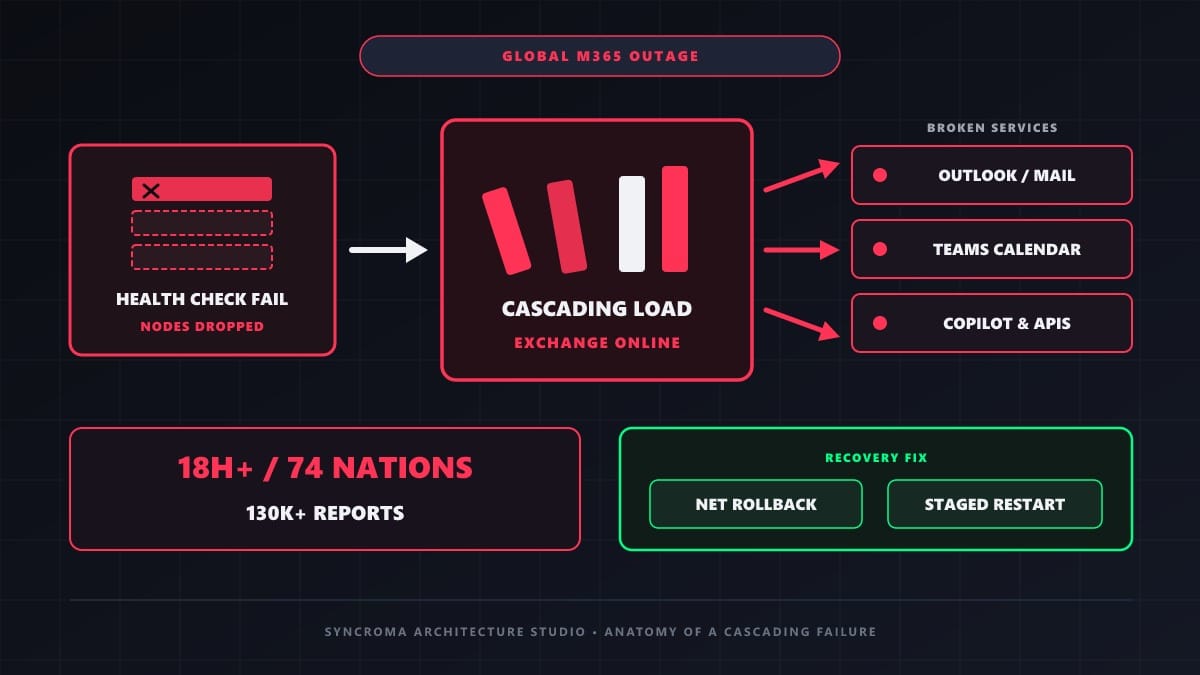
Based on telemetry Microsoft disclosed during mitigation, the meltdown came from a classic interplay between a recent network configuration change and automated node health checks (Petri, UC Today):
- Secure-connection bottleneck: An internal backend process handling secure connections and server health evaluation became overwhelmed—without any surge in legitimate user demand.
- Self-inflicted node eviction: Because the saturated component couldn't answer probes in time, healthy backend nodes started failing automated health checks and were kicked out of load-balancer rotation.
- Traffic funnel into survivors: Shrinking pool capacity dumped global enterprise load onto fewer surviving instances, pinning CPU/memory and knocking nodes down like dominoes.
- Thundering herd on restart: Early Thursday restarts only bought brief relief—every time engineers drained and returned clean servers to the pool, pent-up client retries slammed them straight back offline (Petri).
To stop the bleeding, Microsoft had to freeze all non-essential service deployments, roll back the correlated network configuration change, extend inbound mail delivery timeouts to 48 hours, and ship an upstream authentication and routing configuration patch early Friday (07:24 GMT) before incrementally cycling traffic back online (UC Today, Petri).
The Quiet Architectural Truth: Exchange Online Is Microsoft 365's Hidden SPOF
Look closely at what kept running versus what died across the 18-hour blackout. Core Teams voice calls and 1:1 chats largely stayed up—yet anything wired to the Exchange mailbox layer broke in lockstep (UC Today, CNET).
| Layer / Service | Production Failure Observed | Underlying Shared Dependency |
|---|---|---|
| Exchange Online / Outlook | Web, desktop, and mobile clients unreachable; massive mail queues & empty inboxes | Ground zero (EX1550543): saturated secure-connection & health-check pipeline (Petri). |
| Microsoft Teams | Meeting scheduling, invites, calendar sync, and Live Events broken | Teams calendaring still depends directly on Exchange Online (UC Today). |
| Copilot & External AI Connectors | M365 Copilot mailbox/calendar queries dead; OpenAI and Anthropic connectors impacted | Agentic context retrieval hits the same Graph/Exchange choke point (UC Today). |
| Cloud Suite & SecOps | Degraded SharePoint, OneDrive, Planner, To Do, Intune, and Microsoft Defender XDR | Cross-suite coupling across auth, routing, and telemetry (Petri, Cadena SER). |
That third row deserves special attention: Microsoft Copilot alongside OpenAI and Anthropic's third-party M365 connectors all stalled together the moment Exchange choked (UC Today). The industry loves pitching autonomous enterprise AI agents, yet one stalled legacy mail-layer health probe still blinds the entire agent stack simultaneously.
Three Production Rules This Outage Just Re-Validated
You don't need Microsoft's global footprint to hit this exact footgun on your next infrastructure push:
- Never let health checks execute an auto-DDoS: If your liveness/readiness probes evict instances whenever a shared auth/TLS subsystem hiccups—without a circuit-breaker floor preventing total pool collapse—your load balancer will systematically take down healthy nodes.
- Expect thundering herds during recovery: Returning freshly booted instances into full production traffic without gradual traffic ramp-up, rate limiting, and exponential backoff with jitter turns every restart into an instant second outage.
- Three icons over one shared dependency isn't resilience: When hospitals, courts, the Bank of England, and AI agents stall at the exact same timestamp because email, calendaring, Intune/Defender, and Copilot funnel through one coupled core, it exposes the true blast radius of single-vendor lock-in.
And if your IT team is still watching queues drain today: follow Petri's recovery guidance—don't rebuild local Outlook profiles, touch DNS records, or hack tenant routing rules while Microsoft finishes returning regions to baseline capacity.
Visuals and layout by Syncroma Studio.
Sistemas reales, sin humo corporativo Real systems, zero corporate hype
Recibe los análisis a fondo sobre arquitectura, consumo de recursos y computación de bajo nivel directamente en tu bandeja de entrada. Get deep-dive software architecture, resource consumption metrics, and low-level computing essays delivered straight to your inbox.
Suscribirse a Syncroma Subscribe to Syncroma

