
(🇪🇸 Leer la versión en español aquí)
Whenever millions of iPhone and Mac owners get unexpectedly signed out of iCloud, locked out of app downloads, and blocked from Apple Pay while physical Apple Store pickup and checkout systems simultaneously stall, the official explanation almost always sounds calmer than the underlying systems failure: "It was an internal update, not a cyberattack."
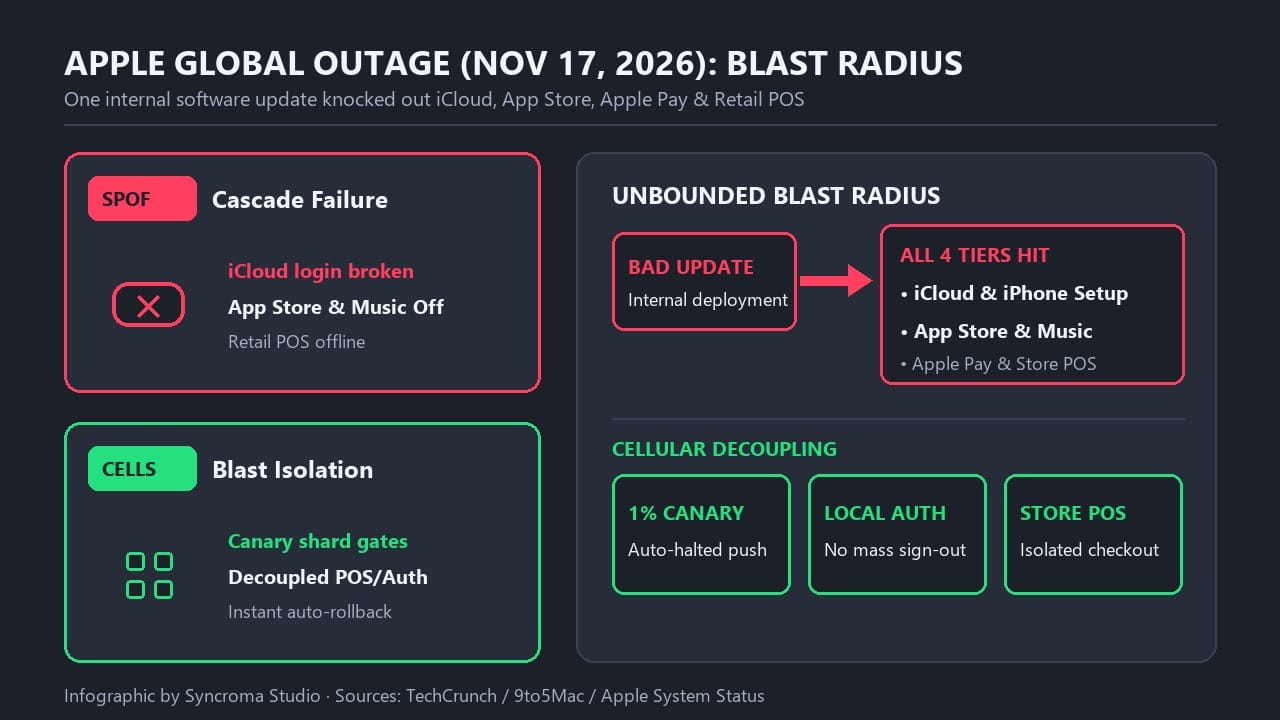
That is what unfolded on November 17, 2026, as reported by TechCrunch, 9to5Mac, Engadget, and Mashable. Beyond a frustrating afternoon waiting on Apple System Status, the blast pattern exposes a textbook distributed-systems flaw: shared control-plane coupling turning one bad push into an ecosystem-wide domino fall.
What Actually Went Dark (Verified Timeline & Surface Area)
Apple confirmed to Bloomberg and TechCrunch that an internal update caused outages beginning late morning Eastern before services recovered by roughly 6:00 p.m. ET. Look at the breadth of supposedly unrelated surfaces hit together:
| Impacted Layer (Nov 17, 2026) | User & Developer Impact Observed | Architectural Red Flag |
|---|---|---|
| iCloud Sign-In, Mail & Web Apps | Sudden account sign-outs & verification failures on iOS/macOS | Centralized token validation errors triggering client-side session drops |
| New Device Activation | Brand-new iPhones & iPads unable to reach activation servers | Hard synchronous dependency stalling out-of-the-box hardware setup |
| App Store, Apple Music & Dev Connect | Frozen downloads, streaming drops & App Store Connect inaccessible | Shared failure domain bridging consumer storefronts and developer tooling |
| Apple Pay, AppleCare & Retail Stores | Payment failures & offline Apple Store POS/pickup checkouts | Insufficient isolation between internal cloud updates and brick-and-mortar retail |
| Enterprise / Education (ASM, VPP) | Device enrollment and Volume Purchase Program offline | Same blast radius colliding with managed corporate & school fleets |
Equally telling, as 9to5Mac highlighted, was the familiar gap between live user telemetry and status dashboards: Downdetector showed sharp spikes for Apple Pay and Apple Support well before status flags caught up. Relying on vendor status pages as your monitoring source guarantees you detect incidents behind your users.
Three Production Lessons From a Single Bad Push
You do not need Cupertino scale to replicate this exact outage pattern inside your own SaaS or enterprise stack:
- Never force-logout healthy local sessions on transient auth errors: When an authentication service throws 5xx responses or validation timeouts, forcing mobile or desktop clients to drop cached tokens creates a thundering herd the moment servers recover, multiplying recovery load tenfold.
- Contain deployment blast radius with hard cell boundaries: When one internal update disrupts consumer music streaming, enterprise device enrollment (
Apple School Manager), developer uploads, and physical store POS registers simultaneously, regional and functional isolation failed its job. - Respect how fast multi-hour outages torch SLAs: Two to five hours of broken login and checkout burns through an entire year of a strict 99.99% SLA allowance. Check how tight your real downtime budget is in our SLA uptime & error budget calculator.
How Pragmatic Engineering Teams Avoid Self-Inflicted Meltdowns
Notice the pattern across November 2026's biggest headlines — from Apple's rollout hiccup to recent Microsoft and banking disruptions: internal software pushes are out-damaging external zero-days.
- Ship via isolated cells & automated canary rollbacks: Route authentication, payment tokenization, and store POS through separate failure domains gated at 1% canary traffic with automated rollback triggers on login drop-offs.
- Avoid single-cloud lock-in for critical local files: Keeping verified local backups ensures an identity provider outage never locks you out of your own archives; compare long-term storage economics using our cloud vs. home NAS TCO calculator.
- Provision database headroom for retry storms: When millions of disconnected clients hammer auth and session tables every few seconds, index bloat and WAL spikes fill undersized disks fast — model realistic headroom with our SQL database table, index & disk size calculator.
Cloud infrastructure never fails gracefully by default: when one internal push signs out devices worldwide and stalls physical retail checkouts at the same hour, the missing ingredient isn't hardware budget — it's decoupling.
Article and infographic by Syncroma Studio. Cover photo: Apple Store interior with display tables and devices, photographed by Seasider53 on Wikimedia Commons (CC BY-SA 4.0).

Sistemas reales, sin humo corporativo Real systems, zero corporate hype
Recibe los análisis a fondo sobre arquitectura, consumo de recursos y computación de bajo nivel directamente en tu bandeja de entrada. Get deep-dive software architecture, resource consumption metrics, and low-level computing essays delivered straight to your inbox.
Suscribirse a Syncroma Subscribe to Syncroma

