
(🇪🇸 Leer la versión en español aquí)
Social feeds on TikTok, X, and group chats spent today pushing viral panic clips claiming a "global internet shutdown" and coordinated bank-draining cyberattack would hit on November 17, 2026. Throw two real platform glitches into the same week, and millions of everyday users immediately start searching whether the internet is actually going dark.
As debunked on November 17 by IFLScience, The Washington Post, and CNN, there is zero evidence of a global internet blackout or coordinated cyber crisis. Google even jumped in publicly today —as covered by TechCrunch— to clarify that Gmail was running normally while users mistook social rumors for live downtime.
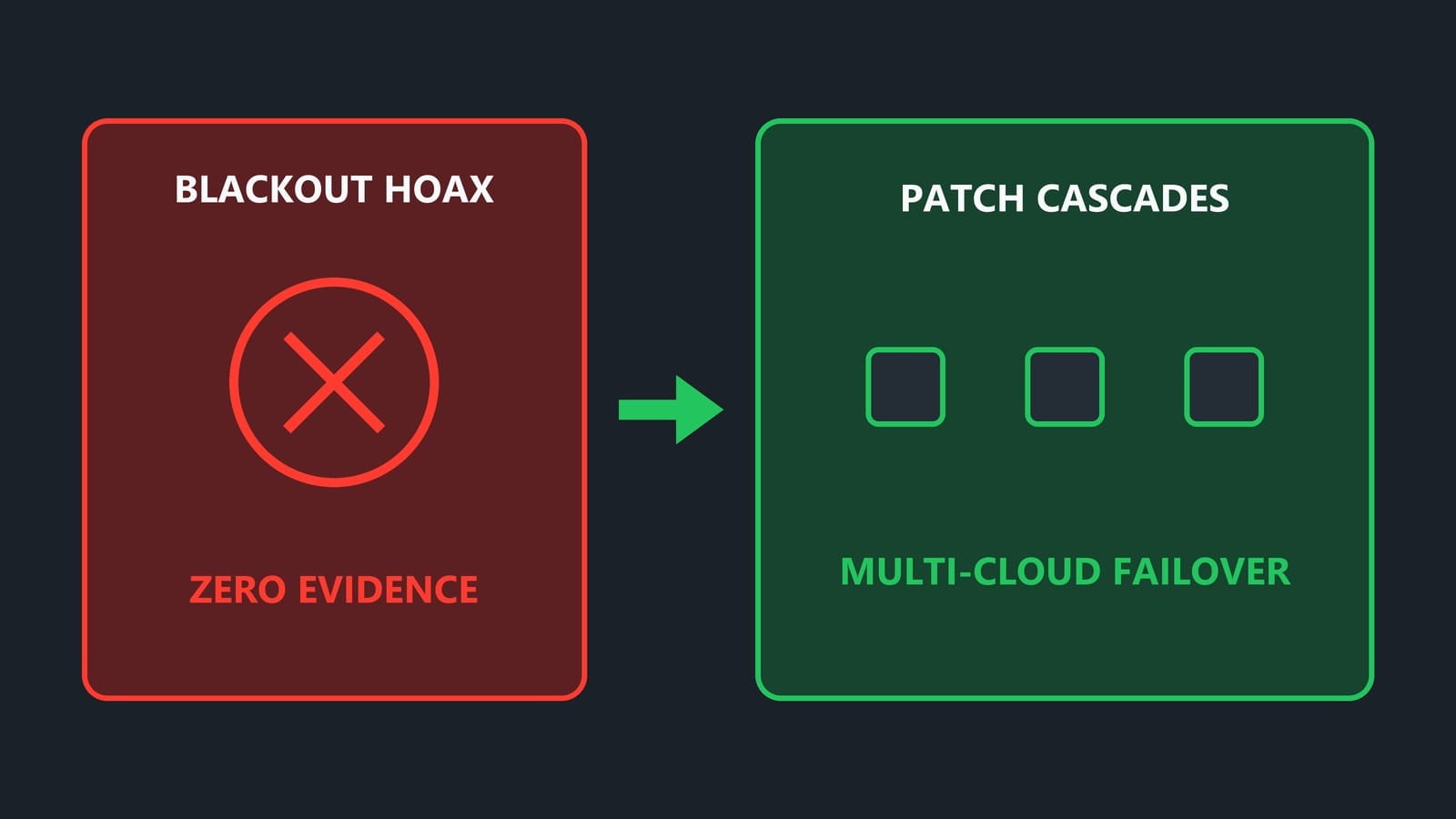
Why Everything Feels Broken at Once (No Conspiracy Required)
Panic doesn't materialize out of thin air — it fed directly off back-to-back disruptions across Microsoft 365, major banks, airlines, and Apple services documented by The Washington Post and CNN:
| Trend / Incident (Nov 2026) | Viral Social Media Claim | Actual Engineering Root Cause | Real SRE Reliability Takeaway |
|---|---|---|---|
| Back-to-back outages (Microsoft, banks, airlines, Apple) | "Coordinated cyberwarfare wiping systems" | Unrelated technical faults: server health-check cascades, internal backend updates & config glitches | Most high-profile downtime stems from self-inflicted config/patch deploys, not nation-state malware |
| Emergency preparedness clips | "Governments warn of Nov 17 grid collapse" | Standard public-alert testing & routine disaster guidance recycled out of context | Keep auth & payment flows decoupled from single third-party chokepoints |
| Rapid security patch velocity | "AI taking down infrastructure" | High-cadence emergency patching shipped quickly to stay ahead of automated exploits | Enforce canary rollouts & strict Error Budgets before pushing global updates |
| Core Gmail / Internet backbone | "Gmail and half the web went offline" | Google explicitly confirmed core Workspace & Gmail systems remained healthy | Without independent observability, localized glitches read like global outages |
The Real Structural Vulnerability: Monoculture Chokepoints
Engineers working in production already understand why unrelated backend hiccups look like an "IT apocalypse" from the outside:
- Three cloud ecosystems define "the internet" for normal users: When an internal rollout inside Microsoft, Apple, Cloudflare, or AWS stalls token verification or DNS control planes for twenty minutes, retail banking apps, airline check-in desks, and email drop simultaneously even though core internet routing never blinked.
- Serial API chains quietly murder your SLA: Stacking external cloud APIs in your critical path multiplies failure probabilities instead of averaging them — model exact composite downtime inside our SLA Uptime & Error Budget Calculator and queue amplification inside our P99 Tail Latency & Fan-Out Calculator.
- High-speed patching without canary blast shields causes more downtime than attackers: Pushing emergency fixes across global regions at once turns minor config typos into front-page headlines.
FAQ: The November 17 "Internet Shutdown" Rumor
Is there a real global internet blackout or coordinated cyberattack happening on November 17, 2026?
No. Both IFLScience and officials interviewed by CNN and The Washington Post confirmed there is no coordinated blackout or systemic bank hack — rumors merged routine alert tests with unrelated recent technical outages.
Why did major banks, airlines, Microsoft, and Apple hit outages within days of each other?
According to The Washington Post, the incidents had separate mundane engineering triggers — ranging from server health-check cascades to faulty internal updates — amplified because modern organizations heavily concentrate on shared cloud layers.
Writing and infographic by Syncroma Studio. Cover photograph: woman texting on a smartphone by a window, public domain (CC0) photo by Kristin Hardwick via Wikimedia Commons.

Sistemas reales, sin humo corporativo Real systems, zero corporate hype
Recibe los análisis a fondo sobre arquitectura, consumo de recursos y computación de bajo nivel directamente en tu bandeja de entrada. Get deep-dive software architecture, resource consumption metrics, and low-level computing essays delivered straight to your inbox.
Suscribirse a Syncroma Subscribe to Syncroma

