(🇪🇸 Leer la versión en español aquí)
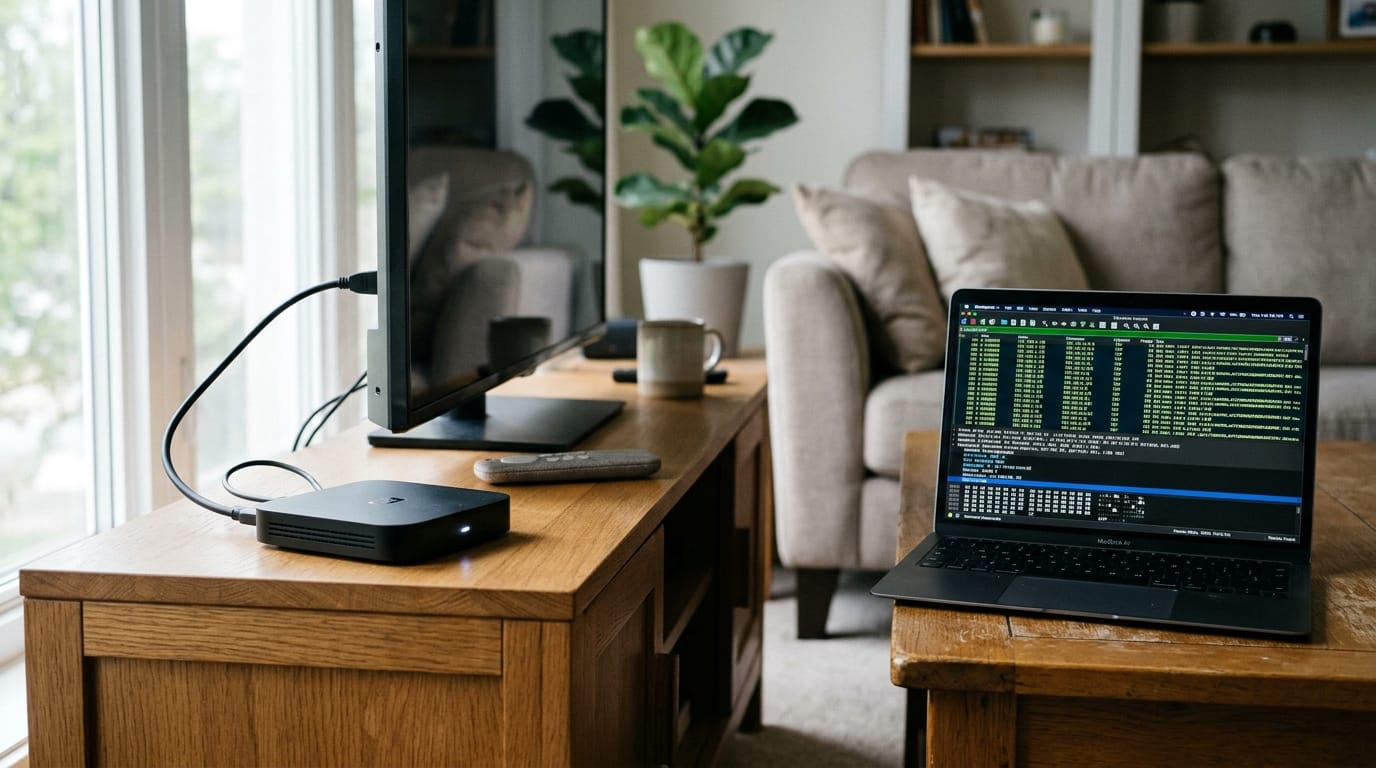
If you purchased a generic Android TV streaming box for $25 on AliExpress, Amazon, or Temu to stream movies on a secondary bedroom television, we have uncomfortable engineering news: you are not the consumer; you are an exit node for one of the largest cybercrime and ad fraud botnets on earth.
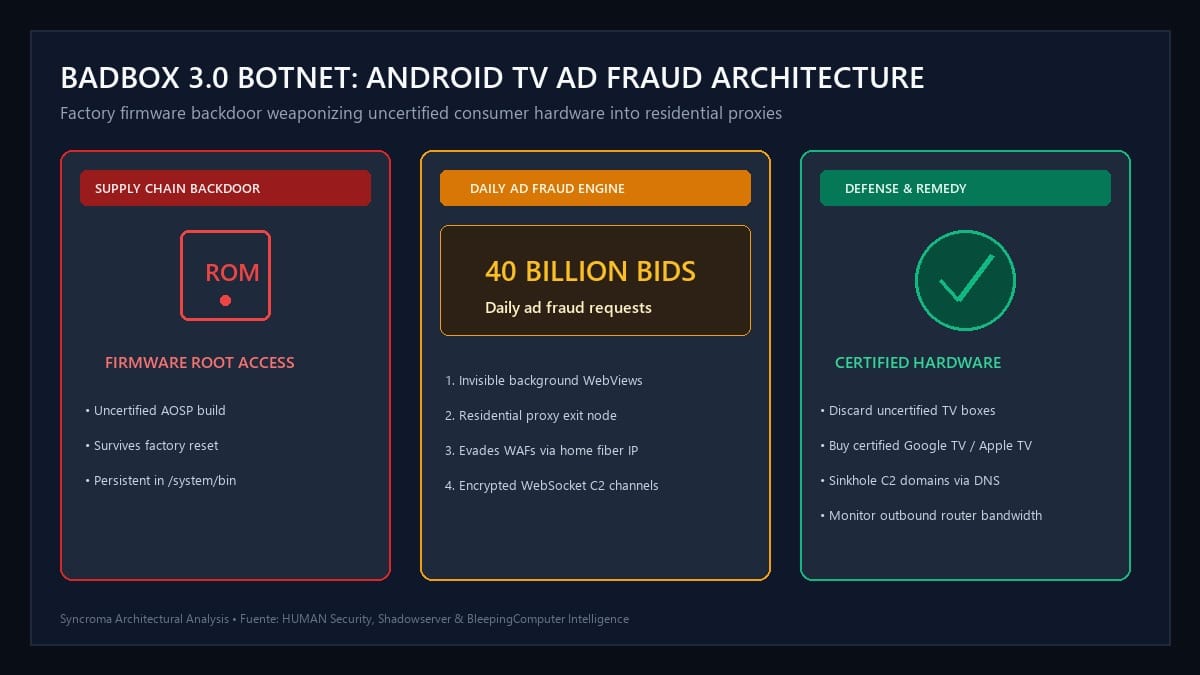
Threat intelligence researchers at HUMAN Security and the Shadowserver Foundation have documented the aggressive global resurgence of BADBOX 3.0. Following law enforcement takedowns and infrastructure sinkholing in 2025 that temporarily suppressed earlier variants, the botnet has rebuilt itself into a commercial-grade fraud engine peaking at a record-breaking 40 billion daily ad bid requests routed through millions of infected consumer living rooms.
Crucially, no antivirus app from an app store and no amount of factory resets can disinfect the device: the malware was flashed directly into the factory ROM firmware during assembly.
The Poisoned Supply Chain: Persistent Root in /system
Unlike conventional Android malware, which relies on social engineering to trick a user into sideloading a malicious APK with accessibility permissions, BADBOX compromises the supply chain at the silicon-to-firmware level.
Overseas low-cost device assemblers build hardware around stripped-down AOSP (Android Open Source Project) images lacking Google Play Protect certification. During the image-flashing stage before retail packaging, intermediaries embed trojanized binaries directly into /system/bin and /system/xbin:
┌────────────────────────────────────────────────────────┐
│ Low-Cost OEM Assembly Facility (Shenzhen / Dongguan)   │
│ Injects trojanized binary into default AOSP ROM image  │
└───────────────────────┬────────────────────────────────┘
                        │
                        ▼ (Flashed directly to eMMC NAND storage)
┌────────────────────────────────────────────────────────┐
│ Generic Android TV Box (Allwinner / Rockchip / Amlogic)│
│ • Hardcoded ROOT privileges baked into system partition │
│ • Factory reset simply restores the infected base ROM  │
└───────────────────────┬────────────────────────────────┘
                        │ (Sold globally via e-commerce for $25)
                        ▼
┌────────────────────────────────────────────────────────┐
│ Consumer Home (Connected to 1 Gbps Fiber / Broadband)  │
│ 1. Spawns headless WebViews playing silent 4K video ads│
│ 2. Establishes reverse-proxy SOCKS5 residential tunnel │
│ 3. Encrypted C2 communications over WebSockets and DNS │
└────────────────────────────────────────────────────────┘
The consumer plugs the box into their TV, pairs their Wi-Fi network, and sees a standard launcher with Netflix or YouTube. Meanwhile, in the background with unrestricted root privileges, the embedded daemon initializes and handshakes with attacker command-and-control (C2) clusters.
The Dual Monetization Model: 40 Billion Bids & Residential Proxies
Maintaining millions of persistent hardware nodes connected 24/7 to high-speed broadband and mains power is extraordinarily valuable. BADBOX 3.0 operators monetize this infrastructure across two synchronized pipelines:
1. Invisible Connected TV (CTV) Ad Fraud
Connected TV commands the highest CPMs (cost per thousand impressions) in programmatic advertising—often fetching $15 to $40 per thousand impressions.
BADBOX capitalizes on this premium by launching dozens of headless background WebViews. The device silently queries ad exchanges, fakes user engagement, streams 4K video advertisements at 0% volume, and spoofs user-agent strings to masquerade as premium Samsung, LG, or Sony smart TVs. Across the entire botnet, this produces over 40 billion automated bid requests daily, siphoning millions of advertising dollars from legitimate brands.
2. The Residential Proxy Pipeline
The second revenue stream poses the greatest direct risk to the homeowner: renting your residential IP address on the dark web.
Enterprise firewalls, fraud filters, and bot-mitigation engines (Cloudflare, Akamai, AWS WAF) aggressively block or rate-limit traffic originating from cloud datacenters. However, your home broadband IP carries an impeccable reputation score. BADBOX deploys a local SOCKS5 proxy server on the TV box, leasing that tunnel to cybercrime syndicates for:
- Distributed credential stuffing against online banking and e-commerce portals.
- Automated scalper botting and retail inventory hoarding.
- Anonymous egress traffic for nation-state advanced persistent threat (APT) reconnaissance.
If law enforcement tracks a fraudulent transaction or network intrusion to that exit node, the IP address recorded in the victim’s server logs is the public IP of your home router.
Why a Factory Reset is Completely Useless
The most common technical misconception among consumers is believing that performing a factory reset from the Android settings menu purges malware.
In the case of BADBOX, that belief is fundamentally flawed. When you initiate a factory reset on Android, the operating system wipes only the /data partition (installed user applications and personal files) and the /cache partition. The /system partition remains untouched because it is mounted read-only during normal operational cycles.
Because BADBOX operators injected the trojanized binaries into the root /system partition prior to packaging, executing a factory reset merely wipes your personal Netflix login and reboots into the original factory image—which was infected before it ever left the assembly line.
Comparison: Certified Hardware vs. Unbranded Clones
| Security Architecture | Generic $25 TV Box | Certified Platform (Google / Apple / Fire) |
|---|---|---|
| Google Play Protect Certification | ❌ None (Modified untrusted AOSP) | ✅ Cryptographically verified certification |
| Hardware-Rooted Verified Boot (dm-verity) | ❌ Disabled (Permanent open root) | ✅ Enforced via hardware secure enclave |
| Automated Monthly Security Patches | ❌ Zero vendor post-sale support | ✅ Continuous OTA firmware updates (4–7 yrs) |
| Firmware Supply Chain Backdoor Risk | 🔴 Critical (BADBOX / Peachpit) | 🟢 Near Zero (Verified signed supply chain) |
| Idle Network & Bandwidth Behavior | 🔴 Continuous outbound proxy & ad traffic | 🟢 True low-power sleep (C-states standby) |
Production Remediation: Securing Your Home Network
If your local network currently hosts an uncertified media player powered by an Allwinner H616, Rockchip RK3328, or generic Amlogic SoC, do not waste time attempting mobile antivirus scans:
- Disconnect the Device Immediately: Unplug the Ethernet cable and remove the device from your Wi-Fi network. Beyond burning bandwidth, it actively pollutes your residential IP address across global threat intelligence blocklists.
- Replace with Certified Platforms: Transition to certified hardware backed by verified supply chain signatures: Google TV Streamer / Chromecast with Google TV, Apple TV 4K, or Amazon Fire TV Stick. The modest price premium represents the cost of authenticated firmware and verified boot integrity.
- Audit Local DNS & Outbound Traffic: If you manage a home lab router (OPNsense, pfSense) or local DNS filter (Pi-hole, AdGuard Home), inspect queries for high-volume outbound connections across non-standard high ports and block known BADBOX C2 sinkhole domains.
The architectural reality of consumer electronics remains absolute: with network-connected hardware, buying suspiciously cheap devices means paying the remaining balance with your home bandwidth, your electrical bill, and your digital reputation.
(Engineered by Syncroma Studio. Verified technical references: HUMAN Security Satori Threat Intelligence, The Shadowserver Foundation, and BleepingComputer Reports).
To audit the energy consumption and thermal output of your hardware, check out our CPU Power Consumption & TDP Sizing Calculator and our Video Bitrate & Network Bandwidth Sizer.
Sistemas reales, sin humo corporativo Real systems, zero corporate hype
Recibe los análisis a fondo sobre arquitectura, consumo de recursos y computación de bajo nivel directamente en tu bandeja de entrada. Get deep-dive software architecture, resource consumption metrics, and low-level computing essays delivered straight to your inbox.
Suscribirse a Syncroma Subscribe to Syncroma

