
(🇪🇸 Leer la versión en español aquí)
Canceling a SaaS analytics contract ends your monthly billing invoice — it does not revoke the cross-account AWS IAM trust role you provisioned in Terraform five years ago. Unless an engineer explicitly tears down that trust policy, the backdoor sits waiting indefinitely in IAM.
In November 2026, joint investigations by Sentra, Wiz, SecurityWeek, —as reported by SecurityWeek and BleepingComputer exposed an active campaign running from October 14 to October 26, 2026, where threat actors leveraged compromised Qubole AWS IAM credentials to assume cross-account roles across dozens of active and former customer environments.
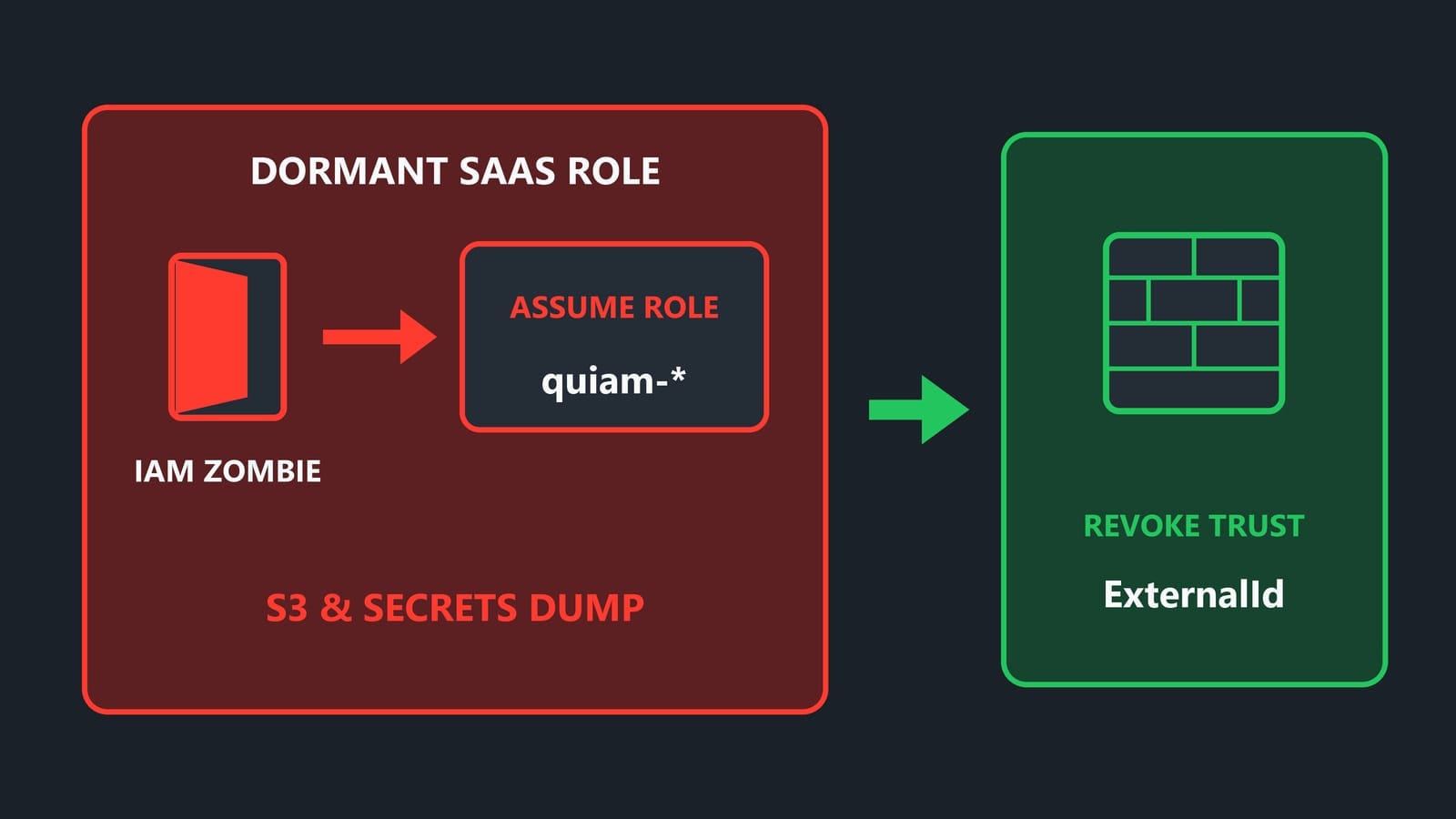
Inside the Attack Playbook (And Exact CloudTrail Indicators)
No AWS zero-day was involved — IAM trust mechanics worked precisely as configured by customer accounts. Joint forensic reporting from Sentra and Wiz outlines the exact blast chain:
| CloudTrail / Forensics Stage | Observed Attacker Indicator | Victim Assets Targeted | Architectural Root Cause |
|---|---|---|---|
| Initial Cross-Account Entry | sts:AssumeRole calls via stolen Qubole IAM credentials |
Customer cross-account IAM integration roles | "Zombie" vendor IAM roles left active years after churn |
| Session Naming Signature | Role session names prefixed with quiam-* (quiam-enum, quiam-scope-full) |
STS & CloudTrail audit logs | Zero anomaly alerting on third-party vendor AssumeRole spikes |
| Network Infrastructure | Traffic routed from rented OVH servers and Mullvad VPN exits | Requests outside vendor corporate IP ranges | Permissive trust policies lacking source network constraints |
| Data & Secret Exfiltration | Rapid bucket listing + millions of file downloads + secret harvesting | S3 Buckets, AWS Secrets Manager, SSM Parameter Store, Lambda env vars | Over-scoped standing permissions beyond analytics prefixes |
| Lateral Key Testing | Automated validation via TruffleHog against connected identity layers | Microsoft Entra ID & Okta tokens | Static secrets stored unrotated in Lambda configs & parameter stores |
Five-Minute AWS Cloud Hygiene Checklist
- Audit every IAM
TrustPolicyreferencing external AWS Account IDs: Scan every AWS organization account right now for third-party vendor principals inAssumeRolePolicyDocument. If finance stopped paying that vendor, delete the role today. - Hunt historical CloudTrail logs for
quiam-*sessions: Per guidance from Wiz and SecurityWeek, searchAssumeRoleevents referencing Qubole's principal orquiam-session strings alongside abnormalListBuckets/GetObjectbursts. - Scrub exposed configs & tighten internal AWS data paths: Before sharing config dumps or rotating environment variables locally, inspect configs offline with our Private ENV/JSON/YAML Secret Auditor and keep S3 data transfers inside private VPC routing using our AWS NAT Gateway vs. VPC Endpoint Calculator.
FAQ: The Qubole Cross-Account AWS IAM Campaign
Was there a flaw in AWS IAM or S3 itself?
No. As confirmed in BleepingComputer's coverage and Wiz's technical brief, AWS services operated as designed; attackers exploited stolen vendor credentials paired with forgotten, overly permissive cross-account trust relationships.
How should teams lock down future third-party SaaS IAM roles?
Require unique customer-controlled sts:ExternalId conditions, scope IAM policies strictly to named S3 prefixes (explicitly denying secretsmanager:*, ssm:Get*, and lambda:GetFunctionConfiguration), and run quarterly automated IAM Trust Policy pruning.
Writing and infographic by Syncroma Studio. Cover photograph: Amazon Seattle Campus Grand Plaza, by Joe Mabel via Wikimedia Commons (CC BY-SA 4.0).

Sistemas reales, sin humo corporativo Real systems, zero corporate hype
Recibe los análisis a fondo sobre arquitectura, consumo de recursos y computación de bajo nivel directamente en tu bandeja de entrada. Get deep-dive software architecture, resource consumption metrics, and low-level computing essays delivered straight to your inbox.
Suscribirse a Syncroma Subscribe to Syncroma

