(🇪🇸 Leer la versión en español aquí)
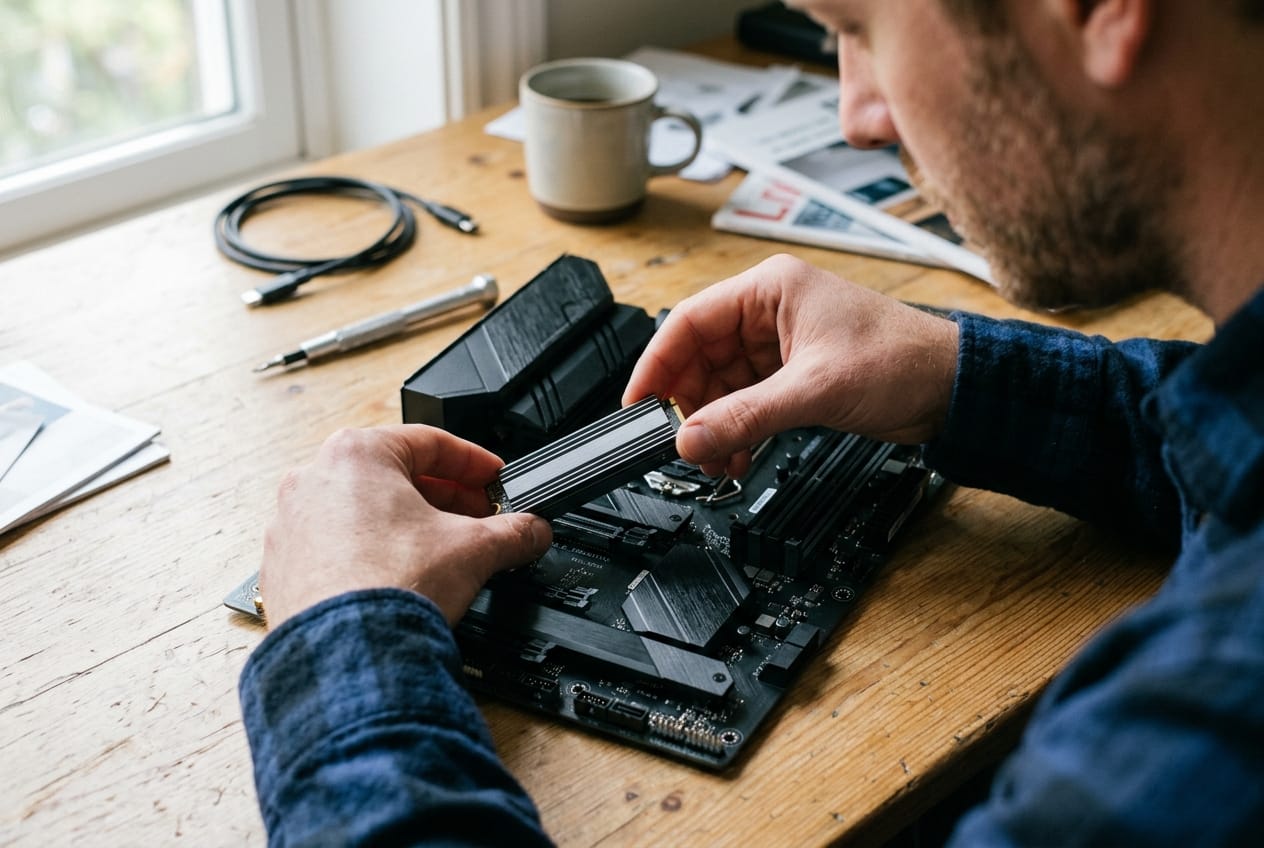
For over two decades, open-world video game engines sidestepped storage bottlenecks using deceptive engineering band-aids: disguised elevator loading screens, winding tunnel passages designed to buy time for 5,400 RPM mechanical platters, and aggressive asset duplication (a single street lamp or mailbox was written up to 400 times onto a disc so the physical drive head wouldn't thrash across sectors).
With the current console hardware baseline and massive titles pushing past 200 GB, that era is definitively dead. The operational floor required to avoid catastrophic engine breakdown is no longer measured in raw gigabytes of capacity, but in sustained input/output (I/O) bandwidth. And that technical floor has stabilized at a blistering 5,500 MB/s.
Any storage medium falling below that threshold—whether an aging 500 MB/s SATA III SSD, an external USB drive, or a cheap DRAM-less QLC NVMe drive running out of SLC cache—doesn't merely impose longer loading times: it actively breaks the geometry, audio threading, and collision physics of the game engine.
The Modern I/O Pipeline: Kraken and DirectStorage Without Touching the CPU
To understand why slow storage freezes a modern engine, one must trace the physical path a data packet travels from a NAND flash cell to the GPU shader cores:
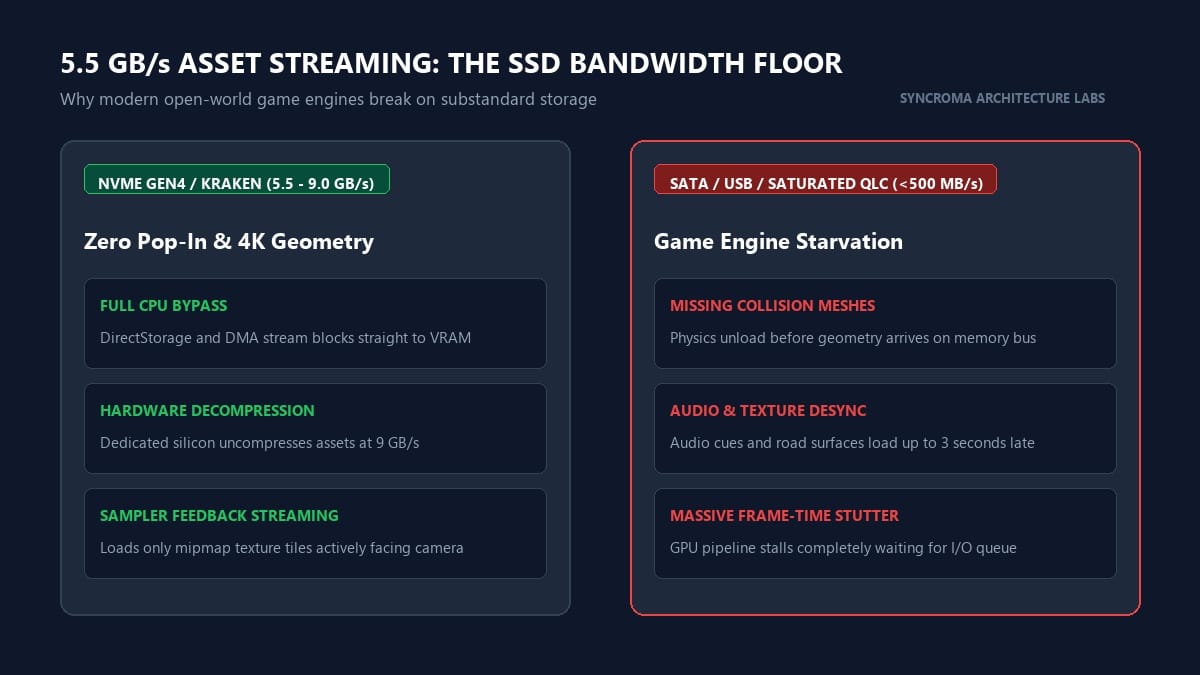
- The Legacy Architectural Bottleneck: In older systems, compressed game assets were read from storage into system RAM, burning 4 to 6 full CPU threads on zlib or LZMA decompression before transferring across the PCIe bus to GPU VRAM. At modern streaming rates of 5 GB/s, the CPU would choke at 100% utilization simply unpacking assets.
- The DirectStorage and Kraken Hardware Bypass: Modern gaming architectures (such as the PS5 custom hardware I/O co-processor powered by RAD Game Tools' Kraken algorithm, or DirectStorage 1.2 on PC) eliminate the CPU from the loop. The NVMe controller transfers compressed data blocks directly to VRAM via DMA (Direct Memory Access). Dedicated silicon uncompresses the incoming stream on the fly at rates up to 9,000 MB/s, leaving CPU cycles entirely dedicated to game logic and physics.
Sampler Feedback Streaming: Slashing VRAM Footprints by 2.5x
In a photorealistic open world with virtual 8K textures and dense photogrammetry, loading all mipmap resolution tiers would instantly blow past 16 GB of unified memory.
This is where Sampler Feedback Streaming (SFS) takes over:
- The GPU evaluates on every frame precisely which specific tiles of a 16,384x16,384 texture are facing the player's camera frustum and at what viewing distance.
- Driving at 120 mph down a highway, the game engine doesn't stream the vehicle coming a mile ahead at full 4K fidelity; it requests only the exact low-res mipmap tiles needed for that specific millisecond.
- The Catch: This turns the NVMe SSD into an active, real-time extension of video memory. If your SSD takes 50 milliseconds instead of 2 milliseconds to fulfill tile requests, the GPU pipeline stalls with nothing to render.
| Storage Architecture Tier | Real Sustained I/O Throughput | Asset Decompression Engine | Impact on 200 GB Open-World Engine |
|---|---|---|---|
| PCIe 4.0 / 5.0 TLC NVMe SSD | 5,500 - 7,300 MB/s | Dedicated Silicon (Kraken / DirectStorage) | Zero pop-in, perfect collision geometry, solid 60 FPS |
| Budget QLC NVMe (Saturated Cache) | 150 - 450 MB/s sustained | Severe CPU bottleneck / software fallback | Massive frame-time stuttering, missing road textures |
| SATA III SSD (6 Gbps Bus) | 480 - 540 MB/s | Bottlenecked by legacy AHCI interface | Invisible terrain, falling through map, delayed LOD |
| External USB 3.0 HDD | 80 - 130 MB/s | Completely unviable | Immediate crash to desktop / console dashboard |
The Budget SSD Trap: When QLC NAND Exhausts Its SLC Cache
Many buyers pick up cheap PCIe 4.0 NVMe drives on discount, assuming the advertised "7,000 MB/s" printed on the retail box applies consistently. In solid-state storage, that assumption is dangerous.
Budget drives rely on QLC (Quad-Level Cell) NAND flash, storing 4 bits per cell. The native, raw write and read speeds of unassisted QLC memory are abysmal: barely 100 to 180 MB/s. To mask this, manufacturers designate a small portion of the drive as a dynamic SLC cache (writing 1 bit per cell at high speeds).
During heavy asset streaming in open-world titles, while the OS concurrently updates background patches or writes telemetry, that SLC cache quickly fills to capacity. The instant it saturates, drive throughput collapses from 5,000 MB/s to 150 MB/s. The gameplay consequence: 50% framerate drops, audio cues playing 3 seconds after an explosion, and street obstacles popping into existence after you've already collided with them.
The Verdict: Storage is Now a GPU Co-Processor
The engineering conclusion for system builders and gamers is clear: in 2026, storage is no longer a passive warehouse where game files sleep until launched; it has become an active co-processor to the GPU memory controller.
If your NVMe drive lacks a dedicated DRAM cache, a multi-channel controller, and resilient TLC flash capable of exceeding 800,000 4K random read IOPS, your flagship CPU and GPU will be throttled into a frustrating, stutter-filled bottleneck.
Image Credits: Editorial photography and technical vector infographics produced exclusively by Syncroma Architecture Labs.
Sistemas reales, sin humo corporativo Real systems, zero corporate hype
Recibe los análisis a fondo sobre arquitectura, consumo de recursos y computación de bajo nivel directamente en tu bandeja de entrada. Get deep-dive software architecture, resource consumption metrics, and low-level computing essays delivered straight to your inbox.
Suscribirse a Syncroma Subscribe to Syncroma