
(🇪🇸 Leer la versión en español aquí)
For more than a decade, mainstream video game studios committed one of the most egregious architectural sins in interactive software: placing blind trust in player client machines via peer-to-peer (P2P mesh) network topologies. In multi-million-player console titles across previous hardware generations, that architectural decision was strictly driven by corporate balance sheets. If 30 players synchronize their coordinates by exchanging packets directly or electing an arbitrary client as the session host (host migration), publisher executive suites save millions of dollars each month on dedicated server fleets and cloud egress fees.
However, the real cost was never absorbed by corporate accounting; it was offloaded onto player hardware, residential bandwidth, and game integrity. Today, with dense open worlds and next-generation AAA multiplayer launches (including the anticipated arrival of GTA 6 and high-concurrency online ecosystems), legacy P2P is officially dead in serious engineering circles.
Below, we tear apart the underlying network physics, CPU tick budgets, and cybersecurity realities compelling the industry to transition to authoritative cloud game servers.
1. The Original Sin of P2P: Unmasked IP Leakage and DDoS
In a pure or hybrid P2P topology, for two console clients to exchange UDP telemetry regarding vehicle velocities and weapon discharge, both clients must know each other's public IP address.
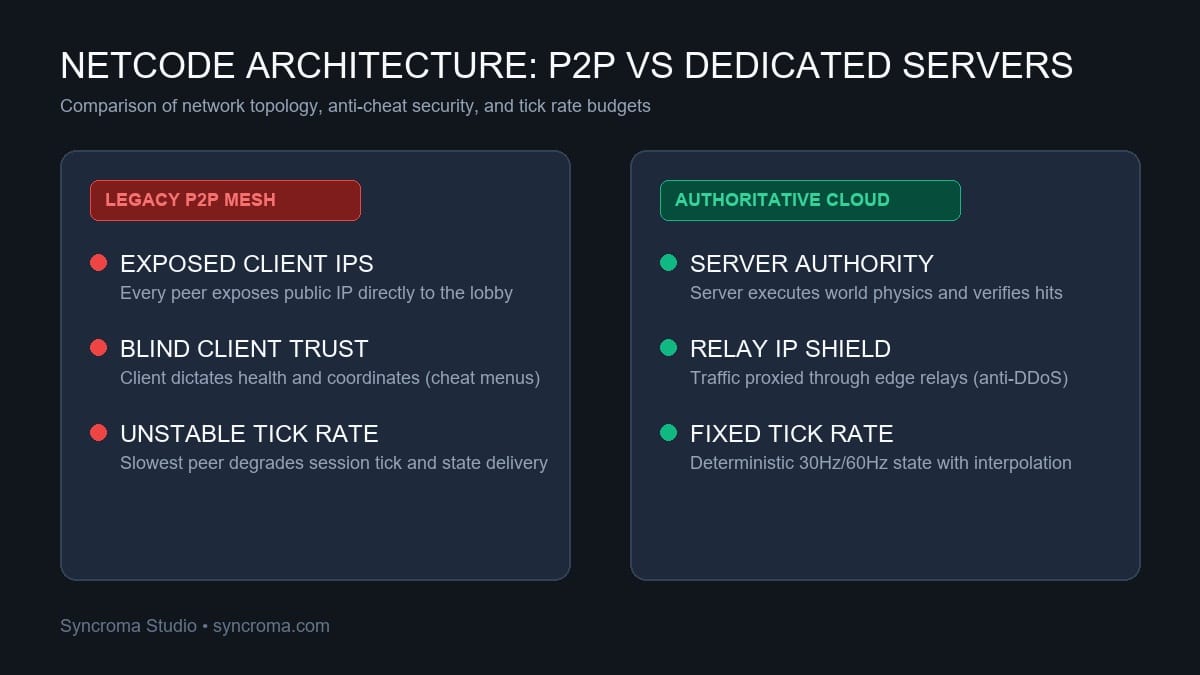
Figure 1: Client-to-client P2P topology versus authoritative cloud architecture with proxy relays. Credits: Syncroma Studio.
This architectural compromise transformed multiplayer lobbies into an attacker's playground:
- Trivial Packet Sniffing: Any teenager running a laptop on the same local network with packet capture tools such as Wireshark could inspect raw UDP payloads and harvest the public IPv4 addresses of all 29 session participants within seconds.
- Targeted DDoS Booter Attacks: Black-market stresser APIs enabled malicious actors to overwhelm residential routers belonging to the lobby host or competitive rivals for under five dollars.
- Doxing and Geographic Profiling: Public IP exposure directly revealed the geographic city, autonomous system number (ASN), and ISP of casual gamers and high-profile livestreamers alike.
In an authoritative dedicated server model utilizing edge relay proxies (such as Valve SDR or AWS GameLift FleetIQ), client runtimes only interface with the anycast IP of an edge proxy. The underlying server infrastructure and the IP addresses of rival players remain completely isolated within the private cloud fabric.
2. Collapse of the Trust Model: Why Client Authority Breeds Cheaters
The fatal conceptual flaw of P2P is client trust. When a client calculates state locally and broadcasts that state to peers, client software becomes the final arbiter of game reality.
When a bad actor injected a memory modification menu (mod menu) on PC or modified firmware, their client transmitted arbitrary authoritative assertions:
- "My player wallet holds 999,999,999 in in-game cash."
- "My vehicle's Cartesian coordinates now overlap the head hitbox of every player in the lobby."
- "I sustained zero damage from that rocket explosion."
Lacking a neutral authoritative umpire, every peer client blindly processed those packets and updated local render buffers accordingly.
Server Authority: "Clients Only Propose Inputs"
Under modern authoritative netcode, client hardware is demoted to a thin, untrusted terminal:
- The client only transmits raw user inputs:
"Pressed throttle trigger (0.95) and turned steering axis (0.42) on tick index 8102". - The cloud server executes the engine physics pipeline, computes rigid-body vehicle dynamics or ballistic trajectories, verifies raycast intersections within its own uncompromised simulation, and generates a canonical state snapshot.
- If a tampered client writes custom memory to fly across the sky, the server identifies a physical impossibility on the subsequent simulation tick and enforces client reconciliation (harsh rubberbanding) or issues an immediate session termination.
3. The CPU Tick Budget: 33.3 ms (30 Hz) vs 16.6 ms (60 Hz)
Operating dedicated game server fleets at scale is a heavy computational workload. The core engineering parameter dictating simulation fidelity and cloud infrastructure expenses is the Tick Rate—the frequency at which the server's discrete physics loop executes each second.
| Infrastructure Metric | 30 Hz Server (Open-World Sandbox) | 60 Hz Server (Competitive Shooter) | 128 Hz Server (Tactical eSports) |
|---|---|---|---|
| Total Tick Budget | 33.33 milliseconds | 16.66 milliseconds | 7.81 milliseconds |
| Physics & Game Logic Window | ~20 ms | ~10 ms | ~4 ms |
| UDP Serialization & Compression | ~10 ms | ~5 ms | ~2.5 ms |
| Safety Headroom Margin | ~3.33 ms | ~1.66 ms | ~1.31 ms |
| Egress Bandwidth per Client | ~40 - 80 kbps | ~120 - 250 kbps | ~350 - 600 kbps |
When hosting an open-world sandbox session with 32 or 64 players surrounded by dense vehicular traffic, complex NPC navigation meshes, destruction physics, and synchronized weather states, finishing the entire scene graph simulation within 16.6 ms demands sustained single-core compute performance (sustained clock frequencies exceeding 4.5 GHz on AWS c6i or AMD EPYC 9004 processors).
Consequently, vast open-world titles deliberately lock their simulation loop to a rock-solid 30 Hz. While 30 Hz may sound modest compared to tactical arena shooters, a deterministic 30 Hz backed by authoritative cloud compute provides vastly superior spatial consistency compared to the volatile packet jitter of a residential P2P host.
4. Latency Mitigation: Client Prediction and Lag Compensation
To prevent players from perceiving the unavoidable 40 to 60 millisecond round-trip time (RTT) to the edge datacenter, modern netcode relies on two deterministic mathematical systems:
- Client-Side Prediction: When a player steers a vehicle, the local client simulation immediately renders the displacement without waiting for network acknowledgement. When the server snapshot arrives 50 ms later, the client compares its predicted historical position against the authoritative state. If delta drift exists, smooth interpolation eliminates visual hitching.
- Server-Side Lag Compensation (Rewind): When firing a weapon at a moving vehicle, the local screen depicts where the vehicle was located one-half RTT in the past. To ensure fair hit registration, the server maintains a circular historical ring buffer of player positions covering the prior 1,000 milliseconds. Upon parsing a fire command tagged with a client timestamp, the server temporarily rolls back the world state to that exact historical moment to validate the projectile vector against the target hitbox.
5. The Financial Reality of Cloud Infrastructure
Running millions of concurrent players on authoritative servers entails massive ongoing operational expenditure across providers like Amazon Web Services, Google Cloud Platform, or Microsoft Azure.
If a 32-player instance produces an average of 60 kbps egress per user: $$\text{Server Outbound Bandwidth} = 32 \times 60 \text{ kbps} = 1,920 \text{ kbps} \approx 1.92 \text{ Mbps}$$
Across continuous monthly operation (720 hours), a single server container outputs over 600 Gigabytes of outbound traffic. Aggregated across hundreds of thousands of concurrent global sessions, monthly cloud egress and container fleet orchestration fees rapidly enter eight-figure territory.
Yet in 2026, no multi-billion-dollar live-service game can tolerate the public relations disaster of modder-ravaged lobbies and exposed player IPs traded on illicit forums. Authoritative cloud hosting is no longer an optional engineering luxury—it is the baseline architectural foundation.
To evaluate network bandwidth consumption, monthly egress volume, and CPU tick execution budgets for your multiplayer titles, explore our Multiplayer Game Server Calculator.
Sistemas reales, sin humo corporativo Real systems, zero corporate hype
Recibe los análisis a fondo sobre arquitectura, consumo de recursos y computación de bajo nivel directamente en tu bandeja de entrada. Get deep-dive software architecture, resource consumption metrics, and low-level computing essays delivered straight to your inbox.
Suscribirse a Syncroma Subscribe to Syncroma

