(🇪🇸 Leer la versión en español aquí)
Apple just swung straight at YouTube and Spotify's favorite cash cow: the living-room television. Alongside today's release of iOS 27.3, iPadOS 27.3, and tvOS 27.3 developer beta 2, Apple is rolling out a dedicated video podcasts section directly inside the Apple TV app—confirmed by MacRumors and 9to5Mac—completely free with no Apple TV+ subscription required.
Better yet for multi-device listeners, Account Settings now exposes a switch to sync queue and playback history between Apple Podcasts and the Apple TV app, paired with a new TikTok-style vertical video carousel (Explore Clip Collections) on the TV Home tab. Because the Apple TV app ships natively on third-party smart TVs, Roku boxes, gaming consoles, Macs, and iOS devices, that single change opens living-room video discovery across more than 1 billion devices.
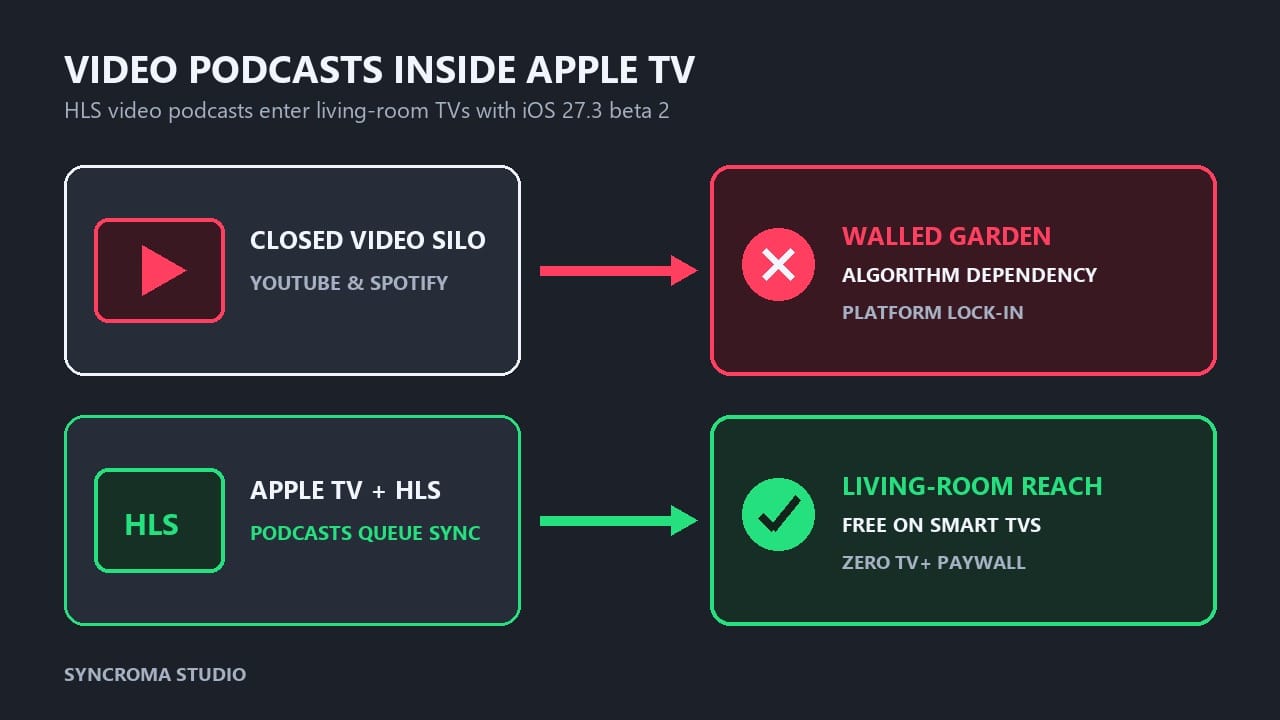
Why This Beats Just "Another Video Tab": HLS Delivery Across 1B+ Screens
For creators, living-room TV distribution previously meant bowing to YouTube's ad-split algorithm or Spotify's proprietary video player. Building on Apple's HTTP Live Streaming (HLS) video pipeline introduced inside Apple Podcasts earlier this year alters the delivery equation:
| Platform Dimension | Closed Video Silos (YouTube / Spotify) | Apple Podcasts + Apple TV App (27.3) |
|---|---|---|
| Big-Screen Footprint | Separate platform app & ad loads | Apple TV app (1B+ endpoints) with zero TV+ paywall |
| Streaming Architecture | Closed player & opaque compression | Adaptive HLS feeds switching smoothly between audio & video |
| Cross-Device Queue Sync | Locked inside single-vendor cloud state | Optional queue/history sync across Podcasts & TV apps |
| Monetization Caveat | Platform controls mid-roll inventory | Paid/subscriber-only podcasts excluded from the TV tab |
Keeping everything under the TV icon reinforces Apple's broader hardware play in the living room, echoing what we analyzed around silicon limits in the Apple TV 4K with A19.
Bandwidth Egress Reality and Two Catches Apple Won't Highlight
Before creators rush to mirror every show onto HLS video feeds, three practical realities deserve a hard engineering look:
- Two-app identity confusion & missing paid shows: Putting Podcasts video inside an app explicitly named TV feels redundant to long-time users—and keeping subscriber-only paid episodes out of the TV tab splits catalogs right where creators make direct margins.
- HLS 1080p/4K video egress burns 15×–40× more CDN traffic than MP3: YouTube eats global VP9/AV1 transcoding and CDN bandwidth in exchange for owning ad inventory and algorithmic reach. Serving multi-bitrate HLS segments via independent podcast hosts costs real egress money; run the math first with our video bitrate, CDN bandwidth, and storage calculator or right-size studio lamp efficiency with the LED lighting, lumens, and kWh savings calculator.
- Vertical "Clips" reveal the real game: Adding swipeable short-form trailers (Absolute Adrenaline, Mind-Bending Moments) proves Apple wants living-room session minutes sticky inside the TV app before viewers bounce back to Netflix or YouTube.
Verdict
Putting free HLS video podcasts inside the Apple TV app in iOS 27.3 is a sharp distribution play—unlocking a billion smart TVs, consoles, and Apple devices without forcing an Apple TV+ upsell. Viewers gain effortless phone-to-sofa handoff, while creators finally get a serious living-room counterweight to YouTube—provided they keep a tight eye on who pays the CDN egress bill for all those video segments.
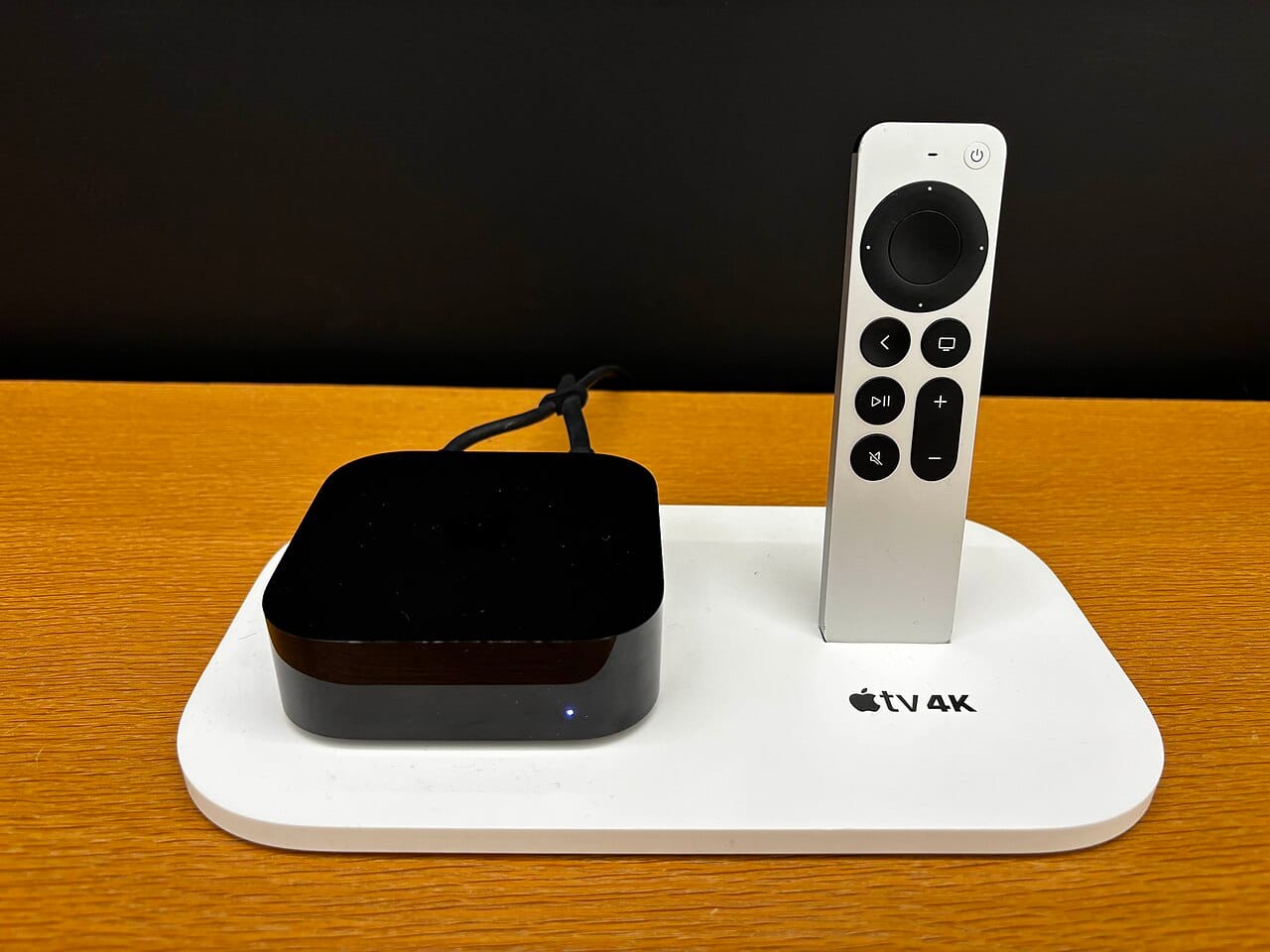
Visual credits: Cover photograph "Apple TV 4K and Siri Remote" via Wikimedia Commons (CC0 Public Domain). Infographic by Syncroma Studio.

Sistemas reales, sin humo corporativo Real systems, zero corporate hype
Recibe los análisis a fondo sobre arquitectura, consumo de recursos y computación de bajo nivel directamente en tu bandeja de entrada. Get deep-dive software architecture, resource consumption metrics, and low-level computing essays delivered straight to your inbox.
Suscribirse a Syncroma Subscribe to Syncroma

