(🇪🇸 Leer la versión en español aquí)
Over 300 million health-related queries already hit ChatGPT every single week, according to OpenAI figures cited today by TechCrunch. While general AI labs rush to ship symptom-answering chatbots prone to confident hallucinations, Apple just debuted its counter-move: a dedicated clinical AI research app built with OpenEvidence.
Announced on November 15, 2026 via Apple Newsroom and detailed by TechCrunch, the Apple Health AI Usage Study targets up to 200,000 U.S. adults (21+) over a 12-month window. Underneath the PR polish lies a revealing systems lesson: why even the loudest champion of on-device privacy had to bridge HealthKit into a third-party cloud RAG stack to make medical AI credible.
Architecture Breakdown: Peer-Reviewed Cloud RAG vs Pure On-Device Chatbots
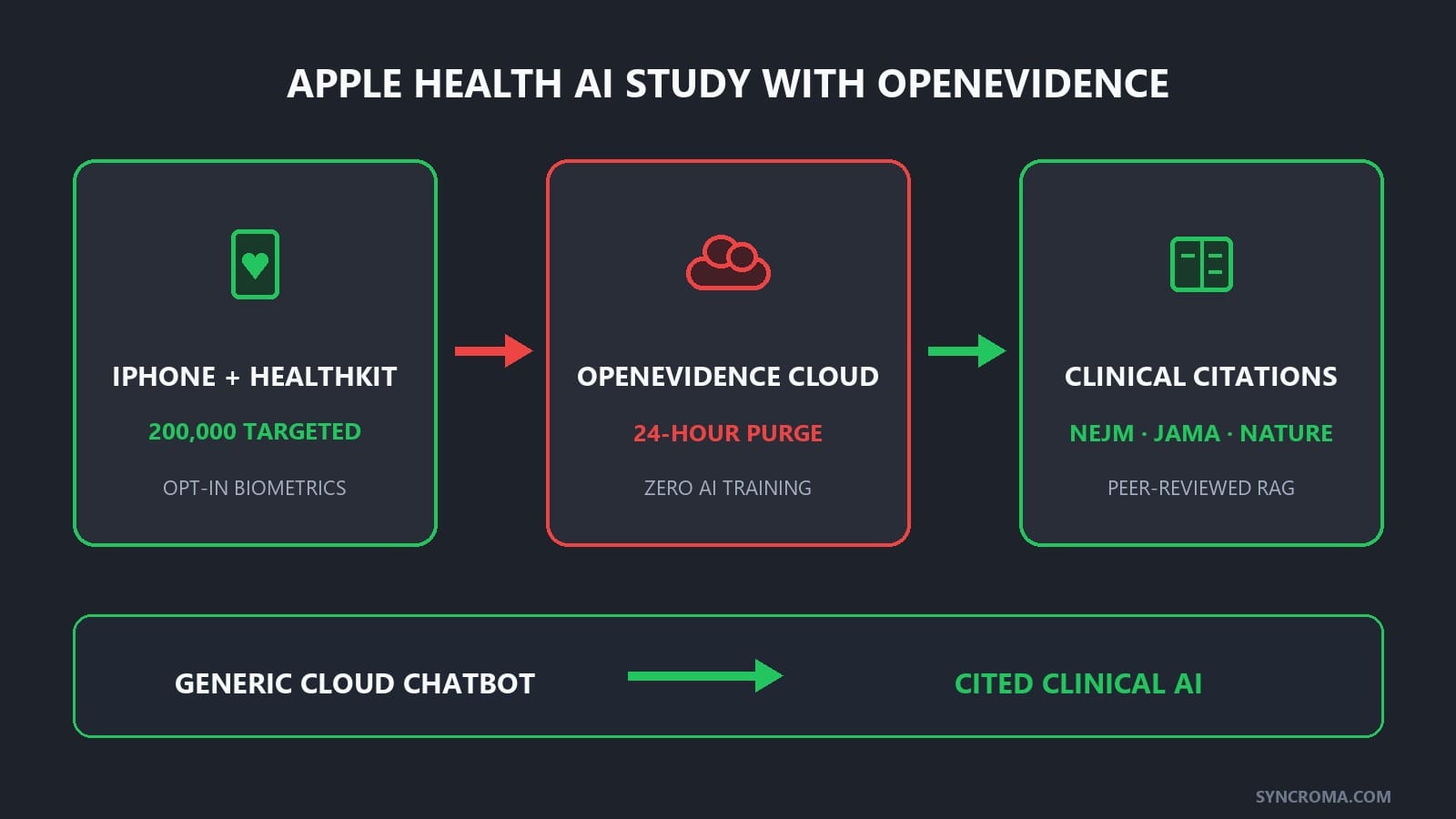
Rather than trusting ungrounded LLM weights with medical dosage or symptom triage, Apple wired the app directly to OpenEvidence—a clinical engine already used by physicians—grounding every answer in peer-reviewed literature from The New England Journal of Medicine (NEJM), JAMA, and Nature:
| Study Parameter | Verified Official Spec | Engineering & Privacy Reality |
|---|---|---|
| Scale & Eligibility | Up to 200,000 U.S. participants (21+), > 12 months | Requires Apple Intelligence-capable hardware (iPhone 15 Pro+ on iOS 26+) |
| Grounding Engine | OpenEvidence clinical AI with linked peer-reviewed citations | Grounds claims in NEJM, JAMA, and Nature rather than bare model memory |
| Optional Biometrics | Opt-in HealthKit sharing (resting HR, sleep, activity, lab results) | Contextualizes prep before doctor visits instead of spitting generic disclaimers |
| Cloud & Retention Path | Anonymized payloads sent to secure third-party cloud; 24-hour purge | Zero AI model training claimed, yet medical prompts physically leave the device |
Three Engineering Realities Hidden in the Fine Print
Read Apple's newsroom release next to TechCrunch's technical breakdown and three tradeoffs jump straight off the page:
- On-device SLMs cannot safely verify live medical citations: Even flagship mobile NPUs lack the fresh index capacity and domain-vetted corpus required to cite specific NEJM and JAMA trials accurately. Safe consumer healthcare AI practically forces cloud retrieval—even at Apple.
- Hardware gating despite external inference: Apple's official eligibility note specifies an "Apple Intelligence-enabled iPhone (iPhone 15 Pro or later) running iOS 26 or later"—locking out baseline iPhone 15 owners even though OpenEvidence handles the heavy external clinical synthesis in the cloud.
- 24-hour deletion beats chatbot logging—but isn't local-only zero-knowledge: TechCrunch notes Apple anonymizes payloads before routing to a secure third-party cloud vendor, prohibits AI training on study inputs, and enforces a 24-hour deletion window at OpenEvidence. That beats standard free chatbots by miles, yet users sharing HealthKit lab values are still trusting anonymization pipelines off-device.
What This Signals for Regulated Enterprise AI
Supported by clinicians like Dr. Robert M. Wachter (Chair of Medicine at UCSF), this study previews the exact architecture any regulated vertical—healthcare, law, accounting—has to enforce: mandatory linked primary sources, automated escalation guardrails when dangerous queries trigger, strict zero-training contracts, and hard 24-hour TTL purges instead of raw chat retention.
When drafting sensitive notes or sanitizing logs that truly shouldn't touch any external cloud provider at all, use our client-side Zero-Upload Markdown to HTML & Word/SEO Counter, redact tokens locally with the Offline PII & Secret Log Anonymizer, or explore all Syncroma Free Tools.
The Trench Verdict
Unlike drafting marketing copy, a plausible hallucination in medical software hurts real humans. Apple made the right call shipping clinical RAG backed by NEJM and JAMA citations through OpenEvidence with a hard 24-hour purge rather than guessing answers from raw LLM weights inside Apple Health. Still, treat any "privacy-first cloud AI" carefully: read exactly what crosses the network boundary when optional HealthKit lab data leaves your phone, and demand hard TTL deletion everywhere you build.
Vector infographic designed by Syncroma Studio.
Sistemas reales, sin humo corporativo Real systems, zero corporate hype
Recibe los análisis a fondo sobre arquitectura, consumo de recursos y computación de bajo nivel directamente en tu bandeja de entrada. Get deep-dive software architecture, resource consumption metrics, and low-level computing essays delivered straight to your inbox.
Suscribirse a Syncroma Subscribe to Syncroma

