
(🇪🇸 Leer la versión en español aquí)
On Friday, November 20, 2026, Apple will permanently pull the plug on one of the longest-running technical support archives on the consumer web: Apple Support Community. As reported by MacRumors, the forums were immediately switched to read-only mode on November 10 — with the final post timestamped at 5:49 p.m. Pacific Time and the sign-in link quietly redirecting to an internal Apple corporate employee portal — ahead of complete shutdown later this month.
First launched in 1998 as Apple Tech Exchange, renamed Apple Discussions in 2000, Apple Support Communities in 2011, and simplified to Apple Support Community in 2022, the site accumulated 28 years of real-world macOS Kernel Panic traces, weird iOS update regressions, USB-C hub quirks, and battle-tested workarounds from sysadmins and power users. In its shutdown banner, Apple states the decision followed a "careful evaluation of strategy and customer needs", pointing everyone back to the generic Apple Support knowledge base — scripted official pages that rarely touch edge-case firmware or OS bugs — leaving independent communities like MacRumors Forums and r/applehelp to carry the load.
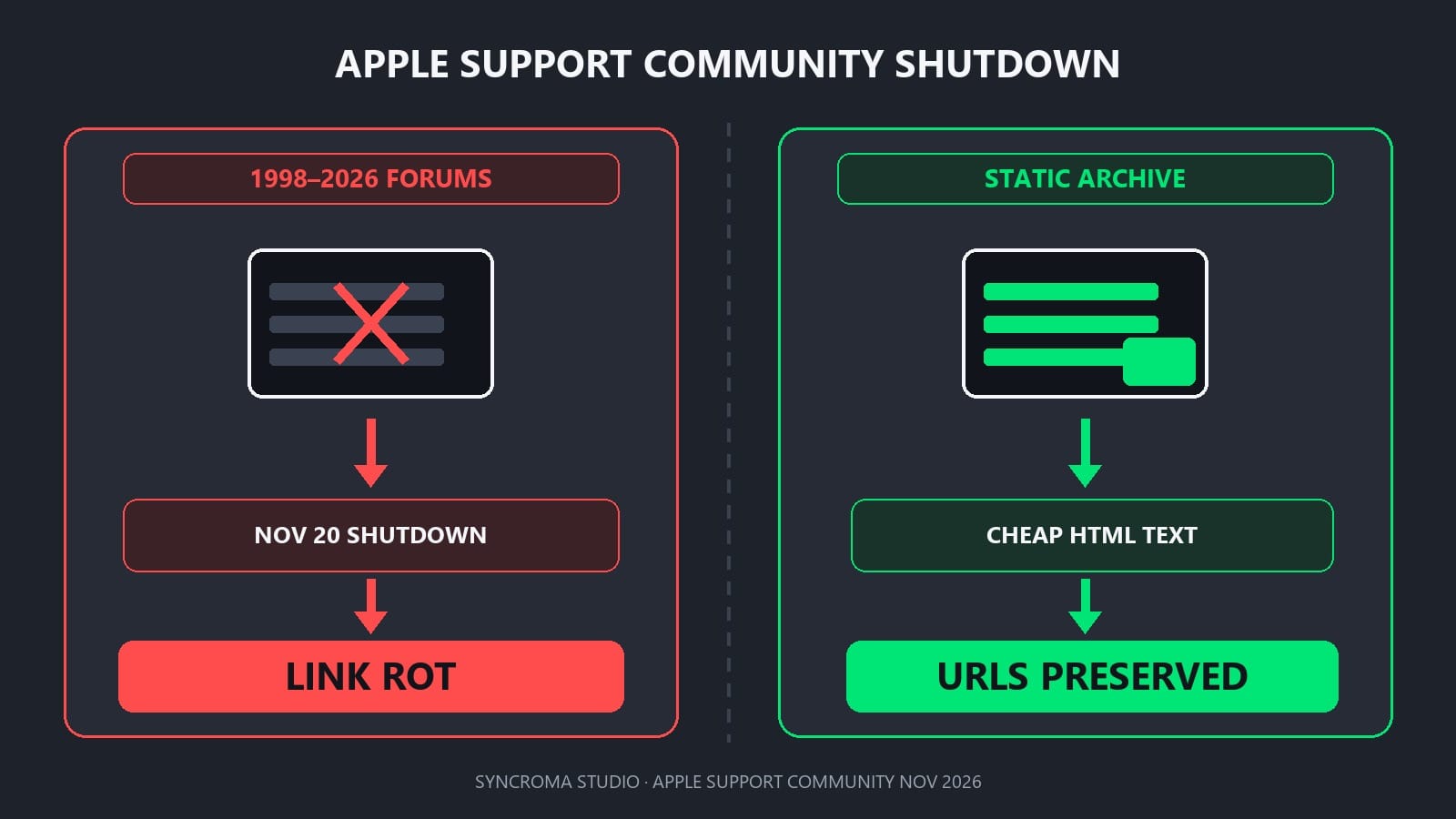
The Architectural Reality: Killing Read-Only Static HTML Saves Practically Nothing
From a systems engineering perspective, shutting down active write operations on a legacy forum can make operational sense. Deleting the read-only historical archive makes none.
Running a dynamic interactive forum at Apple's scale involves live relational databases, session management, distributed caching, user moderation queues, spam mitigation, and aggressive AI scraper traffic hammering search endpoints. Keeping write paths open has real engineering overhead. Yet the moment a forum flips to read-only, turning its threads into pre-rendered static HTML files behind a CDN shrinks the problem down to pennies:
- Negligible compute and storage overhead: Compressed text threads take a few hundred gigabytes at most. Without application servers, SQL writes, or dynamic auth loops executing per page view, you get zero dynamic compute cost and no fresh moderation burden.
- Catastrophic link rot across the engineering web: Countless GitHub issues, Stack Overflow answers, corporate IT wikis, and search engine results point straight into
discussions.apple.com. When those URLs go dark on November 20, an entire layer of collective debugging history turns into 404 errors overnight. - Official support scripts are a leaky abstraction: Replacing human-verified workarounds ("toggle this
launchdplist or reset NVRAM on this specific MacBook Pro revision") with sanitized official support flows or generic chat funnels slows down actual root-cause resolution — especially when LLMs already rely on indexed community fixes not to hallucinate outdated flags.
Infrastructure Tradeoffs at a Glance
If you manage Mac fleets, troubleshoot developer laptops, or simply refuse to waste two hours hearing "have you tried erasing and reinstalling macOS?", here is the real architectural math Apple chose to ignore:
| Preservation Strategy | Approximate Infra Overhead | Security Surface | Real-World Support Impact |
|---|---|---|---|
| Live dynamic forum (1998–2026) | High (DB clusters, auth, anti-spam, moderation) | Medium-High (XSS, account takeover) | Great for emerging OS/hardware regressions |
| Static HTML snapshot on CDN (recommended) | Marginal (object storage + CDN edge cache) | Near zero (no live backend execution) | Keeps 28 years of indexed fixes alive |
| Complete takedown (Apple's current path) | Zero direct forum hosting spend | None | Irreversible knowledge loss + more human support tickets |
That same zero-bloat engineering rule applies whether you run enterprise edge caches or compare everyday hardware and utility costs without marketing spin. While you're benchmarking real numbers, check out our new Kitchen Cooktop Cost Calculator (Induction vs Ceramic vs Gas) or browse the full Syncroma Tools Suite.
What Engineering Orgs — and Mac Users — Should Do Before November 20
- Never delete high-signal historical URLs: If your product org retires a legacy community forum, freeze it into a read-only static S3/edge snapshot and keep 301/canonical paths intact. Wiping decades of solved edge cases to save negligible hosting pennies burns hard-earned developer goodwill.
- Archive your critical troubleshooting threads now: If your IT runbooks, MDM scripts, or hardware setups reference specific
discussions.apple.comthreads, save local HTML/Markdown copies immediately before November 20. - Bookmark independent troubleshooting hubs: Once Apple clears the archive, real unscripted troubleshooting lives on r/applehelp and MacRumors Forums.
Cover photo credit: Shixart1985 via Wikimedia Commons (CC BY 2.0). Technical infographic by Syncroma Studio.

Sistemas reales, sin humo corporativo Real systems, zero corporate hype
Recibe los análisis a fondo sobre arquitectura, consumo de recursos y computación de bajo nivel directamente en tu bandeja de entrada. Get deep-dive software architecture, resource consumption metrics, and low-level computing essays delivered straight to your inbox.
Suscribirse a Syncroma Subscribe to Syncroma

