(🇪🇸 Leer la versión en español aquí)
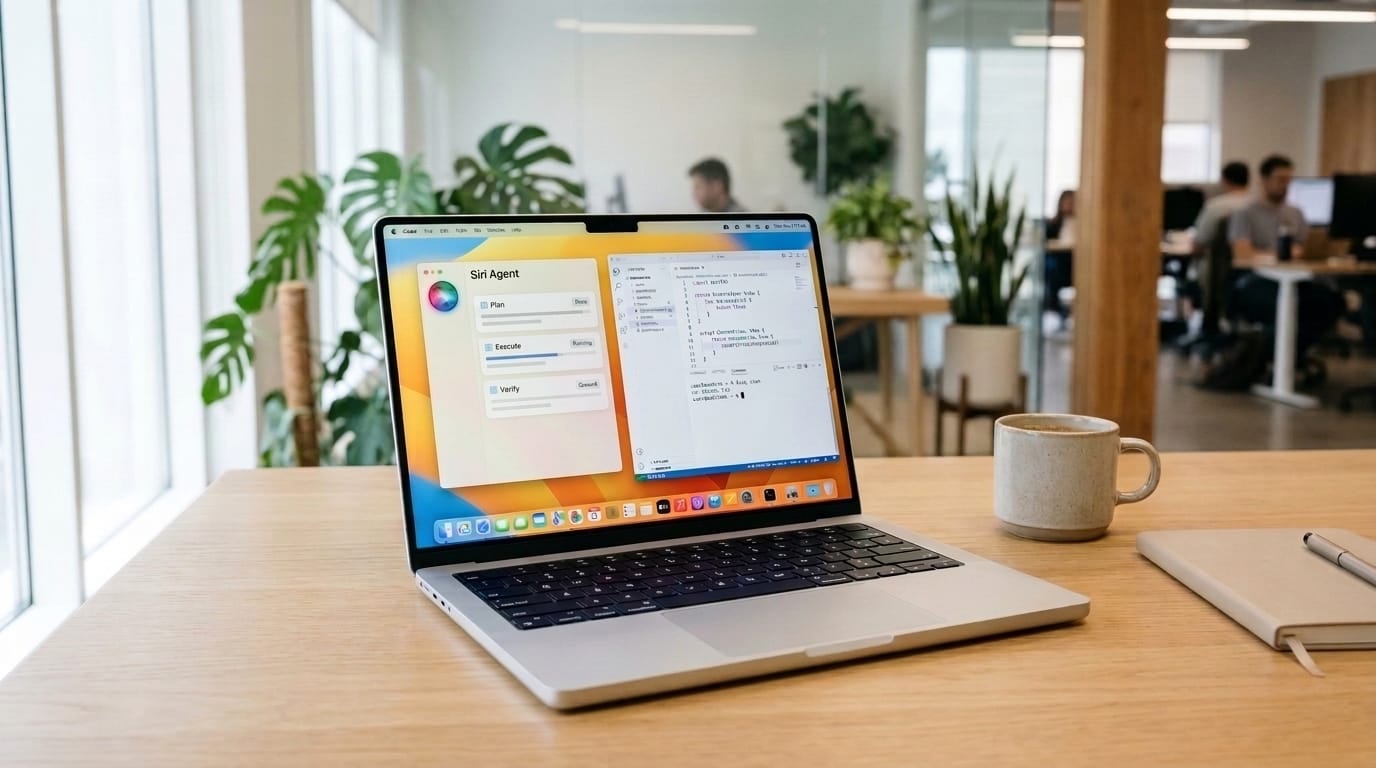
Cupertino's marketing engine has spent months promising that Apple Intelligence will seamlessly transform iPhones and Macs into proactive, context-aware digital companions. But behind the curtain, in the trenches of systems engineering, the reality is far harsher: Apple recently published—and then hastily scrubbed after being spotted by Bloomberg—a batch of high-level job openings seeking leadership for "Agentic AI – Proactive Intelligence".
The technical requirements spelled out in the leaked listings leave no ambiguity: Apple is scrambling to engineer an assistant capable of "using a computer the way a capable person does" (Computer Use). In other words, an agent that goes beyond summarizing unread emails or generating cartoon emojis to autonomously navigate live browser sessions, execute terminal commands, inspect foreign application trees, and coordinate sub-agents without waiting for step-by-step user prompts.
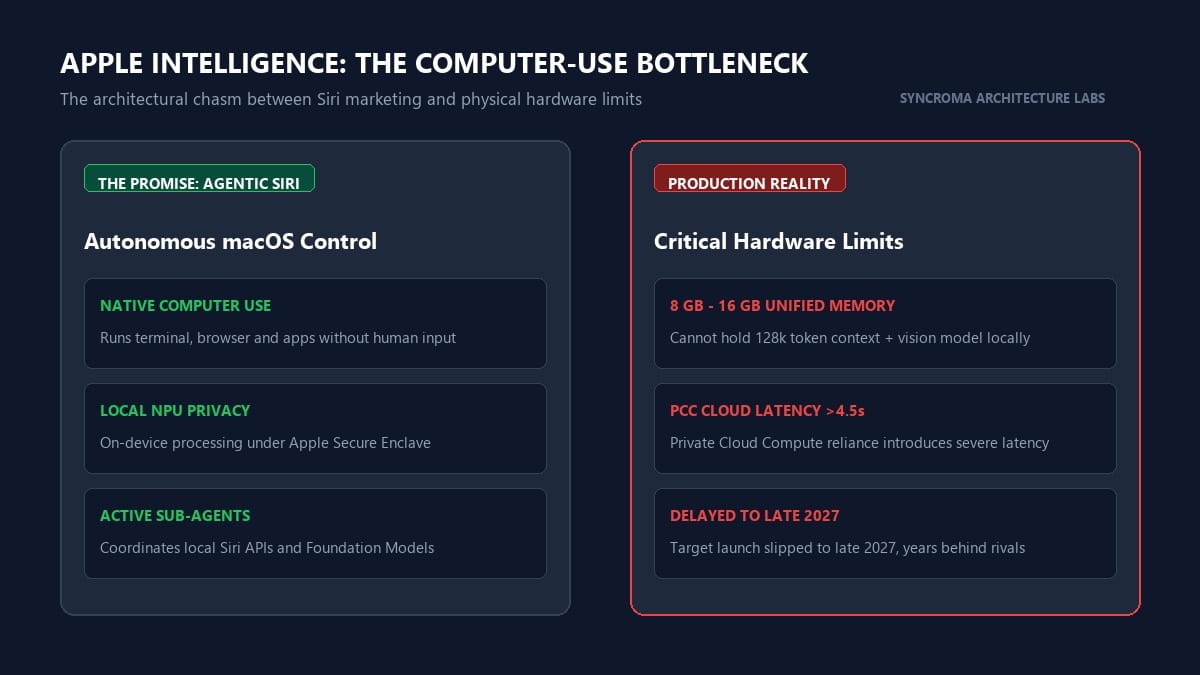
The problem isn't the ambition. The problem is that Apple is arriving three years late to the architectural party, burdened by client hardware constrained to 8 GB and 16 GB of unified memory, with commercial release already pushed internally to late 2027.
The Anatomy of the Agent: What Apple is Attempting to Build
According to internal role briefs across Apple Foundation Models & Siri UI Frameworks, Cupertino's planned autonomous system relies on three core operational layers:
- Accessibility Tree & Visual Inspection (UI Automation): Moving away from brittle, developer-dependent Siri Shortcuts, the agent observes the screen dynamically via multimodal vision models, identifying interactive buttons, input fields, and canvas elements across native macOS and iOS applications.
- Multi-Step Directed Graphs (DAGs): Deconstructing high-level user directives (e.g., "extract VAT expenses from my recent invoice PDFs and sync them to my accountant's spreadsheet") into interdependent tasks handled by specialized micro-agents.
- Hardened Sandbox Execution: Enforcing strict privilege isolation under Apple's Secure Enclave to guarantee that terminal commands or external web payloads cannot trigger arbitrary remote code execution or hijack credentials.
The Hardware Wall: Why Apple Silicon Stalls on "Computer Use"
In production engineering, the Computer Use paradigm pioneered by Anthropic's Claude and deployed by Google across desktop macOS environments imposes severe computational penalties:
- Massive Context Expansion: Autonomous UI navigation demands continuous high-resolution display captures. Tokenizing full-screen 1080p or 4K frames consumes roughly 1,600 tokens per capture. A 10-minute multi-step workflow easily exceeds a 128,000-token context window.
- Unified Memory Starvation (UMA): High-precision visual reasoning requires models with 7B to 14B parameters. Even when quantized to 4-bit integers (int4), model weights alone consume 6 GB to 9 GB of VRAM—completely ignoring the memory footprint of the long-context KV cache. On an entry-level MacBook Air or base iPhone with 8 GB or 16 GB of shared system RAM, the model simply cannot fit. It triggers aggressive SSD swapping and freezes the entire OS (memory thrashing).
| Architecture Metric | On-Device Local Agent | Private Cloud Compute (PCC) | Meta / Anthropic Cloud |
|---|---|---|---|
| VRAM Consumption | 8 GB - 12 GB dedicated | Rack-mounted Apple Silicon | Enterprise H100 / Blackwell clusters |
| P95 Latency per Action | ~400 ms - 800 ms | 3,800 ms - 5,500 ms | 1,200 ms - 2,000 ms |
| Credential Privacy | 100% On-Device (Hardware Enclave) | E2E encrypted, stateless | Corporate cloud API policy |
| Battery Impact (Laptops) | 35W sustained drain on NPU/GPU | Negligible (network-bound) | Negligible (network-bound) |
| Production Readiness | Impossible on current base spec | Slated for late 2027 | Live in production today (2026) |
The Private Cloud Compute Toll: Unusable Latency
To circumvent client silicon constraints, Apple is forced to offload heavy vision inferencing to Private Cloud Compute (PCC). However, this offload incurs catastrophic engineering trade-offs:
- P95 Latency Destroys Workflow Fluidity: Compressing screen buffers, transmitting them over mobile networks, processing inference across M2 Ultra/M4 Max server nodes, and streaming back coordinate clicks generates a round-trip latency exceeding 4 seconds per action. A 15-step automation takes over a minute to execute—an unacceptable delay for a user actively staring at their screen.
- Unsustainable Unit Economics: Serving multimodal video and vision streams for hundreds of millions of iPhone users at zero marginal subscription cost would devastate Apple Services' operating margins.
The Verdict: The 2027 Target Confirms the Gap
While Signal actively blocks AI screen captures to safeguard user communications and competitors roll out mature desktop agents, Apple's quiet recruitment scramble validates what infrastructure engineers already knew: Siri's marketing is running three years ahead of its hardware capability.
Until Apple makes 32 GB of unified memory the entry-level baseline across all Macs and refines multimodal Small Language Models (SLMs) below 3 billion parameters that execute within sub-second thresholds, an autonomous Siri that controls your Mac remains a marketing aspiration deferred to late 2027.
Image Credits: Editorial photography and technical vector infographics produced exclusively by Syncroma Architecture Labs.
Sistemas reales, sin humo corporativo Real systems, zero corporate hype
Recibe los análisis a fondo sobre arquitectura, consumo de recursos y computación de bajo nivel directamente en tu bandeja de entrada. Get deep-dive software architecture, resource consumption metrics, and low-level computing essays delivered straight to your inbox.
Suscribirse a Syncroma Subscribe to Syncroma

